Guy Hudson’s account of finding hope in climate technology begins in a ute. He was in drought-stricken New South Wales with agronomist Guy Webb, talking about what tiny organisms might do for an enormous problem. An IPCC report sat on the dashboard. Hudson later recalled that both of them had read it cover to cover. A report rarely enjoys such attentive company, particularly in a vehicle with other places to go.
The subject was fungi, and the possibility of helping crops put more carbon into the soil and keep it there. Hudson had already spent years working in climate and clean technology. His frustration was with speed and scale. Webb brought a different vantage point: the ground on which a farmer’s decisions eventually have to work.
That conversation helps explain the business Hudson would go on to build. Loam Bio connects a climate ambition with a farm operation. Its products have to survive the journey between those two worlds, including all the equipment, weather, financial calculations and human attention along the way. Today Hudson is its executive chairman. The seed remains a useful place to begin his story.
Two readers in a dusty ute
Hudson came originally from the United Kingdom and became an Australian citizen. The research visit that put him in Webb’s vehicle introduced him to an idea with roots at the University of Sydney. Professor Peter McGee had investigated microbial fungi and their role in the quantity and stability of soil carbon. Webb saw a possible tool for agriculture in that research.
The distinction between quantity and stability matters. Carbon can move through soil and return to the atmosphere. A climate business built around storing it has to concern itself with how it is held, as well as how much appears in a sample. Hudson’s interest was in a biological process already operating in nature, and the possibility of making it more useful within farming.
There is a pleasing awkwardness to the setting. Someone accustomed to climate initiatives and business development finds a promising direction while talking with an agronomist in a dry landscape. The important objects are a report, a vehicle and the land outside. The story gives the ambition a location. It also gives it a collaborator who understands what happens when an idea leaves the meeting room.
The company needed more than a climate expert
Hudson’s earlier career had given him practice connecting different kinds of organizations. He spent six years as a strategy manager at Accenture, led Founders Intelligence in the Asia-Pacific region and was a director of Australian consultancy How to Impact. He also founded the Opportunity Cooperative, a community accelerator, and worked on initiatives to attract private capital to green growth at the World Economic Forum.
By 2018 he was managing director of SparkLabs Cultiv8, an accelerator based at the Orange Agricultural Institute. Its first cohort brought together food, agriculture and sustainability businesses. The program linked founders with research facilities, mentors and investment. Hudson was helping other people bring their technologies into the world. Loam would give him a more direct stake in the result.
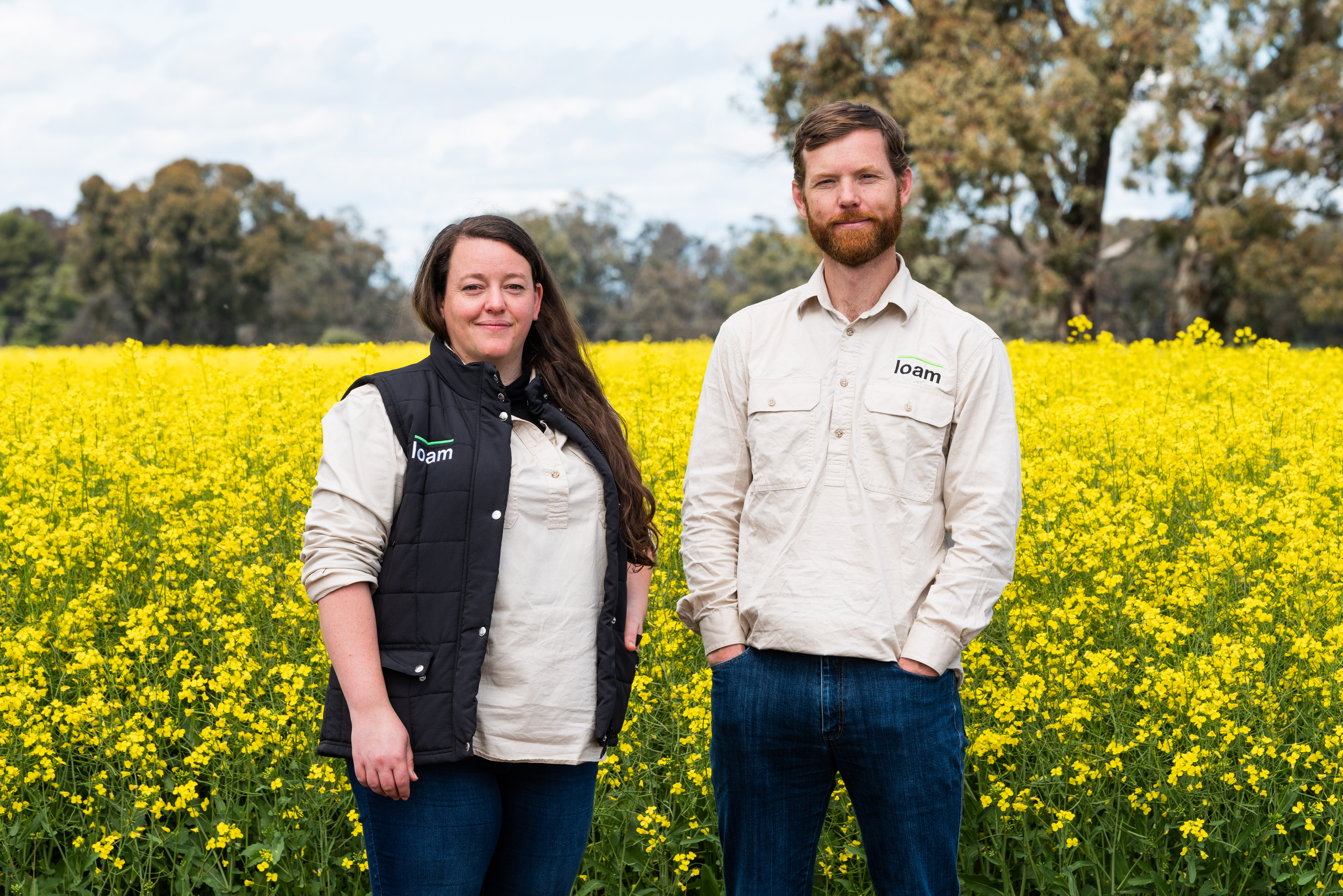
In 2019 he joined with Webb, Tegan Nock, Mick Wettenhall and Frank Oly to form the company that became Loam Bio. Nock and Wettenhall brought farming experience; Webb brought agronomy; Oly’s background included filmmaking and cattle breeding. Hudson’s climate and business experience occupied one place among those capabilities. The mix is more informative than a lone-founder legend.
A soil-carbon company needs people who understand organisms, and people who understand the person buying the product. The two forms of knowledge can meet at a seed, but they arrive by different routes. Hudson’s job as CEO involved making that meeting into an organization capable of doing repeated, expensive work.
The seed has to fit the seeder
Loam’s CarbonBuilder uses microbial fungi to help crops build stable soil carbon. Its work includes identifying organisms, developing formulations and adapting them to crops and regions. The company’s account of the biology involves carbon protected within soil aggregates and associated with minerals. These are mechanisms for holding carbon below ground, rather than simply counting material that may cycle away quickly.
For Hudson, the practical route into a farm has been a recurring concern. Australian and American products use different organisms and application methods. His emphasis is on fitting the product into established operations. A farmer’s interest in the science does not create more hours in the sowing day.
“At Loam Bio, we prioritize listening to farmers.”
Guy Hudson, April 2025
In Australia, the company’s FurrowMate equipment puts the product near the seed through an air seeder. In the United States, the biology can be incorporated with the seed lubricant. The details sound small beside the scale of the climate problem. They are also the details that decide whether anyone uses the product.
Imagine the extra task in the abstract: another container, another instruction, another point at which something might need attention. Each addition can make a new product harder to fit into a busy day. Hudson’s ambition depends on products being workable for people whose main occupation is growing a crop. The tractor cannot run on enthusiasm, however generously a founder supplies it.
Investors can hurry. Harvests cannot.
The early business was called Soil Carbon Company. In June 2020, the Clean Energy Finance Corporation announced an A$1.7 million investment as part of an A$10 million raising. Hudson was already describing both sides of the proposition: more stable carbon in soil, and a way for farmers to participate in carbon trading. The commercial idea extended beyond selling a treatment.
In October 2021, Loam announced an A$40 million Series A led by Marc Benioff’s TIME Ventures. At that point, the company described more than 1,500 microbial strains in its library, four laboratories and 25 field sites. Those were a snapshot of a research operation, rather than a claim that every organism would become a product. Finding candidates and making something dependable are different stages of the work.
The A$105 million Series B followed in February 2023, co-led by Lowercarbon Capital and Wollemi Capital. CarbonBuilder and the SecondCrop program launched into the Australian market. Hudson later announced their US commercial launch as well. The company was moving from a research proposition toward products farmers could buy and projects they could join.
Money can buy equipment, hire people and allow more experiments. A crop still needs its season. The funding announcements compress years into a few numbers, while the evidence accumulates through work that takes longer to describe and longer to finish.
“Agricultural R&D has long cycles and requires patient capital.”
Guy Hudson, March 2026
That remark supplies a counterweight to the round sizes. For a founder in agriculture, progress has a biological timetable. Another location can broaden a trial; another investor can extend the company’s runway. Neither makes last year’s weather repeat on demand. Hudson has to hold an expansion story alongside the slower work that gives farmers confidence in it.
A second crop needs a ledger
SecondCrop is Loam’s carbon-project platform. It addresses the administrative and commercial work between storing carbon and receiving value for it. The name suggests a harvest below ground, alongside the crop above it. The challenge is making that metaphor survive a measurement, an audit and a transaction.
Hudson’s public appearances have carried the idea beyond the farm. At DLD Munich in January 2023, he discussed soil carbon with Lithos Carbon co-founder Mary Yap and journalist David Kirkpatrick. A conversation about fungi shared the stage with a different approach using rock dust. The company’s place in that discussion was the biology of storage and durability.
- 01 / ApplyMicrobial product enters the cropping system.
- 02 / BuildPlants and fungi contribute to soil-carbon formation.
- 03 / VerifySampling and project rules establish an eligible outcome.
- 04 / ParticipateCarbon projects create a route into carbon markets.
In April 2026, Loam announced 4,867 Australian Carbon Credit Units from the Nicholson project across 881 hectares in central New South Wales. The family had made several management changes, including rotations, reduced tillage and residue management, before adding CarbonBuilder in 2024. That history is essential to understanding the result. The credits belong to a farming project with multiple changes, rather than proving what the fungal product achieved by itself.
For Hudson, the issuance marked a route into carbon markets for broadacre growers. It also made the company’s original proposition more concrete: a farming business could pursue income associated with measured soil carbon. A credit is a different object from a promising organism in a laboratory. Reaching it requires the biological work to pass through a system of rules.
That is where much of the difficulty sits. The buyer needs confidence in the outcome. The farmer needs a workable project. The founder needs both to coexist. No amount of affection for fungi removes the need for a ledger.
A different chair, the same long game
On 1 July 2026, Hudson moved from CEO to executive chairman as Rob Hranac became chief executive. The new arrangement gives Hudson more time for long-term strategy, fundraising and major investor relationships. Hranac is based in the United States; Hudson remains in Sydney, while Loam’s headquarters stay in Orange.
The change gives his story a useful pause. A founder who helped bring the business through research, funding and commercial launches now has a different set of responsibilities within it. His work continues, with more attention directed toward the conditions that allow the company to grow.
The ute conversation offers an appealing beginning because it contains both an enormous question and a particular place. The company that followed has had to retain both. Climate ambition opens the conversation. A farmer’s field decides what can be done with it.
Hudson’s bet has always needed that connection. The seed is small enough to hold. The business around it must accommodate science, equipment, capital, seasons and trust. Getting those things to work together is the occupation he chose after that conversation in a ute.
Keep digging
Conversations, company milestones and the people behind them.
- Loam Bio
- Guy Hudson on LinkedIn
- The ute conversation and Loam’s co-founders
- His earlier consulting career
- The first SparkLabs Cultiv8 cohort
- 2019 conference biography
- 2020 seed funding
- 2021 Series A
- 2023 Series B and Australian launch
- The Series B’s co-lead investors
- Hudson on farmers and regional products
- Hudson on trials and patient capital
- Watch: Climate Solutions Under Our Feet
- Watch: Bloomberg interview
- The Nicholson carbon project
- The executive-chairman appointment