Mohan Giridharadas was at a Silicon Valley party when a stranger put a hole in his next career. He was planning to leave McKinsey and start a software company. The stranger pointed out that his employer’s name could get him onto a chief executive’s calendar. Once he left, with a company still to build, who would agree to see him?
A party is an inconvenient place to receive a business examination. There are no slides to hide behind. Giridharadas had already decided to leave, but the company’s precise shape was still unsettled. The question made that gap difficult to ignore.
He later described the exchange as a building block. His new business would have to draw on skills accumulated over roughly two decades. Experience could travel with him, even if the appointment book became less obliging. LeanTaaS, founded in 2010, would grow from that calculation.
The interesting part of this origin story is its restraint. A discouraging question helped narrow an ambition. The next move needed a reason beyond the desire to make it.
A household full of engineers
In Giridharadas’s childhood home, engineering was already a family occupation. His father was an engineer. So were his three older brothers. By the time he chose electrical engineering at IIT Bombay, he had several examples close at hand.
He was born and raised in India, then came to the United States for a master’s in computer science at Georgia Tech. Five years working as a software engineer at Intel and Mentor Graphics followed, before an MBA at Stanford. Circuits, code, business: the sequence gave him three different ways to examine a working system.
Those early software jobs matter to the later company story. He had worked on the building side before spending years advising organizations. His eventual move into software carried him back toward a form of work he already knew.
The route also resists the customary hurry of a founder’s biography. Education took time. Software work took time. Consulting would take considerably more. LeanTaaS arrived after a substantial apprenticeship, with several professions already behind its founder.
The telephone that took four years
One of his accounts of growing up begins with a telephone. His family applied for a landline in India. Installation took four years. He remembered other families waiting even longer. Eventually, mobile service offered households a different way to get connected.
It is a particularly useful memory for someone interested in how systems change. A telephone is wonderfully ordinary once it works. Before it works, an installation process can organize a family’s expectations for years. The technology and the arrangements surrounding it occupy very different calendars.
Giridharadas has used the story to explain how a newer technology can overtake an older one before everyone has received the older version. The family memory supplies the scale that a grand account of technological progress often lacks: one household, one application, four years.
There is gentle comedy in the contrast. A device intended to make communication immediate required an extended period of silence from the installation department. Anyone who has waited for a promised service visit can recognize the principle, even if their own wait was shorter.
“In my mind, Excel is middle school math.”
Mohan Giridharadas, September 2026
Eighteen years, then a blank sheet
At McKinsey, Giridharadas became a senior partner and led lean manufacturing and lean service operations practices in North America and Asia-Pacific. He spent 18 years at the firm, leaving at the end of 2009. His job involved helping organizations improve the way they worked.
A recurring frustration followed him into the next venture: sophisticated organizations were trying to improve operations using spreadsheets and project teams. The team would work on a problem, then move to another assignment. He wanted a way to deliver that analytical work through software, with more substantial mathematics underneath it.
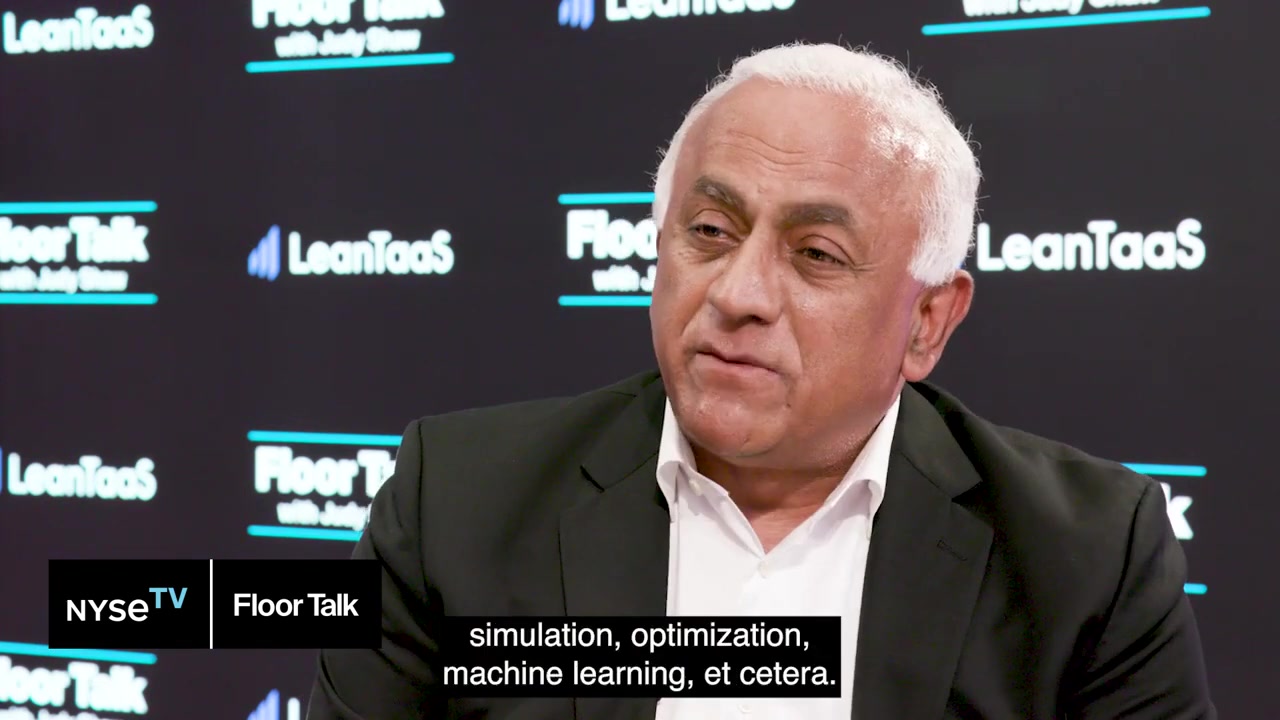
By September 2026, he was still returning to the same complaint about spreadsheets. His language had become admirably blunt. The point was to bring simulation, optimization, machine learning, and AI to operational decisions at industrial scale. The ambition had a long memory.
Seen this way, his departure becomes easier to understand. Years of consulting had supplied a recurring problem and a working vocabulary. Starting a company offered a way to put an answer into a product that could keep working after a project ended.
His early business was broad. He has described work with companies including Google, Home Depot, and Flextronics. The original proposition concerned operational performance across industries, with custom software doing part of the work previously carried by a visiting team.
That breadth also makes the company’s name easier to read. Lean transformation as a service is a proposition about delivery. An improvement method becomes something customers can use repeatedly. The promise creates its own practical test: the software has to be useful on an ordinary working day, when its founder is elsewhere.
The court has to be free first
For a less formal introduction to his working interests, consider tennis. Giridharadas has described himself as a weekend player, with the familiar hope that more practice might produce better results. First, however, he needed a court at a convenient time.
He wrote about early mornings and weekend evenings, the slots that could fit around work without consuming the rest of the day. His example brings the discussion down to a booking sheet. An unused court at an inconvenient hour does little for someone whose free time falls elsewhere.
That is the appeal of the anecdote. A reader does not need a technical qualification to understand that availability has a clock attached. The court may exist, the player may be willing, and the match may still fail to happen.
His writing repeatedly reaches for recognizable activities to explain operational ideas. Tennis supplies a small, believable frustration. It also permits a little self-deprecation. The person explaining a scheduling problem is trying to get a game in, with a backhand that could presumably use the appointment.
at Intel and Mentor Graphics
McKinsey & Company
founded LeanTaaS
A larger company, the same chair
The business eventually attracted a different sort of attention from the skeptical party guest’s. In June 2022, Bain Capital announced a majority investment in LeanTaaS. Existing investors Insight Partners and Goldman Sachs would retain stakes. The management team, including Giridharadas, would continue leading the company.
Financial terms were undisclosed. The observable fact is sufficient: an institutional investor was committing to a business whose founder would remain in place. Twelve years separated the founding date from that announcement.
Earlier, in 2019, Giridharadas had spoken about using a new funding round to hire and develop products. He emphasized growth and the creation of new offerings. The priorities he named were practical ones: build the organization, expand the work, give customers more reasons to buy.
An investment announcement compresses all this into a few names and a transaction. The working life behind it is longer. The company has to recruit people, organize their efforts, and keep making decisions after the celebratory announcement has left the news cycle.
His response to LeanTaaS’s 2025 company kickoff offers a smaller picture of that responsibility. More than 370 team members gathered in Santa Clara. Giridharadas publicly welcomed several days spent together, describing connection, learning, and alignment around the year’s plans.
The detail has a useful physical quality. A software company can be discussed through contracts, products, and ownership percentages. A gathering makes it a room full of people again. Everyone needs to understand where the work is going, preferably before returning to their own part of it.
The next unread chapter
There is another version of Giridharadas away from the transaction announcement. In a 2024 conversation, he discussed his reading. He was partway through Extreme Ownership and had just received The Journey of Leadership. Two of the latter book’s authors were former McKinsey colleagues, Hans-Werner Kaas and Ramesh Srinivasan.
He had ordered the book himself. A signed copy could be arranged when he next saw them. It is a pleasantly unceremonious detail: a founder and CEO with a delivery to unwrap, a book to begin, and friends whose signatures were still outstanding.
Reading a leadership book cannot tell us how someone behaves in every meeting. It does show an experienced executive making room for another account of the job. The reading pile remains unfinished even when the business card looks complete.
His publisher’s biography places him in the San Francisco Bay Area with his wife and two dogs, and notes their two grown daughters. These are quieter coordinates than the institutions on his résumé. They give the career a place to return to.
The party question still makes a useful ending. What could he take with him after leaving McKinsey? The answer, visible across the years that followed, included technical training, an accumulated interest in operations, and a problem he wanted to keep working on. He gave those things a company. The calendar could take care of itself.