She left consulting and diagnostics to build the company she wished had existed: Manta Cares.
FOUNDER & CEO · MANTA CARES · SAN FRANCISCO
Most founders start with a market. Samira Daswani started with a notebook. Today she runs Manta Cares, a San Francisco healthtech company building clinically trusted, AI-enabled tools that help patients and caregivers find their way through the most disorienting stretch of their lives - a cancer journey. The company is free to use, HIPAA-compliant, and already in the hands of thousands of people.
The flagship is a digital platform the team nicknames “Cancer GPS.” It does for a patient what a map app does for a road trip: it takes a sprawling, branching, frightening process and turns it into something you can actually read. Appointments, resources curated by more than 100 medical professionals, a notebook you can share with the people helping you - all in one place.
Daswani is not a tourist in this world. She trained as a bioengineer at MIT, studied at Wellesley, and earned a master's in healthcare design from Stanford's famed d.school. She has shipped real products in regulated, high-stakes environments. Manta Cares is what happens when that toolkit gets pointed at a problem she takes personally.
What separates Manta Cares from the usual wellness app is its refusal to choose between warmth and rigor. The resources are reviewed by more than 100 medical professionals; the tone is built for a human being on the worst week of their year. Daswani spent two decades learning both halves of that equation - the clinical and the personal - and she has stopped pretending they are separate problems. The result is a company that treats a frightened patient as a capable adult and a clinical fact as something worth translating, not hiding.
That posture is unusual in digital health, where products are often built for the buyer - the hospital, the payer, the pharma sponsor - rather than the person staring at a diagnosis. Manta Cares keeps its loyalties straight. The platform is free to the people who use it most, and the business is built around partners who benefit when patients are better informed, not kept in the dark.
Before there was a platform, a seed round, or a private beta, there was a planner Samira made for herself. She designed it out of frustration - a simple, physical way to keep the moving parts of treatment in order. Her care team saw it and told her to print more. She did. According to her own account, the planners now “go like hotcakes.”
That detail is the whole company in miniature. Manta Cares did not begin as a grand thesis about artificial intelligence in medicine. It began with an object that worked, in the hands of people who needed it, who then asked for more. The digital platform - the “Cancer GPS” - is the same instinct scaled: meet people where the work actually happens.
And where it happens is at home. “Over 90% of cancer care actually happens in the home,” Daswani has said. Hospitals get the headlines; kitchens and living rooms do most of the work. Building for that reality - the binder on the counter, the question you forgot to ask, the caregiver trying to keep up - is the design problem she keeps returning to.
Her other conviction is just as plain: “Patients are capable of understanding our diagnoses.” It sounds obvious until you notice how rarely the system is built as if it were true. Manta Cares treats clarity not as a courtesy but as the product.
There is a discipline in starting with paper that founders raised on growth metrics tend to miss. Paper has no analytics and no engagement loop. It either helps the person holding it or it ends up in a drawer. By forcing the first version of Manta Cares to survive that test, Daswani built a company that knows the difference between attention and usefulness. The software inherited that standard. “Cancer GPS” is judged the same way the planner was: does it reduce the chaos, yes or no.
The d.school training shows here. Human-centered design is less a method than a refusal to build for an imagined user. You watch real people, in their real kitchens, hitting their real walls, and you build for that. It is slower than guessing. It is also the only thing that reliably produces a product people describe as the thing they always wished had existed.
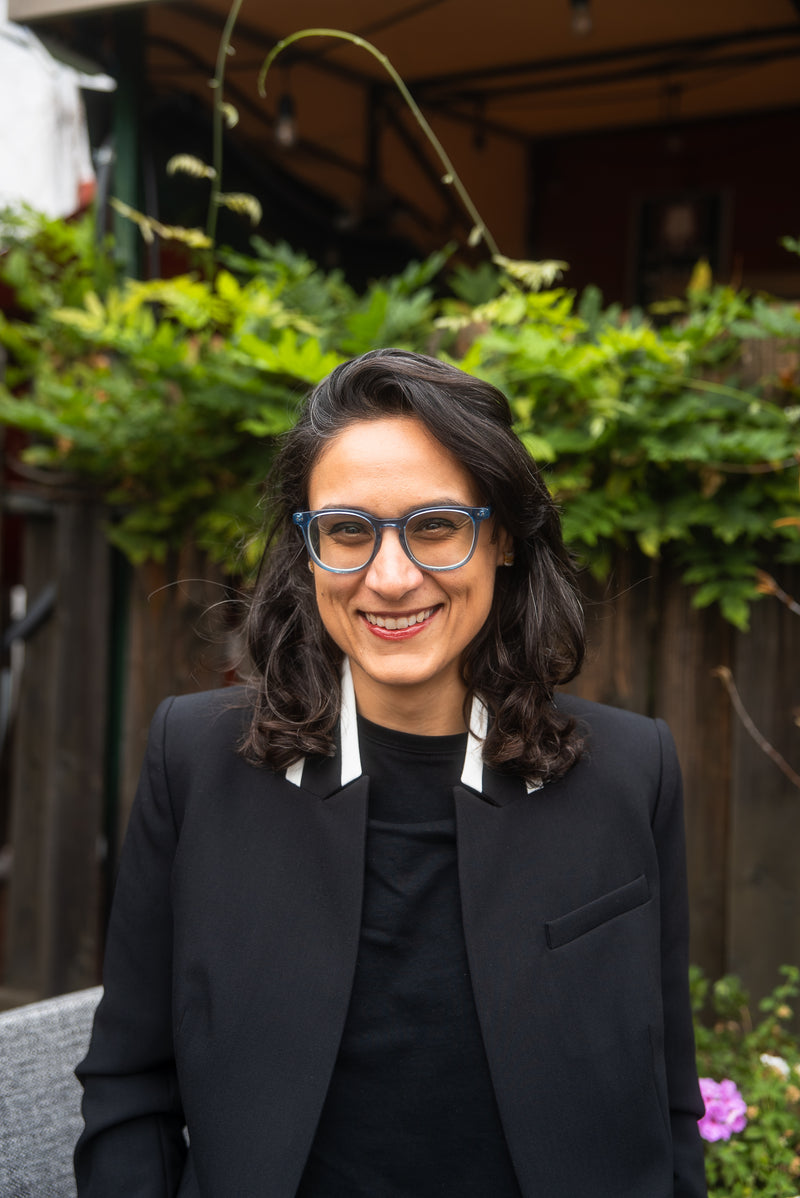
“Patients are capable of understanding our diagnoses.”Samira Daswani · Founder, Manta Cares
She began in management consulting at McKinsey & Company, learning how big healthcare organizations actually move - and where they get stuck.
As VP of Product, she launched a multimillion-dollar infectious disease diagnostic test - shipping a real product under real regulatory pressure.
She has led design and AI research at the Stanford Clinical Excellence Research Center, bridging academic rigor and applied product work.
Bioengineer by training, designer by choice. The combination is the point.
The seed round was led by Pear VC and Sozo Ventures - Pear being early backers of names like DoorDash and Guardant Health - with additional support from 1843 Capital and strategic angels, including a chair of a major cancer center. Investors describe the bet in one line: a company that puts patients first.
But funding is not the proof. Distribution is. Manta Cares works with three top-15 pharmaceutical manufacturers, eight health systems, and 40 patient advocacy groups, with distribution reaching academic hospitals such as Stanford. The platform's resources are reviewed by more than 100 medical professionals, which is the unglamorous, essential part: clarity that holds up to scrutiny.
The recognition followed. Manta Cares has collected the Advocate Health #LovedOneStandard Award and the Corinne Leach Patient Experience Award at the CancerX Accelerator Showcase. Daswani has taken the stage as a keynote speaker at the ASCO Quality Care Symposium and spoken at NCODA on the patient experience.
“Over 90% of cancer care actually happens in the home.”— the design problem Manta Cares keeps solving for
She went from reluctant podcast guest to host. On “Patient from Hell,” Daswani asks the questions people are too overwhelmed or too afraid to ask, bringing together doctors, researchers, advocates, and survivors for evidence-based answers. Spotify ranks it in the top 10% of globally shared podcasts, and it earned a 2025 Digital Health Award (Bronze).
The first version of her flagship product wasn't software. It was a notebook she designed by hand. The software came only after people kept asking for more copies.
She named her podcast “Patient from Hell.” No euphemism, no soft branding. The honesty is the brand.
A bioengineer who went back for a design degree. Most people pick a lane. She built at the seam between the two.
Ask what Manta Cares is trying to become and the honest answer is bigger than a single product. Daswani's ambition is to make navigated, human-centered care the default rather than the exception - to take the hard-won clarity a few patients manage to assemble for themselves and make it standard equipment for everyone who comes after them.
The pieces are in place to try. There is funding that didn't need to be chased. There are health systems and advocacy groups that act as distribution. There is a podcast that doubles as research, putting Daswani in regular conversation with the doctors, researchers, advocates, and survivors who know where the system breaks. And there is the Stanford research seat, which keeps the work tethered to evidence while the AI parts of the platform mature.
It is a particular kind of founder who turns a personal frustration into a notebook, a notebook into a company, and a company into an argument about how an entire field should behave. Daswani has been quietly assembling the credentials for that argument for years - the engineering, the strategy, the diagnostics, the design. Manta Cares is where they finally point in the same direction.
Redesign the experience so every patient and caregiver can navigate care with clarity - built from lived experience, scientific rigor, and technology, in that order.
Profile compiled from public sources including Manta Cares, OncoDaily, Bold Journey, PRWeb, and Samira Daswani's own published interviews and podcast. Figures and affiliations reflect the most recent public reporting available.