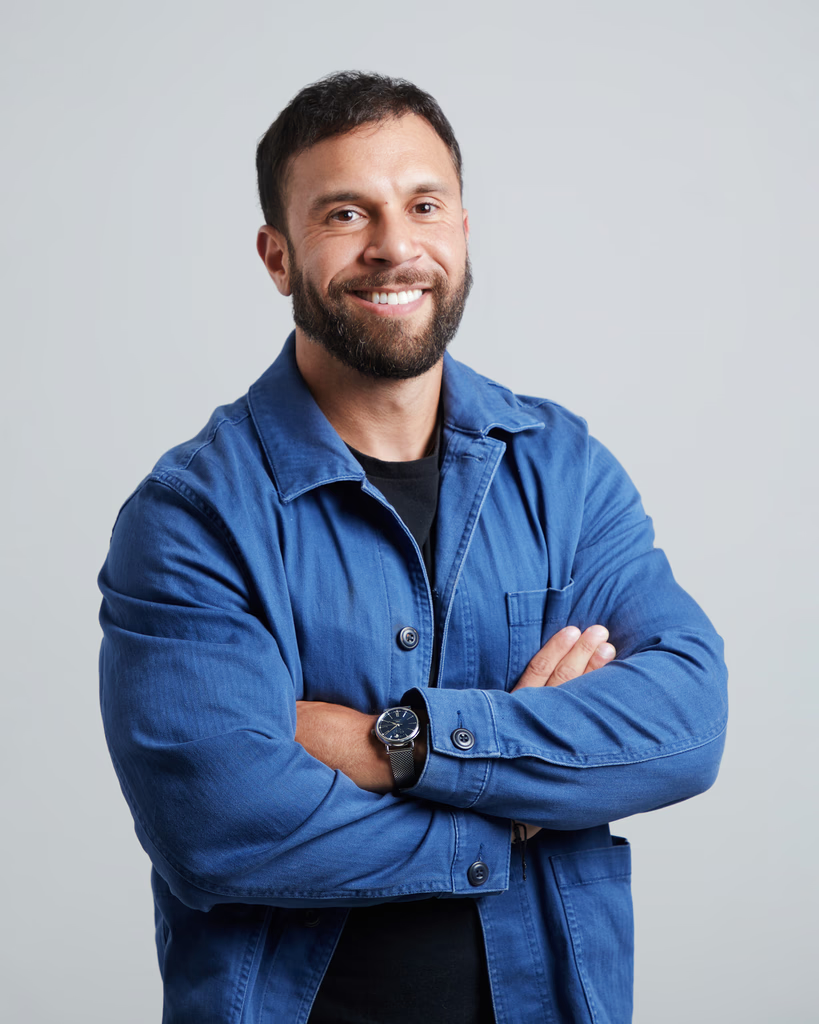
The company that means "in my home"
Fidari is the rare startup whose name is also its thesis. It is Arabic for "in my home," and that single phrase explains the whole enterprise. Othman Ouenes co-founded the company to drag oncology out of the waiting room and into the place where patients actually live, eat, worry, and recover. The platform sits on top of the electronic health records that hospitals already run - connecting through standards like FHIR and HL7 instead of demanding a rip-and-replace - and turns those static records into something that does work: it automates the grind of patient navigation, captures the billing revenue that supportive care quietly generates, and stitches patients to a network of home-based services.
The numbers are the kind a founder repeats in his sleep. More than 12,000 patients navigated on the platform. A go-live measured in weeks, not quarters. A care team dashboard that tracks barriers and intervention outcomes rather than just appointment slots. But Ouenes is careful not to let the dashboard become the point. Fidari is built around a belief that the hardest part of cancer is rarely the part a scanner can see.
That line is not marketing. It comes from an essay he published about an encounter that has the texture of a short story. In a New York elevator he made small talk with a woman who was on her way to chemotherapy. He asked how her treatment was going. She began to cry - not from pain, he wrote, but because almost no one ever asked. A thirty-second ride became the emotional blueprint for a company. Fidari exists, in large part, to make sure someone asks.
From compliance software to compassion software
Before Fidari there was QURE Healthcare, the company Ouenes co-founded in 2012 and helped build for roughly twelve years as its head of business development. QURE was the unglamorous, deeply important kind of healthtech: software that measured how clinicians actually perform, ran virtual clinical utility trials, and nudged physician behavior toward the guidelines. Its calling card was a patient-simulation method - Clinical Performance and Value, or CPV - used to benchmark and improve care quality. In 2021 the company was acquired by TRC Healthcare, with the deal announced publicly in early 2022.
Plenty of founders treat an exit as a finish line. Ouenes treated it as a warm-up. He left after more than a decade not to retire to a beach but to attack a problem that is messier, more emotional, and far less tidy than compliance metrics. The throughline is consistent: both companies are bets that the human side of medicine - whether a doctor's adherence to evidence or a patient's need to be seen - can be measured, supported, and scaled with good software.
Why oncology, and why now
Cancer navigation is one of those problems that everyone in healthcare agrees is broken and almost no one has fixed. Patients fall through cracks between oncologists, primary care, mental health, nutrition, and transportation. Hospitals lose reimbursable revenue because the supportive work goes uncaptured. Payers watch costs balloon with no clean way to intervene. Fidari's pitch is a three-sided one: help patients afford and access home-based oncology services through a free-to-use portal, help providers reach more patients and tame their workflows, and help insurers keep costs sane across their networks. It is value-based care with a human face bolted firmly to the front.
In his own words
Her tears were not just about physical pain but a cry for understanding, compassion, and a more humane approach to care.
They deserve more than just medical treatment; they deserve compassion, understanding, and a supportive community.
If you speak well, people will listen.
Fidari - "in my home." Care should travel to the patient, not the other way around.
The kid who could not speak, the founder who will not stop
Ouenes was born in France, to a Moroccan mother and a French-Algerian father, and the family emigrated to the United States when he was young - teaching themselves English largely from scratch. There is a useful detail buried in his origin story: as a kid, he stuttered. The thing he is now known for - persuasion, pitching, telling a story that makes investors and clinicians lean in - was once the thing he could not do at all.
He credits high school debate and extemporaneous speaking with rewiring that. He has called overcoming his stutter one of his biggest achievements, and his communication philosophy is endearingly engineered: lead with your thesis, back it with three points, and above all listen to the room before you talk to it. For a man who builds software that helps patients be heard, learning to be heard himself is not a footnote. It is the foundation.
He studied Human Biology at Stanford, where he gravitated toward public policy, activism, and human rights rather than the clinical track. That choice - biology with a conscience, science aimed at systems rather than slides - reads like the prequel to everything he has done since. He did not want to be the doctor in the room. He wanted to fix the room.
A method, not just a mission
It would be easy to file Ouenes under "well-meaning founder" and move on. The more interesting story is how disciplined the meaning is. His communication style is a small window into the whole operating system. Start with the thesis. Support it with exactly three points. Listen to the audience before you decide what to say. That is not the patter of a natural-born talker - it is the scaffolding a former stutterer built so he would never freeze again. He carried the same structural thinking into product. Fidari does not try to replace the systems hospitals already use; it makes them actionable. It does not ask patients to learn a new app before they can be helped; it meets them at home, often for free. The discipline shows up as restraint, which in healthcare software is rarer than ambition.
There is also a hard-nosed business logic underneath the empathy. Supportive oncology care - navigation, monitoring, the unglamorous follow-up calls - generates reimbursable activity that hospitals routinely leave on the table. Fidari's argument to a health system is not only "be kinder." It is "be kinder and capture the revenue you are already owed for doing it." That alignment between margin and mission is what separates a sustainable company from a charity that happens to have a login screen. Ouenes has been in healthtech long enough to know which one survives.
He talks about happiness, too - he has appeared on a podcast devoted to the subject - but not in the soft-focus way the word usually invites. For Ouenes, happiness reads less like a destination and more like a byproduct of building something that outlives you. The math of a 1,000-life legacy is, in the end, a math of meaning.
The firefighter clause
Here is the detail that refuses to fit on a pitch deck: Othman Ouenes is a part-time firefighter. He lives and works in Santa Fe, New Mexico, and serves with a local fire department when he is not running a venture-backed company. It is tempting to call it a hobby, but it lines up too neatly with the rest of him. This is someone whose instinct, repeatedly, is to run toward the emergency other people walk around - whether it is a burning structure or a healthcare system that lets patients face the worst news of their lives alone.
He also gives that instinct an institutional home. Ouenes serves as a board member of the Raymond A. Wood Foundation, whose work supporting survivors of rare brain tumors aligns with his focus on patient-reported outcomes and quality of life. The pattern is hard to miss: the work, the volunteering, the board seat, the company - all of it points the same direction.
The legacy he is actually chasing
Ask most founders for their goal and you will hear a valuation. Ask Ouenes and you get a headcount of a very different kind. His stated ambition for Fidari is to leave a legacy where at least 1,000 patients - and ideally many more - live longer and better lives because of what his team built. It is a deliberately human metric for a deliberately human company, and it is the sort of number that is much harder to fake than a funding round.
Whether Fidari becomes the connective tissue of American oncology or one more good idea in a brutal market, the bet is clear and a little old-fashioned: that technology works best when it remembers to ask how you are doing, and then actually waits for the answer.