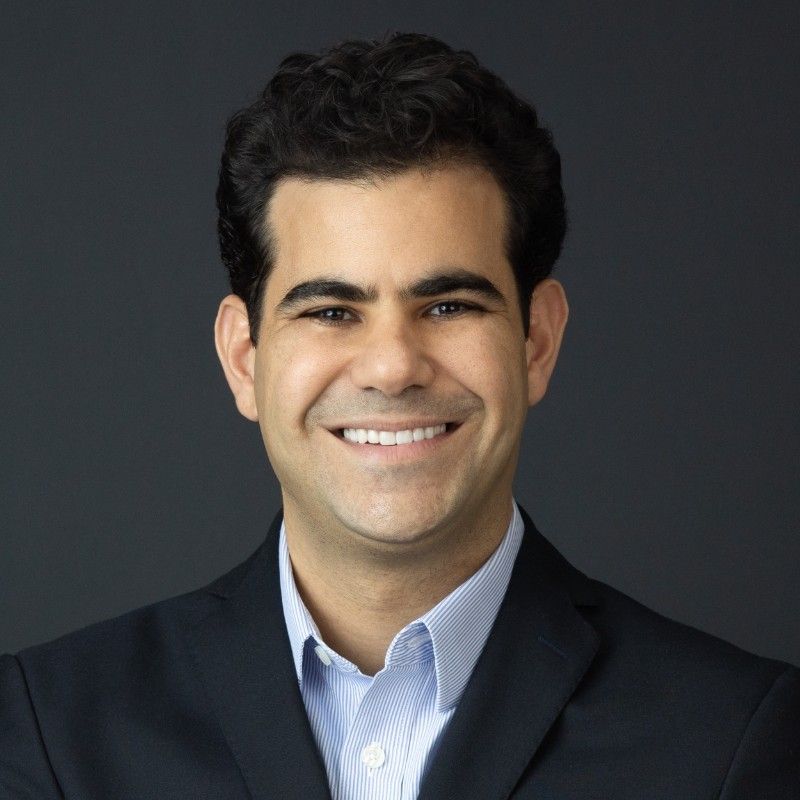
Betting on the doctor in the room
Faris Ghawi runs Vytalize Health, a company that spends its days on an unglamorous question: how do you pay for health instead of paying for procedures?
Ghawi is the co-founder and chief executive of Vytalize Health, a value-based care company headquartered in Hoboken, New Jersey. Its job is to sit between Medicare and the primary care physicians who treat older patients, and to change the math underneath that relationship. Instead of rewarding doctors for the volume of visits and tests they order, Vytalize gives them data, analytics, and financial incentives tied to keeping patients healthy. The company works with thousands of providers and manages care for hundreds of thousands of Medicare beneficiaries across dozens of states.
The results have been hard to ignore. In August 2024, Inc. Magazine named Vytalize Health the fastest-growing private company in America, ranking it No. 1 on its annual Inc. 5000 list. The company reported roughly $1.5 billion in 2023 revenue and a three-year growth rate above 90,000 percent, numbers that put a Hoboken healthcare firm ahead of far more famous technology names. A year earlier, in February 2023, Ghawi had led the company through a $100 million Series C round backed by Enhanced Healthcare Partners and Monroe Capital, capital earmarked for reaching more patients, investing in technology, and building out the team.
What Ghawi is selling is not a gadget. It is a wager that the American healthcare system has been paying for the wrong thing. "In the past, we paid for services, and as a result, we got a lot of services," he has said. "And I think the future is paying for better outcomes, and hopefully getting better outcomes." Vytalize's pitch to physicians is almost disarmingly simple: spend more time with your patients, keep your independence, and let the company handle the data plumbing and the payment complexity that value-based care demands.
Value-based care involves 100 different problems. There's no magic wand.— Faris Ghawi, on why healthcare resists easy fixes
An engineer wanders into medicine
Ghawi did not arrive in healthcare by the usual door. He graduated from Lehigh University in 2009 with degrees in civil engineering and finance, and his early working life had little to do with hospitals. He did project management work at Clark Construction Group before moving into transaction advisory and mergers-and-acquisitions work at Ernst & Young, where his assignments spanned healthcare, telecom, and utilities. It was the consulting years, spent poring over how large health systems actually operated, that pulled his attention toward the industry's inefficiencies.
The company itself was born at Columbia Business School, where Ghawi enrolled for an MBA. By his own telling, he was focused on his family business and planned to return to Jordan. Two physician friends had other ideas. They wanted to build what they described as the "Uber of healthcare," and they wanted Ghawi to help. He had met co-founders Amer Alnajar and Hasan Bayat during his Lehigh years; the friends had drifted into different careers but kept circling back, in conversation after conversation, to the same frustration about how wasteful medicine had become. Vytalize Health launched in 2014 with four co-founders - Alnajar, Ghawi, Bayat, and Omar Elrabie - out of the business school.
Ghawi tends to credit that outsider vantage point. He came in as an engineer and a finance person rather than a clinician, and he treats the health system less like a moral crusade and more like a badly designed machine that can be re-engineered. That instinct shows up in how he talks about the work. Technology alone, he argues, will not fix anything. "Technology, timely data, and financial incentives are all extremely important," he has said, "but they are all needed together." Pull one lever and the machine barely moves.
We think of primary care physicians as the coaches or the quarterbacks in the whole healthcare system. They have the ability to create a lot of value, but they need a way to do that.— Faris Ghawi
Quarterbacks without a playbook
The organizing metaphor of Ghawi's career is the primary care physician as quarterback: the person best positioned to direct a patient's care, and the person most often left without the tools to do it. Vytalize's model is built around handing those doctors a playbook - the analytics to spot gaps in care, the timely data feeds from hospitals, and a payment structure that finally rewards them for prevention rather than procedures. Ghawi keeps returning to the relationship at the center of it all. "When the PCP-patient relationship was there, when there was trust, a lot of wonderful things happened," he has said. "We want you to spend more time with your patients."
That relationship-first framing is also a strategic bet. Plenty of healthcare startups have tried to replace the doctor with an app or a call center. Vytalize's approach is closer to the opposite: keep the existing physicians, protect their autonomy, and change what they are paid to do. It is slower and less flashy than a consumer app, and it requires solving a hundred unglamorous problems at once - claims data, quality reporting, care coordination, provider incentives - which is exactly the point Ghawi keeps making about why the work is hard.
For all the growth, Ghawi frames the ambition in terms of the payment shift rather than the balance sheet. The goal is to move Medicare and primary care away from fee-for-service and toward paying for outcomes, at a scale large enough to matter, without breaking the trust that makes medicine work in the first place. Whether the American system follows him there is still an open question. But for now, a company that started as a long argument among friends at business school has become one of the loudest arguments in favor of value-based care.
"In the past, we paid for services, and as a result, we got a lot of services. The future is paying for better outcomes."
"Technology alone isn't enough. All these things are absolutely needed, but they are all needed together."