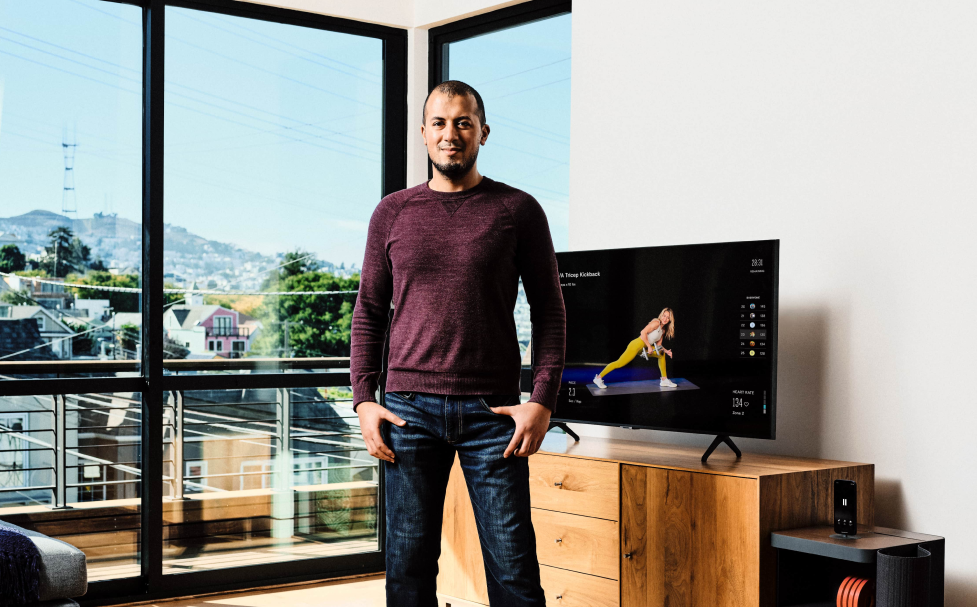
Moawia Eldeeb, CEO and Co-Founder of Tempo

Moawia Eldeeb — San Francisco, CA

Founder Profile  /  Health Tech  /  AI Fitness

Moawia
Eldeeb

CEO & Co-Founder — Tempo

He grew up in a Nile delta village. He coded on machines found in the trash. He worked 12-hour pizza shifts at age 11. And he built a $316M AI company that watches you lift and tells you when your form is wrong. Moawia Eldeeb is not a story about luck.

Founder AI Fitness Computer Vision YC W15 Forbes 30U30 Series C
$316M Total Raised
220+ Employees
$220M Series C (2021)
2015 Founded (YC W15)
30U30 Forbes 2020

The Man Whose Gym Watches Back

The Tempo sits in your living room and it knows things. It knows your range of motion on a deadlift. It knows when your knee is caving. It knows whether your left shoulder is tracking behind your right. It counts your reps, adjusts your weight suggestions, and over time builds a model of your body that a human trainer would need months to develop. That system is what Moawia Eldeeb has been building since 2015 - and the arc from founding to a $220M SoftBank-led Series C is the kind of trajectory that looks inevitable only in retrospect.

The hardware is precise: a 3D depth-sensing camera - the same class of technology deployed in autonomous vehicles - mounted to a studio-quality rack that ships to your door. The software processes your movements in real time, cross-references your form against coaching models, and corrects you mid-set. No subscription to a crowded gym. No waiting for a trainer. No excuses about bad form nobody caught. The product is a studio. The AI is the trainer.

Eldeeb's pitch has always been democratization. Not the word - the actual thing. The personal trainer who costs $150 an hour in a Midtown gym is available to precisely the people who don't need access to an $150-an-hour trainer. Eldeeb grew up in the gap. He knows what it looks like from that side.

America was never defined by where you came from. It's what you become being here.

- Moawia Eldeeb

The story starts on a farm in the Nile delta, in a village outside Alexandria where his family had lived for seven generations. It continues on a plane to New York - his younger brother was born with ectodermal dysplasia, a rare genetic condition that prevented him from sweating. The family relocated for his brother's medical needs when Moawia was nine.

What happened in the years immediately after is the part most founders would leave out of the pitch deck. In sixth grade, Eldeeb dropped out of school. His father needed help paying bills. The family needed a second income. He worked 12-hour shifts at a pizza restaurant in Queens - standing, slicing, ringing up orders - while his classmates were doing homework. Then a boiler explosion destroyed the apartment building, and the family had nowhere to go. They ended up in a Red Cross shelter in Harlem.

A public library stood next door to the shelter. A librarian there noticed him. She did not hand him a pamphlet about resources. She built him a custom curriculum. Khan Academy. Structured progression from pre-algebra through algebra. The kind of personalized attention that accelerates learning - the exact same thing he would eventually build an AI to provide, in a different domain, two decades later. He does not seem to think the parallel is a coincidence.

YC Winter 2015

Al-Madinah, a private Islamic school in New York, tested him and offered a full scholarship. They placed him in 10th grade. He graduated before most kids his age were starting senior year. Columbia University Engineering came next - and he paid for it by becoming a personal trainer at the university gym. He was good at it. His clients got results. One of them, a student named Josh Augustin, was studying computer vision.

Augustin and Eldeeb noticed the same thing most gym-goers ignore: the difference between knowing an exercise and executing it with correct form is enormous, and most people have no reliable way to see their own movement. Eldeeb had the fitness domain expertise. Augustin had the computer vision background. In 2015, the year Eldeeb graduated with a BS in Computer Science (he also picked up a BA in Applied Mathematics from Queens College), they founded Tempo - then called SmartSpot - and walked into Y Combinator's Winter 2015 class.

Three-Dimensional Coaching

The original SmartSpot concept was simpler: a system to assist gym trainers. The pivot to a direct-to-consumer home gym system was the kind of decision that looks obvious after Peloton's IPO and a pandemic that made home exercise infrastructure suddenly essential. Tempo shipped its first product in 2020. The $60M Series B followed in July of that year. Nine months later, SoftBank Vision Fund 2 led a $220M Series C - the largest ever raised for a home fitness hardware startup at that point.

The 3D sensing approach distinguishes Tempo from every camera-based fitness startup that came before it. Depth-sensing sees in three dimensions, not two. It can track the full trajectory of a barbell, the angle of your spine, the precise position of your elbow. It can determine that your back rounds at the bottom of a Romanian deadlift, or that you're compensating with your right side during a press. That's not image recognition. That's the kind of spatial analysis that requires custom models trained on movement data at scale.

The 2023 platform update pushed further: adaptive training that adjusts in real time with every movement and every heartbeat. Eldeeb's vision for Tempo is not a smarter workout app. It's a fitness system that accumulates a clinical-grade understanding of your body over time - the kind of longitudinal picture that a dedicated coach builds through months of observation, compressed and automated.

The Tech Stack

Tempo uses depth-sensing cameras - the same class of technology used in self-driving cars - combined with AI models trained on millions of movement patterns. The system performs real-time 3D body pose estimation, tracks barbell path, counts reps with near-perfect accuracy, and detects form deviations that cause injury over time. Integrated smart weights with color-coded identification complete the physical setup.

Tempo Funding History
Seed / YC
~$2M
Series A/B
~$60M
Series C
$220M (SoftBank Vision Fund 2)

How a Librarian Changed Everything

Eldeeb is careful in interviews not to center the hardship. He does not perform his past for effect. What he returns to is the role specific people played at specific moments: the librarian, the scholarship committee at Al-Madinah, the trainer at the YMCA who helped him during the shelter period. The through-line is access. The detail that repeats across his interviews is that the quality of attention a person receives - a real, specific, responsive kind of attention - determines what they are able to become.

That conviction is not metaphorical in his product. Tempo is literally an attempt to manufacture the kind of individualized, responsive, corrective attention that transforms beginners into people who know their bodies. The librarian who built him a custom curriculum did not give him a textbook and a checklist. She watched him, assessed where he was, and built a path forward. That is what Tempo's AI does with a squat rack.

He taught himself to code before he knew what a startup was. Broken machines appeared on New York City sidewalks with some regularity. He took them apart. He figured out how they worked. He installed Linux on rescued hardware. This is not the origin story of a kid who watched TED Talks - it is the origin story of someone who is constitutionally unable to look at a broken system and not try to understand it.

I think the best leaders are people that first and foremost know how to be a good follower and know how to really listen and adopt great ideas.

- Moawia Eldeeb

The Robin Hood Foundation's Heroes Award, which Eldeeb received in 2016, recognized his work with the Coalition for the Homeless as much as his technical ambitions. At Columbia, he was the student who had worked in a pizza restaurant in sixth grade and coded on salvaged hardware. He graduated knowing exactly which gap his company was trying to close.

Co-founder Josh Augustin is his complement: where Eldeeb brings the fitness floor knowledge and the emotional intelligence of someone who has coached real bodies, Augustin brings the computer vision research depth. The founding story is genuinely unusual - CEO and co-founder met when one was the other's personal trainer. The company they built together reflects that: the product is a machine built by a trainer and a vision researcher who both decided that the best coaching session was one you never had to schedule.

Career Timeline

~1994
Born in a farming village in the Nile delta near Alexandria, Egypt, where his family had lived for seven generations.
~2003
Immigrated to the United States at age 9 with his family after his younger brother was born with ectodermal dysplasia.
~2005
Dropped out of sixth grade to work 12-hour shifts at a Queens pizza restaurant alongside his father.
~2006
A boiler explosion destroyed his family's apartment. They relocated to a Red Cross shelter in Harlem.
~2007
A librarian next to the shelter created a custom curriculum, guiding him through math via Khan Academy. He also taught himself coding on salvaged machines found on NYC streets.
~2008
Al-Madinah Islamic school offered him a full scholarship, placed him in 10th grade. He graduated high school early.
2011
Enrolled at Columbia University Engineering; financed tuition by working as a personal trainer on campus.
2015
Graduated Columbia with BS in Computer Science (and BA in Applied Mathematics from Queens College). Founded SmartSpot (now Tempo) with Josh Augustin. Joined Y Combinator Winter 2015.
2016
Received the Robin Hood Foundation Heroes Award for his work and community impact.
2020
Named Forbes 30 Under 30 - Consumer Technology. Raised $60M Series B in July.
2021
Closed $220M Series C led by SoftBank Vision Fund 2, with General Catalyst, Norwest Venture Partners, DCM, and others. Total funding reached $316M.
2023
Launched new Tempo platform: real-time adaptive AI training that evolves with every movement and heartbeat.

Achievements

🏆
Forbes 30 Under 30
Consumer Technology, 2020
🏁
Robin Hood Heroes Award
Robin Hood Foundation, 2016
Y Combinator
Winter 2015 cohort
📈
$220M Series C
SoftBank Vision Fund 2, April 2021

Quotes

"America was never defined by where you came from. It's what you become being here."
"Progress is a natural result of staying focused on the process of doing anything."
"I think the best leaders are people that first and foremost know how to be a good follower and know how to really listen and adopt great ideas."
"Anything is possible as long as you push through."