Mo Al Adham had already done the difficult thing. He had built a company, sold it, and reached the point where people offer to help you manage your money. Then came the emails. Moving cash required coordination. Useful financial products arrived wrapped in relationships. An invitation to a ballgame made him wonder what would be sold there. Success, it turned out, could come with a fresh administrative burden.
His preferred solution was brief: “To me, I just wanted an app.” That wish eventually became Frec, the investing company he founded in 2021. The revealing part is the size of the wish. He was asking for a way to get something done without making financial administration another occupation.
A founder’s time is a peculiar asset. There is always a compelling argument for spending more of it on the business. Managing investments competes with that argument. Al Adham’s second company begins in this friction: someone who understands software finds a task that still asks him to arrange his life around the service.
Four months in class, four months at work
At the University of Waterloo, Al Adham studied software engineering within a co-op system that alternates study with employment. His placements included Microsoft, AMD and Texas Instruments. A classroom could introduce an idea; the next work term could expose what happened when it met a deadline, colleagues and an actual product.
He has kept that route into the industry close to Frec. In a public account of its intern hiring, he said the company had recruited Waterloo co-op students every summer since it started. He also reported that the interns had returned for full-time roles after graduation. For him, the practical experience is part of their appeal.
There is a modest continuity in that choice. A founder can use hiring to declare an entirely new philosophy, or he can return to a system that helped him learn his own trade. Al Adham has chosen to keep inviting people through a familiar door. The four-month rhythm becomes part of a longer career.
Relationships from those years survived the move into company building. He has known Ahmad Al-Dahle since Waterloo, where they studied different branches of engineering. Years later, he invited Al-Dahle to a discussion at Frec’s office. The campus acquaintance and the company event belong to the same continuing conversation.
Before portfolios, the play button
Al Adham’s first startup was Twitvid, a way to share video through Twitter. It became Telly in 2012, with an expanded interest in helping people discover videos. In that business, the abundance of material was itself a problem. A person could have access to an enormous library and still struggle to find something worth watching.
Writing about online video in 2013, he argued that discovery needed attention. He looked at how people found music, pictures and ideas through other services, and imagined better ways of bringing video together. The product question was familiar to anyone who has spent an evening browsing: how does access become a useful experience?
That early work offers a way to read his later choices. Finance has its own abundance: products, interfaces, strategies, explanations. Availability alone does little for someone who must still assemble all the pieces. Moving from video to portfolios changes the subject; the question of what the customer should have to organize remains.
Along the way, he worked in product at Twitter and became Instacart’s first advisor. His account of that connection begins with friends, including his Waterloo roommate Avlok Kohli, and a growing circle in Silicon Valley. He helped people he knew as they tried ideas and started companies. Careers can acquire an impressive list of names through a decidedly ordinary activity: staying in touch.
Taking the basket apart
Frec launched publicly in October 2023, announcing $26.4 million in funding, with Greylock leading the financing. Its initial direct-indexing choices included the S&P 500 and an information-technology index. The service gave Al Adham a concrete answer to the problem that had bothered him: investors could use software to handle a more detailed portfolio.
The central idea is easier to picture as a basket. An exchange-traded fund gives an investor one security representing a collection of holdings. Direct indexing owns individual stocks in a portfolio designed to follow an index. That gives the software more pieces to work with when individual holdings decline.
Conceptual illustration. Taxes, trading constraints and tracking differences affect outcomes.
Loss harvesting realizes selected investment losses that may offset taxable gains. Owning the pieces also permits customization: a customer can exclude particular stocks. Al Adham has written about both the attraction and the situations where direct indexing may be a poor fit, including accounts whose other trades complicate wash-sale management.
That detail matters to the portrait. A software founder can make the interface approachable while acknowledging that the underlying job has conditions. Index tracking involves differences from the benchmark. Tax results depend on the investor’s circumstances. A harvested loss is a tax attribute, with its own rules, rather than money magically appearing in an account.
The apparent simplicity is earned underneath the screen. The more the system handles, the more important it becomes that someone can explain what it is doing. Al Adham is building for people who want to make their own decisions without manually performing every operation those decisions require.
Pencils down. Phones out.
For Frec’s launch, Al Adham describes ten people gathering contacts from phones, email, calendars and social accounts into a spreadsheet. The list contained more than 2,000 entries. On launch day, coding stopped. The team began calling and messaging people they knew.
There is something pleasingly unglamorous about that scene. A company offering automated investing began with people manually working through a list. Somewhere in the history of almost every contact was another conversation, an old job, a friendship or an introduction. The spreadsheet gave those scattered relationships a common purpose.
He credits that outreach with the first increase in customers, followed by referrals from people who liked the service. His point is about conviction: the builders believed enough in the product to put it before people in their own lives. A financial app still has to cross the distance between being available and being trusted.
That distance cannot be reduced to a tidy growth formula. Asking a friend to try software carries one kind of social obligation. Asking them to entrust investments to it carries another. The early outreach made the people behind Frec visible. The subsequent product experience had to justify the introduction.
The explanation has to travel
In October 2024, Al Adham shared a photograph taken shortly before he spoke at the Hotel del Coronado in San Diego. Howard Lindzon, whose firm Social Leverage supplied seed capital to Frec, had organized the event. About 150 people would be listening.
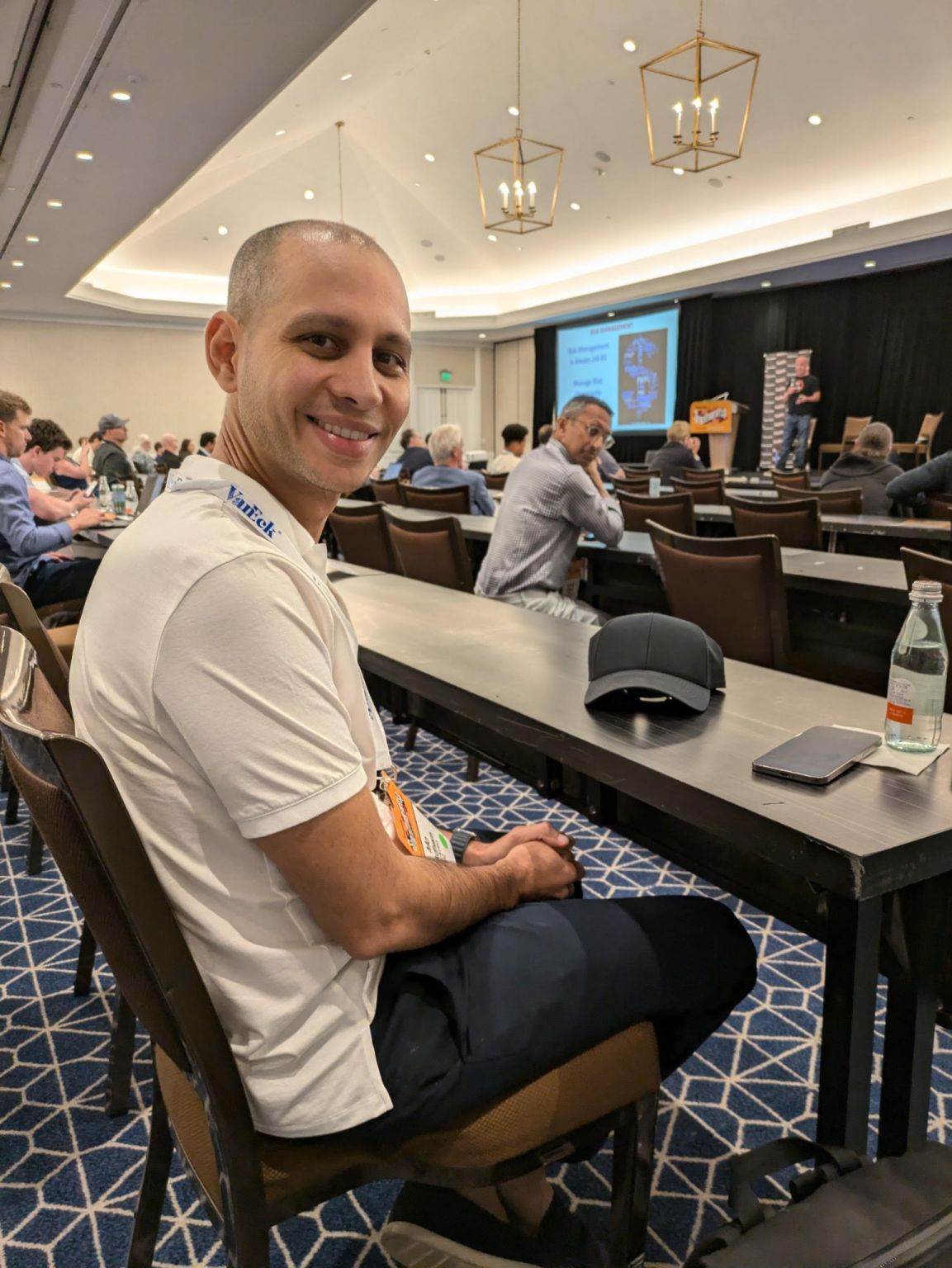
By his count, he had already told Frec’s story more than a hundred times in the year since launch. The repetitions often took about an hour. Once he got into the rhythm of explaining the product, he found himself enjoying it. A familiar explanation still had to become a conversation with the particular people in front of him.
He put the task neatly: “it’s a product you explain.” That is a substantial addition to a founder’s job description. An automated service might save its customer time while requiring its creator to spend plenty of time talking. Somewhere, the complexity needs a human interpreter.
“it’s a product you explain.”Mo Al Adham, on introducing Frec
In his discussion of product design, Al Adham emphasizes confidence, understandable information and transparency about what the system does. A collection of sophisticated tools can burden its user if every tool creates another decision. He wants the background work to support a surface that a person can follow.
A customer gets to choose
One of his more specific product convictions comes from holding concentrated stock. As an early Instacart advisor, he encountered wealth managers urging him to diversify. He disliked the sales approach, which asked him to imagine what would happen if the stock collapsed.
Reading Charlie Munger’s Poor Charlie’s Almanack helped him think through circumstances where concentration could make sense to him. He describes a framework based on whether he had an information advantage. The story is his account of making a decision, rather than a general instruction that everyone should follow it.
It became relevant again when Frec built Diversify, a product for reducing concentrated holdings. He told his team to avoid scaring customers into diversification. Someone might choose to remain concentrated; when they decided to change that, he wanted Frec to be an option.
There is a useful restraint in that position. A company can believe in what it sells and leave the customer room to decide when it belongs in their life. In Al Adham’s telling, his own experience supplied both the product opportunity and a boundary for how to discuss it.
The next account, the next conversation
In April 2026, Al Adham announced that Frec had crossed $1 billion in customer assets. His account described the pace accelerating: roughly a year to the first $100 million, another year and a bit to $550 million, then less than four months to a billion. He set his sights on $10 billion and beyond.
Assets held on the platform. These figures describe customer money, not company revenue or the founder’s wealth.
By September, Frec reported $1.5 billion and marked the milestone with an appearance on Nasdaq’s Times Square tower. The scale had changed. A founder’s invitation to try an app was now connected to a substantial amount of other people’s money.
Al Adham continues discussing the company’s direction, including direct indexing and long-short strategies, with other founders. The second company keeps bringing him back to an old product problem: deciding how much machinery a customer needs to see, and how much work the software should absorb.
The original wish remains a useful measure. Someone has a task, a limited amount of time, and a reasonable desire to get on with their life. Al Adham wanted an app. Building it has required contacts, conversations, explanations and repeated decisions about trust. Those parts of the work still belong to people.