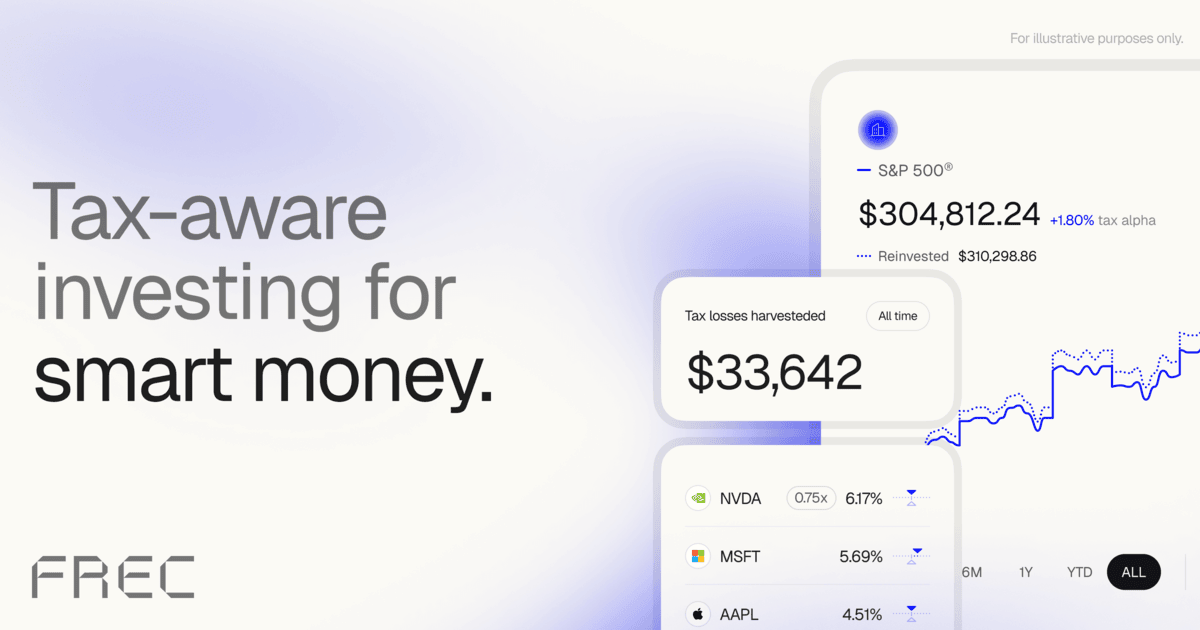
There is a version of investing where you buy an index fund, watch it go up, and pay a large capital-gains bill when you eventually sell. And there is a version where you own the same basket of stocks directly, and the software quietly sells the losers, banks the losses to offset your gains, and buys something almost identical back. Frec sells the second version to people who used to only get the first.
Here is the thing about index funds that nobody tells you at the dinner table: they are tax-inefficient in a very specific, avoidable way. When you own a share of an S&P 500 fund, you own one thing. It goes up or it goes down as a unit. If Nvidia triples and Boeing falls in half inside that fund, you cannot reach in and sell the Boeing to harvest the loss - it's all fused into a single share. The fund is a smoothie. You cannot un-blend a smoothie.
Direct indexing is the un-blended version. Instead of buying the fund, you buy the roughly 500 underlying stocks in the same weights. Now when Boeing falls, you can sell it, book the capital loss, and use that loss to cancel out gains elsewhere in your taxes - a maneuver called tax-loss harvesting. Then you buy something highly correlated so your portfolio still tracks the index. You keep the market exposure and pocket the tax benefit. The industry calls the extra after-tax return "tax alpha," which is a fancy name for money you were leaving on the table.
This is not a new idea. It's been the standard operating procedure of private wealth managers for decades - the kind with a $5 million minimum and a golf membership. The catch was always operational. Owning and rebalancing 500 individual positions, tracking cost basis on each lot, avoiding wash-sale rules, doing it every day - that's a nightmare to do by hand, which is exactly why it was gatekept behind human advisors charging 1% a year.
Frec's bet is that the gate was made of software, and software gets cheap. The company automates the whole apparatus and charges 0.10% a year - a tenth of what a traditional advisor takes - with a $20,000 minimum instead of a seven-figure one. It is, in the most literal sense, a private-banking service compressed into an app download.
The founder is Mo Al Adham, who is not a career finance guy, which turns out to matter. He was a product person - a stint at Microsoft, product roles at Twitter, and the first advisor to Instacart. He started Frec in 2021 for the least glamorous reason in startups: he wanted the thing for himself and couldn't buy it. He wanted to manage his own money the way the sophisticated investors around him did, found no good self-serve option, and noticed his friends had the same complaint. Some of those friends became his first customers. A few became his investors.
The company came out of stealth in October 2023 with $26.4 million in combined seed and Series A funding led by Greylock - the firm that got in early on Airbnb, LinkedIn, and Figma - with Social Leverage, Conversion Capital, and a roster of operator-angels including Instacart and Oculus co-founders. Then it did the thing that makes VCs feel good about their check: it grew. Frec crossed $100 million in customer assets within nine months of launch, and later reported passing $600 million.
What's notable is what Frec did with that momentum. It did not bolt on a crypto wallet or a checking account with a metal card. It went deeper into the boring, high-value stuff. It added more indices - Russell 1000, 2000, 3000, an ESG large-cap index - so the S&P 500 wasn't the only game. It launched a Portfolio Line of Credit, letting customers borrow against their holdings at the Effective Federal Funds Rate plus 1% without selling anything and triggering a tax event. It added a treasury account for idle cash, and a tool called Diversify that unwinds a concentrated single-stock position into an index while spreading the tax hit thin.
That last one is quietly the most interesting product, because it solves a real and specific pain: the engineer sitting on a mountain of appreciated employer stock who is terrified to sell because the tax bill would be brutal. Diversify is the structured, gradual exit from that trap. It is the kind of problem that used to require a phone call to a wealth advisor. Now it's a menu item.
"From tax-loss harvesting to intelligent rebalancing, automation is redefining retail investing - simplicity, not features, will win the future of finance."
Mo Al Adham, Founder & CEO
It is worth pausing on why this business can exist now and couldn't twenty years ago, because the answer is not really about investing at all. It's about the price of computation and the death of the trading commission. Direct indexing means holding hundreds of positions and rebalancing them constantly, and in a world where every trade cost $7.95 that was economically absurd for anyone below the ultra-wealthy tier. Once retail brokerage commissions went to zero and fractional shares became normal, the math flipped. You could now buy $40 worth of 500 different stocks without the transaction costs eating the tax benefit alive. Frec is, in a sense, a company that the zero-commission era made possible - a strategy that was always sound, waiting for its cost structure to arrive.
The regulatory posture matters too, and Frec leans into it rather than around it. This is a US-only, registered operation with a Chief Compliance Officer in the leadership group, custodial accounts, and licensed index methodologies from S&P Dow Jones, FTSE Russell, and CRSP sitting underneath the products. That is not the profile of a company trying to move fast and break securities law. It's a company that decided the boring, regulated version of fintech - the one that touches people's actual retirement money - is the one worth building. In an industry that spent a decade chasing engagement and gamified day-trading, choosing to be the responsible tax-optimization utility is itself a positioning.
There's a philosophical thread that runs through everything Al Adham says, and it's mildly countercultural for a startup: fewer features are better. The temptation for any consumer fintech that reaches scale is to become a super-app - add a debit card, a crypto tab, a buy-now-pay-later button, a social feed of what your friends are trading. Frec has mostly declined. The products it adds tend to be adjacent tax-and-liquidity primitives - a line of credit so you don't have to sell, a diversification tool so you don't get taxed all at once - rather than attention-grabbing distractions. The thesis is that in finance, the winning product is the one you don't have to think about, working quietly in the background, and that the company which resists the urge to be flashy will still be standing when the novelty apps churn out.
Who is the customer? Broadly, someone with a taxable brokerage account, real capital gains to offset, and enough financial literacy to understand why any of this matters - which skews toward tech workers, high earners, and the mass-affluent who are too rich to ignore taxes and not rich enough to have a private banker. The Diversify product sharpens that further: it's aimed squarely at the person holding a concentrated pile of appreciated employer stock, which describes a very large share of everyone who has ever worked at a company that IPO'd. For that person, Frec is less a nice-to-have and more a structured escape hatch from a genuinely stressful tax situation.
None of this is risk-free, and Frec doesn't pretend otherwise. Direct indexing's tax benefits are real but front-loaded - the harvesting opportunities are largest early, when the portfolio is young and volatile, and they diminish as unrealized gains accumulate over the years. Tax-loss harvesting defers taxes rather than erasing them, which is genuinely valuable but requires understanding what you're actually getting. And the whole edifice depends on the market cooperating enough to produce losers to harvest. Frec's job is to make a nuanced strategy legible to people who aren't going to read a 40-page whitepaper, and to do it without overpromising. The tagline - "tax-aware investing for smart money" - is careful. It's not promising to beat the market. It's promising to be smart about the part of investing almost everyone ignores.
The competitive field is crowded and getting more so, which is usually the sign of a real market rather than a fad. Wealthfront and Betterment offer automated direct indexing to their existing bases. Vanguard bought its way in with Personalized Indexing. Fidelity has FidFolios, Schwab has its own personalized indexing, and Morgan Stanley's Parametric has been running the institutional version for decades. Frec's answer to "why you and not them" is focus and price: it is a direct-to-consumer company for which this is the entire product, not a feature bolted onto a robo-advisor or a bank, and it charges accordingly. Whether that's a durable moat or a temporary head start is the question that the next few years of asset growth will answer.