Mitratech makes software for the work nobody notices until it breaks. A legal invoice slides past its billing rules. A litigation hold misses a custodian. A vendor's cyber problem becomes your cyber problem. An employment form expires. A policy exists, but the person who needs it cannot find it. These are not cinematic problems. They are expensive, repeatable and unusually well suited to software - provided someone first agrees how the work should move.
That last condition explains both the appeal and the danger of Mitratech. The Texas company began in 1987, long before “legal ops” became a conference badge. Its flagship, TeamConnect, developed into a system of record for corporate legal departments: matters, invoices, outside counsel, documents, budgets and reports in one configurable platform. Then Mitratech kept adding rooms to the house.
Today the portfolio stretches from e-billing and legal holds to no-code workflows, document assembly, policy management, third-party risk, business continuity, I-9 compliance, background screening and performance management. Mitratech says at least one of those products is used by 72 percent of the Fortune 100, 42 percent of the Fortune 500 and 70 percent of the Am Law 200. The narrower TeamConnect product page claims penetration of 60 percent of the Fortune 100.
The software stack built around a legal filing cabinet
TeamConnect is the anchor. It gives an in-house legal department one place to open a matter, assign work, manage a budget, receive law-firm invoices and measure what happened. Collaborati connects those e-billing customers with a large network of outside vendors. Acuity ELM serves teams that want a lighter matter-and-spend product. LegalHold handles preservation workflows. None of this is glamorous; all of it becomes important when a general counsel has to explain spending or prove that a process was followed.
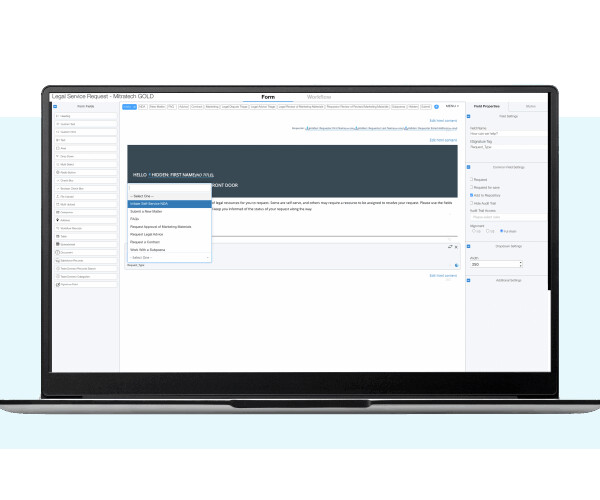
TAP is the connective tissue. It lets operations teams design forms, approvals and routing logic without asking a developer to hard-code every step. HotDocs, acquired in 2024, adds document assembly: collect the right answers, insert governed language and generate the paperwork. Prevalent adds third-party risk. Preparis adds incident response and continuity planning. Acquisitions including Circa, Trakstar, Mineral and Syntrio pushed Mitratech into HR compliance and talent.
ARIES is the new layer meant to make that collection feel coherent. Mitratech describes it as a governance-grade AI ecosystem, not a standalone chatbot. It appears in invoice review, document extraction, policy lookup and workflow guidance. A matter-and-spend agent can answer plain-language questions against TeamConnect data. Non-LEDES Invoice Capture reads invoices that do not arrive in the legal industry's standard format; by December 2025, Mitratech said the tool had processed thousands of invoices and millions of dollars in spend before expanding to international tax and currency formats.
“We are not deploying AI for novelty. We are applying it to the everyday operational challenges our customers face.”Chris Iconos, CEO of Mitratech Legal Solutions
The ROI lives in one boring queue at a time
The sharpest evidence does not come from the size of the portfolio. It comes from customers measuring a narrow workflow. Dow reported a 127 percent return on its Acuity ELM investment and a 10 percent reduction in legal spend after using automated budgeting and analytics. Bath & Body Works began with a privacy-addendum process that involved emailing vendors, negotiating changes and collecting wet signatures. The legal team launched its first TAP workflow within two days of signing and later reported saving 40 hours per privacy update, along with lower outside-counsel spend.
A Mitratech workflow paper offers a more mechanical model. It estimated that employee time made the average corporate NDA cost $129.81 to complete. Automation reduced that labor by 75 percent, or $97.36 per NDA, while completion time fell 95 percent. At 1,000 NDAs a year, the modeled return passed 100 percent; at 2,000, it passed 300 percent. Those figures are vendor research, not a universal law, but the method is worth copying.
Start with one frequent, stable process. Shadow the people doing it. Count every handoff, correction, reminder and hour. Put a price on the current state before buying anything. Automate the obvious routing first, preserve an escape hatch for judgment and compare the result with the baseline. Bath & Body Works did not begin by asking for “digital transformation.” It began with a queue everyone already disliked.
“Successful workflow automation never starts with technology - it starts with understanding your current state.”Elizabeth Lugones, Mitratech
What it costs - and what fails first
Mitratech does not publish a simple current price list for TeamConnect. A 2021 market report says pricing depends on the user base, chosen modules, legal spend, contract term and usage. Customers can encounter subscriptions, hosted environments, implementation work, data migration, integrations, training and premium support. That makes a neat per-seat comparison mostly fiction.
A 2020 U.S. government schedule listed this price for a perpetual TeamConnect Enterprise platform license covering 51-100 named users. Financial management and other modules were separate. It is useful as a scale marker, not as a current offer.
What fails first is usually not the invoice engine. It is the organization's confidence in its own process. Old data arrives dirty. Different regions use the same field to mean different things. Lawyers route around forms they did not help design. A highly configurable platform can encode good operations, but it can also preserve years of exceptions in digital amber. The first symptom is often low adoption; the next is a shadow spreadsheet quietly returning to someone's desktop.
Mitratech's acquisition strategy adds another condition. A portfolio assembled from many products does not become integrated because the sales slide uses one color palette. Identity, permissions, reporting, data models and workflow handoffs have to line up. ARIES may help users cross those seams through a common conversational layer, but buyers should test the underlying handoff: Can a vendor-risk event open the right legal workflow? Can a matter generate a governed HotDocs document? Can reporting span products without a custom data project?

Why customers change their minds
Enterprise teams rarely replace email because email suddenly stops sending. They change when volume, regulation or a merger makes informal coordination indefensible. TD SYNNEX adopted TeamConnect and TAP after the Tech Data-Synnex merger created a need for a scalable matter system. Its litigation reporting had depended on manual updates and vulnerable versions; automation turned the process into a controlled source of truth. A workers' compensation insurer facing rising caseloads made a similar move after siloed investigation tools became the bottleneck.
That is Mitratech's real market position. It competes with Thomson Reuters Legal Tracker, Wolters Kluwer, Onit, Brightflag and LexisNexis CounselLink in legal operations; with ServiceNow, OneTrust, MetricStream, Archer and LogicGate in workflow and GRC; and with specialists in screening, I-9, document automation and vendor risk. But the most common incumbent is still an accidental stack: Outlook plus Excel plus a finance system plus institutional memory.
The business model follows enterprise software convention: recurring subscriptions, with perpetual licenses still appearing in some product histories, plus hosting, implementation, migration, training and support. This is not software a department casually trials on Friday and rolls out companywide on Monday. Mitratech's expertise is partly technical and partly procedural - translating billing rules, preservation duties, policy controls and hiring obligations into fields, permissions and audit trails. Its partner network matters for the same reason. Large deployments need consultants who understand both the platform and the regulated work being encoded. That service layer raises total cost, but it can also be the difference between a useful system and an expensive database no one trusts.
The breadth can reduce vendor handoffs when several departments genuinely share data. Legal, procurement and security may all care about the same third party; HR and legal may share an investigation; a policy exception may trigger both a control review and a document workflow. If those connections are real, one platform has leverage. If the overlap exists only in a procurement presentation, separate specialist tools can remain easier to own.
Where the bet works
- High-volume, repeatable work
- Regulated or audit-sensitive teams
- A clear process owner and baseline
- Capacity for integration and change management
Where it probably does not
- Small teams with a handful of matters
- Unstable processes full of exceptions
- No owner for data quality
- A need for instant, transparent self-service pricing
The copyable lesson is smaller than Mitratech's platform pitch: map the work, price the waste, automate one queue and make the result visible. The approach will not work when volume is too low to repay setup, when the process changes every week, when judgment cannot be reduced to safe checkpoints or when nobody has authority to standardize the workflow. Under those conditions, a lighter point tool - or simply a better checklist - may win.
Mitratech's advantage is accumulated structure. Decades of matters, invoices, policies and controls give its AI something more useful than a blank chat box. Its risk is accumulated complexity. The company has bought enough capability to become a compliance operating layer; now it has to prove that customers experience one governed system rather than a well-stocked software cupboard.
Go deeper
Explore the company, its product demonstrations and current announcements directly: