The clever part of a structured product is usually over before the difficult part begins. A bank combines a bond with a derivative, engineers a payoff tied to an index or basket, and gives the result an enticing name. Then the machine room starts humming. Legal teams need terms. Regulators need disclosures. Distributors need clean data. Investors need a website that makes sense. Months later, someone still has to calculate coupons, barriers, calls and maturity. Every handoff offers a fresh chance for one field to be retyped badly.
WSD has built its business inside those handoffs. The London company, originally WallStreetDocs, sells software and specialist services for structured products and over-the-counter derivatives. Its platform receives a product definition, governs it as a shared source of truth, and pushes it into documents, calculations, regulatory filings, distribution channels and analytics. It is the sort of technology buyers notice most when it is absent.
One definition, many consequences
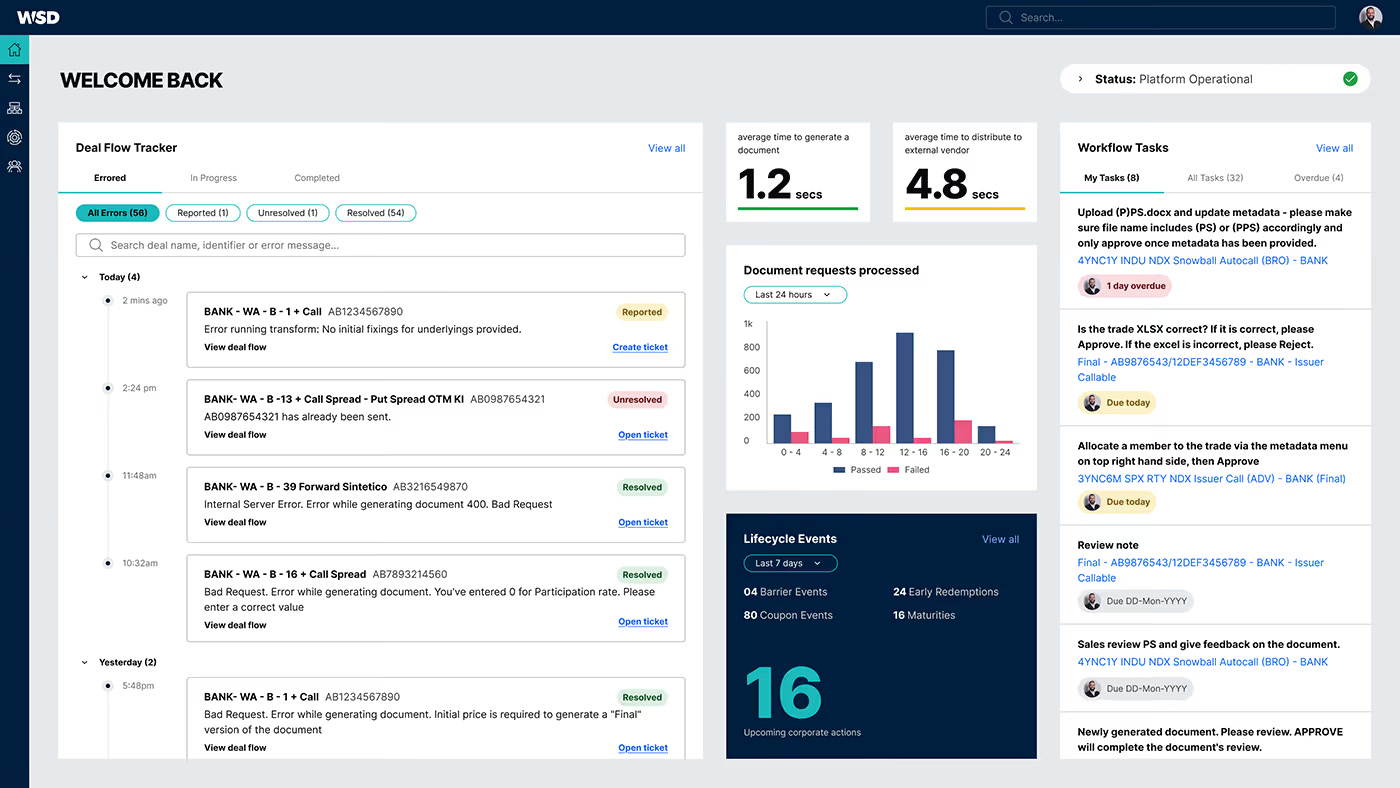
The company’s most important idea is almost stubbornly plain: a product should mean the same thing everywhere. Trading and structuring systems send data through an interface or API. WSD maps it into a governed product model. Doc Auto turns that model into term sheets, pricing supplements and investor communications. PRIIP Cloud adds risk scores, performance scenarios, costs and Key Information Documents. Workflow moves the work through legal, compliance, risk and outside counsel. Regulatory Filings converts finished documents for EDGAR or SEDAR. Distribution tools publish the same data outward. After issuance, the model keeps working through coupon dates, autocalls and corporate actions.
That sequence explains what makes WSD different from a document generator. A narrow tool can merge data into a template. WSD wants to remain present for the life of the instrument. It stores versions, logs approvals, feeds exchanges and data vendors, recalculates disclosures when conditions change, and gives issuers or private banks an investor-facing portal. The company combines software with template development, implementation and round-the-clock support. For a global bank, the human expertise is not decoration. Someone must understand why a disclosure changes across jurisdictions before the system can repeat it safely.
“What usually takes weeks, we do in seconds.”WSDThe origin
A derivatives lawyer finds the repetitive bit
Founder Mathias Strasser did not arrive from generic workflow software. He practiced law for more than two decades and became a specialist in derivatives law and automation. That biography matters. WSD’s wedge was not “documents are annoying.” It was that highly structured legal documents lend themselves to automation because their variables already belong to an underlying financial product.
By 2015, WSD and Compliance Xpressware had connected document creation to SEC filing. A user could create and edit an offering document, convert it, review a proof and submit it without leaving the same straight-through process. The first thing to fail in the old arrangement was the handoff: a completed Word file still had to cross into formatting and filing, inviting delay and error. WSD removed that seam.
Regulation made the opportunity bigger. In 2017, the EU’s PRIIPs regime demanded standardized KIDs containing risk, performance and cost information. WSD formed a consortium of ten investment banks around PRIIP Cloud. Rather than treating each KID as a bespoke legal artifact, the platform calculated and generated them at industrial volume. Today WSD says PRIIP Cloud works in more than 23 languages and monitors more than 500,000 ISINs daily.
The acquisition that revealed the plan
Bowmark Capital acquired a majority shareholding in April 2022. The price was not disclosed. The investor described a roughly $3 trillion structured-products market growing at more than 10 percent a year, with much of its legal and regulatory drafting still manual. WSD had already grown revenue by more than 15 percent annually since 2019. Two years after the investment, Bowmark said revenue had more than doubled.
The capital was meant to speed product development and geographic expansion, but WSD’s 2023 purchase of Solvians was the sharper strategic signal. Solvians brought German market data and web portals. Added to WSD’s document and workflow engine, that gave the group more of the chain: data in, documents out, then publication and investor experience. The combined company topped 200 employees across the United States, United Kingdom, Germany, Switzerland and Asia-Pacific. WSD now describes a team of more than 250.
The market position is specialist rather than horizontal. WSD serves issuers, distributors, private banks, wealth managers, broker-dealers, RIAs and OTC desks. Named relationships include Advisors Asset Management, Bank of America, Luma Financial Technologies and Vienna Stock Exchange. In Vienna, a standardized stream of master and reference data automated the listing process, with Raiffeisen Centrobank as the first customer. WSD also says its platforms are used by 75 percent of tier-one banks and, by 2025, all of the world’s top ten investment banks apart from China-onshore firms.
“The entire WSD team brings creativity, enthusiasm, deep industry knowledge and a top-notch work ethic to the partnership.”Advisors Asset ManagementWhat customers buy
Fewer humans moving the same field twice
There is no public price card. WSD sells negotiated enterprise software, data and managed services, where the bill is shaped by products, integrations, volume and support. The useful comparison is not another monthly SaaS subscription. It is the cost of lawyers editing repeatable language, operations teams reconciling formats, technology groups maintaining point-to-point connections, and compliance staff proving who changed what.
Doc Auto targets drafting time and legal cost. PRIIP Cloud targets the calculation and monitoring burden. RegXchange gives distributors a central place to retrieve PRIIP and MiFID II documents and metadata through a portal, API or daily feed. TranspariTrade lets a bank offer product search, payoff analysis, requests for quotes and ordering under its own brand. SP Intelligence cleans public and manufacturer data into reference sets, market-share analysis and lifecycle intelligence. The range is broad, but the commercial logic is consistent: charge institutions to replace repeated labor and fragmented systems with a governed flow.
RegXchange is the revealing exception inside that model. Browser access is free for distributors, which lowers the friction of joining a shared utility. Manufacturers still gain a wider route for their documents, while WSD strengthens the network around its data formats and delivery rails. In 2018, the service coordinated 22 investment banks, more than 150 wealth managers and 15 data vendors. That is not ordinary seat-based software. It is an attempt to make one connection useful to an entire market, especially when each participant would otherwise maintain a thicket of bilateral feeds.
What changed buyers’ minds was not a sudden affection for enterprise transformation. Deadlines did the work. PRIIPs and MiFID II forced enormous volumes of standardized output on already lean teams. Exchanges wanted cleaner listing data. Investors expected searchable portals. Once a bank had automated the KID or the term sheet, extending the same product definition into filing, distribution and lifecycle management became easier to justify.
The part worth copying
- Find a costly handoff between expert teams, not merely a tedious screen.
- Model the shared object underneath the work before automating the documents around it.
- Use regulation as a forcing function for standardization, then expand into adjacent workflows.
- Keep specialists close to the software when interpretation carries legal or financial risk.
This pattern has conditions. It pays when volume is high, outputs are repeatable, deadlines bite, and the same data must travel through several controlled systems. It is less persuasive for a low-volume desk with genuinely bespoke transactions, a firm unwilling to standardize its product taxonomy, or a project where integration costs exceed the labor being removed. WSD’s connected model also asks customers to trust a vendor with a large operational surface. Bank-grade security, auditability and service are therefore part of the product, not procurement ceremony.
The new wrapperAI arrives, but the plumbing stays
WSD now calls itself AI-enabled and has experimented with Melody, a virtual agent designed to support KID work. The better reason to watch the company, though, is the data foundation beneath the fashionable layer. Generative systems can draft language and answer questions. They are much more useful when every product term, document version and lifecycle event already has a controlled home. WSD’s old obsession with structure may make its newer AI claims more credible than a chatbot bolted onto a document library.
In April 2026, the company unveiled a new brand and website organized around a single platform from pre-trade through analytics. The presentation is cleaner; the job remains wonderfully fussy. Every day, hundreds of thousands of calculations must be right. Every document must agree with the trade. Every downstream recipient must receive the proper version. WSD has turned that fussiness into a business - proof that some of fintech’s most valuable machinery is built not where money is imagined, but where its meaning is kept intact.
The result is a company that sits in an odd, durable corner of finance. It is part software vendor, part data network and part expert operations team. Competitors can attack any single piece with a better editor, feed or portal. WSD’s defense is the connective tissue among them. The wager is that a bank will value continuity more than novelty when the same instrument must remain accurate across desks, languages, regulators and years.