Somewhere inside a large company, an employee has just seen something that should not have happened. Perhaps it is a bribe, a safety shortcut or a manager behaving badly. The employee now has two problems. The first is what happened. The second is deciding whether the company can be trusted with the truth. NAVEX lives in that second problem.
Its best-known product, EthicsPoint, receives concerns by phone and web, preserves anonymity where the rules allow it, routes cases and keeps a record of the investigation. But NAVEX is no longer simply the company behind the number printed beneath a code-of-conduct poster. NAVEX One connects that report to policy distribution, employee training, conflicts disclosures, vendor screening and enterprise risk. The buyer is typically a compliance, legal, HR, audit or security team. The audience is everybody else.
The first failure is usually paper
The company’s customer stories are repetitive in a useful way. Before NAVEX, reports sit in paper files, scattered inboxes or a hotline database that cannot track an in-person complaint. Alliance Data, then a 20,000-person financial-services business, described the paper trail as unwieldy. DP World had email plus a Dubai phone line serving only English and Arabic. Currys wanted a faster, more secure case process with better analytics. Different industries, same administrative fog.
What changes is not merely storage. A structured system can confirm receipt, assign an investigator, preserve notes, prompt follow-up and show leaders whether cases are aging. At the YMCA of Delaware, employees could return anonymously with a key and password. The organization posted follow-up questions on more than 80 percent of reports; reporters supplied more detail in every instance but one. That tiny loop is the product in miniature: a report becomes a conversation without forcing the speaker to surrender identity.
“Every investigation starts with someone making the decision to speak up, and that first interaction matters enormously.”Raj Sethuraman, president and chief product & technology officer
The practical lesson is copyable even without NAVEX. Offer more than one intake channel. Give anonymous reporters a safe way back into the case. Standardize the minimum facts an investigator needs. Track time to closure and outcome. Then explain, repeatedly, what the system is for. A technically perfect hotline advertised once during onboarding is office wallpaper.
A roll-up with a product thesis
NAVEX arrived in 2012 looking less like a garage startup than a carefully packed toolbox. Riverside had acquired four specialists: Employment Law Training, EthicsPoint, Global Compliance Services and Policy Technologies International. Their histories reached as far back as 1981. The combination, then valued above $200 million, united online training, hotlines, advisory work, incident management and policy software under the NAVEX Global name.
Four compliance specialists combine. Vista buys the platform two years later.
RiskRate adds third-party monitoring; The Network adds more training and hotline reach.
Expolink, Lockpath, WhistleB and CSRware widen the map into European reporting, enterprise risk and ESG data.
Goldman Sachs Alternatives takes control; a new CEO and the Nira AI product mark the next chapter.
The sequence matters. NAVEX did not invent every component. It accumulated proven specialist products and tried to make them behave like one system. RiskRate, launched in 2013, put vendors and third parties into view. The 2019 purchase of Lockpath brought integrated risk management. NAVEX said plainly that customers had changed its mind: they wanted a more holistic program and a single provider. Expolink and WhistleB strengthened European whistleblowing; CSRware added ESG reporting in 2020.
This is the difference NAVEX sells against MetricStream, ServiceNow, Diligent, OneTrust, Riskonnect and a long row of point solutions. EthicsPoint, PolicyTech, NAVEXEngage and RiskRate can be bought as recognizable jobs, but the suite argument is shared context. A policy attestation, a missed course, a vendor alert and an incident are more revealing together than in four exports. For a lone compliance officer, one login and familiar navigation can also mean fewer hours acting as an unpaid systems integrator.
Each module has a prosaic job. PolicyTech controls versions and records who has read what. NAVEXEngage assigns training and adapts material to the learner. Disclosure Management collects conflicts and gifts before they become unpleasant discoveries. EthicsPoint catches concerns and manages the case. RiskRate screens and monitors outsiders. NAVEX IRM gives risk owners a broader register of operational, technology and strategic exposure. The platform layer is supposed to make those jobs legible to one another and to the people preparing a board packet.
That breadth is useful only if the underlying work is ready. A company cannot connect policies it has never cleaned up, benchmark cases it classifies differently in every division or automate investigations nobody is accountable for finishing. The sensible implementation order is unglamorous: name owners, agree on categories, map escalation rules, import clean employee data and start with the workflow causing the most pain. Add adjacent modules when shared data answers a real question. Buying the whole diagram on day one can produce an expensive diagram.
The moat is the benchmark
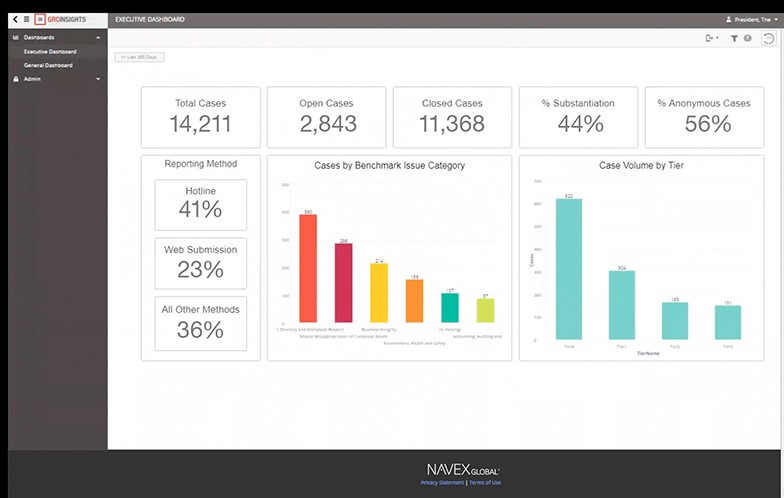
Connecting workflows creates convenience. Aggregating their exhaust creates something harder to copy. NAVEX publishes annual whistleblowing benchmarks from what it calls the world’s largest incident-management database. Its 2024 report analyzed more than 1.8 million reports. The next edition found a quiet milestone: web intake accounted for 33.4 percent of reports, passing the telephone hotline at 29.4 percent for the first time in the analysis.
Those figures give a compliance chief a reference point. A reporting rate that looks alarming in isolation may be healthy next to similar organizations; a strangely low rate may signal silence rather than virtue. In the United States, NAVEX found a median 1.78 reports per 100 employees in 2024, versus 1.57 globally. Context turns a dashboard from decoration into a question generator.
The benchmark also shows why channel design should follow the workforce. North American organizations still received 31 percent of reports by phone, while the hotline represented 18 percent in Europe and 11 percent in Asia Pacific. Web intake reached 57 percent in Europe and 62 percent in Asia Pacific. A manufacturer with shift workers, a university and a distributed technology company should not expect the same mix. Copy the measurement discipline, not somebody else’s channel ratio.
RiskRate applies a similar data appetite outside the workforce. NAVEX says its monitoring reaches more than 500 regulatory lists, 1.5 million politically exposed persons and eight million adverse-media profiles. A procurement team can score a new supplier, route deeper checks toward the risky ones and keep watching after onboarding. The useful move is prioritization, not the fantasy of eliminating third-party risk.
Now the database has an agent
In July 2026, NAVEX introduced Nira, short for NAVEX Intelligent Response Agent. The first version lets users ask natural-language questions of their program data, produce reports and compare performance with benchmarks. August brought policy guidance and customer support. On September 1, Nira moved to the most sensitive edge: intake. Instead of presenting a rigid form, it can guide an employee through a multilingual conversation, balancing narrative with the structured details a compliance team needs.
This is a more credible AI pitch than dropping a general chatbot beside a policy library. NAVEX owns domain workflows, benchmark context and years of case patterns. It also promises human oversight and transfer to its contact center when a reporter needs a person. That boundary matters. Summarization and field standardization can save time; credibility, proportionality and investigative judgment cannot be delegated to autocomplete.
What the customer actually buys
Pricing is tailored by headcount, regions, chosen modules, report volume and workflow complexity. NAVEX advertises up to 30 percent savings for bundles. The real expense also includes implementation, policy cleanup, training, ownership and the organizational courage to act on what comes in.
The business model fits that complexity. NAVEX is private enterprise SaaS with services around implementation, consulting and customer success. There is no universal sticker price. A small organization with one narrow requirement may find a specialist tool - or a disciplined internal process - cheaper and faster. A multinational facing whistleblowing laws, vendor checks, training obligations and board reporting is the natural customer for the connected suite.
Private equity has repeatedly paid for that position. Riverside sold NAVEX to Vista in 2014. BC Partners took a majority stake in 2018. In October 2025, Goldman Sachs Alternatives completed a new majority acquisition, Blackstone became a significant minority investor and BC kept a meaningful minority position. Terms were not announced, but people familiar with the deal put the value above $2.5 billion. In May 2026, former Bain leader Arpan Sheth became chief executive with a brief centered on expansion, transformation and AI.
Trust remains stubbornly manual
NAVEX can make reporting accessible, investigations consistent and patterns visible. It cannot make a frightened employee believe the chief executive. The system works poorly when leaders retaliate, managers bury findings, data is fed in carelessly or nobody owns the workflow after launch. It is also excessive when the organization lacks enough volume or complexity to benefit from an enterprise platform. Integration value only appears when teams agree to integrate their work.
That is also why NAVEX is more interesting than its sober category suggests. It sits between human confession and institutional memory. Its platform records the moment a private concern becomes corporate knowledge, then asks whether the company learned anything. The hotline still matters. But the durable product is the chain of evidence after somebody speaks.