Corporate compliance training begins with a small indignity: somebody blocks an hour on your calendar so you can prove you are not a crook. Slides arrive. A narrator speaks. The “Next” button glows with the promise of release. LRN Corporation has spent more than 30 years arguing that this ritual confuses attendance with understanding. Its alternative is part software platform, part course studio, part research shop, and part management consultancy - all built around a sharper question: when an employee meets a gray area on Tuesday afternoon, what will they actually do?
That question has made LRN a quiet piece of infrastructure inside large companies. More than 2,500 organizations use its products and services, reaching over 30 million learners worldwide. The client list visible in its case studies and product pages includes American Express, Sanofi, Domino's, PepsiCo, HP, Hasbro, Corteva, Red Hat, Bosch, FedEx and Standard Chartered. These are companies with sprawling workforces, different languages, heavily regulated operations and reputations that can be damaged by one bad decision.
The first thing that failed was the stopwatch
Sanofi's U.S. healthcare compliance program offers the cleanest view of the old problem. Employees faced multiple courses built around recorded lectures and slides. The material met regulatory requirements, but it offered limited practice with the actual decisions people encounter at work. Training exposure also varied by role. The company wanted a common foundation without forcing everyone through the same thicket of material.
LRN helped Sanofi replace four separate trainings with one role-based program called Leading with Integrity in US Healthcare Compliance. The course borrowed the pressure-and-precision language of Sanofi's McLaren Racing partnership, then sent employees through realistic, choose-your-own-path scenarios. It reached about 8,900 U.S. employees through Sanofi's existing learning system. The important design move was subtraction: seat time fell from roughly 190 minutes to 60.
Minutes per employee
The 68% reduction translated into more than 19,000 hours of annual time savings and over $1.4 million in estimated payroll savings.
The savings are an estimate, not LRN's fee or a disclosed contract value; LRN sells through demos and custom quotes rather than a public price sheet. Still, the result puts a useful number on a neglected cost. Every unnecessary minute in mandatory training is multiplied by the entire workforce. Compliance teams often defend a program by showing that it happened. Sanofi could show what it gave back.
“Catalyst Reveal has helped us move from counting completions to understanding behavior.”Sanofi compliance leader
A course library grew a nervous system
LRN began in 1994 with founder Dov Seidman's belief that legal and ethical knowledge should be accessible. By the end of that decade, it had moved into software-delivered compliance education. The modern company still makes courses, including an Inspire library spanning major risk topics and more than 70 languages, but the center of gravity is Catalyst, a modular ethics and compliance management suite.
Catalyst Design lets teams alter courses, scenarios and branding. Reach handles enrollment, campaigns, reminders and reporting. Mobile puts courses, policies and codes into workers' pockets. Disclosures collects attestations and follow-up information. Smart Code turns the code of conduct from a PDF into an interactive site. Supplier carries training and codes beyond the payroll into the supply chain. A 2025 phishing product added simulations and adaptive microlearning, while AdminAI promises to make the administrator's side less fiddly.
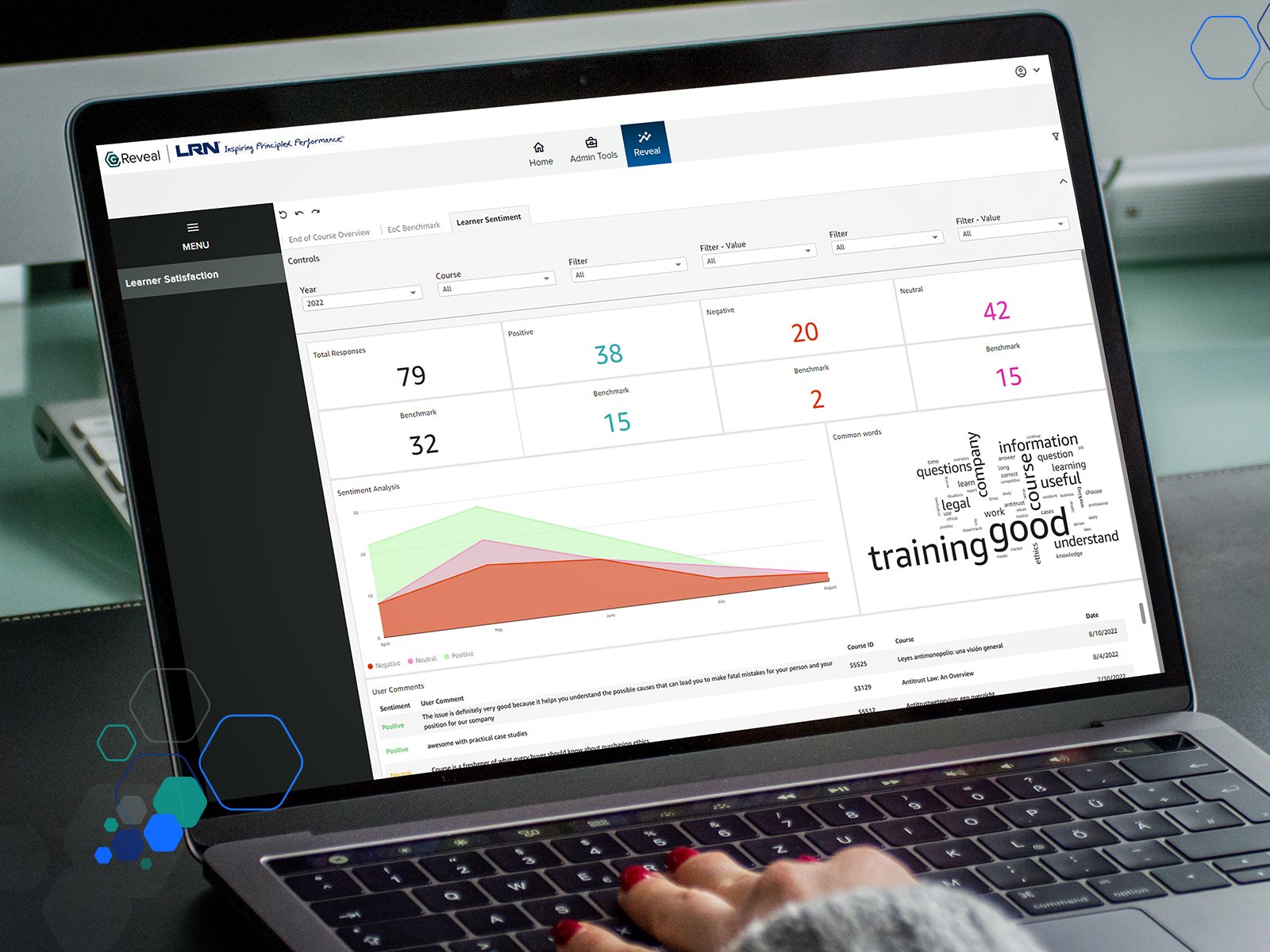
Reveal is the connecting tissue. It examines participation, knowledge checks, attempts, sentiment and patterns across courses, regions and roles. In one Sanofi analysis, 49% of learners needed four or more attempts to pass a module. That looked like a knowledge problem until the team inspected the assessment and found that a multiple-select question was contributing to confusion. The analytics did not merely grade employees; they caught the course designer.
The product is the loop, not the lesson
That loop separates LRN from a plain learning-management system. A general LMS can distribute content and record completion. A broad governance, risk and compliance suite can manage incidents, policies and third-party controls. LRN sits between them: deep specialist content, delivery software, behavioral analytics, surveys, custom production and advisers who interpret what the data means. NAVEX and SAI360 compete with wider GRC stacks; Skillsoft and other learning vendors compete with catalogs and distribution; internal teams compete with control and lower incremental cost.
LRN's advantage is coherence. The same vendor can rewrite a code, build a branded game, distribute it through Workday or Cornerstone, survey the culture and brief executives on weak spots. Integrations cover familiar enterprise plumbing such as Okta, Microsoft 365, SAP, Oracle and ADP. For a global compliance chief, buying fewer seams can matter as much as buying more features.
Domino's demonstrates the less exotic version of the payoff. Before its update, training completion hovered around 90%. The content and delivery felt dated, and the program did not fully reflect the company's current risks or global workforce. Domino's used Catalyst Design to tailor courses and the Inspire library to serve employees in many markets. It now reports 100% completion. That number does not prove perfect conduct, but closing the last ten points shows what relevance, localization and steady program support can do.
American Express chose LRN after comparing providers, citing mobile access, customer support, bespoke development, customization, content breadth and analytics. It reports saving six to 12 administrative hours each week. AIB took a more playful route when its customer-first culture began to erode: an online complaint-resolution game, a plain-language video and an in-person soft-skills session. The program earned 100% employee approval, won training awards and coincided with a higher Net Promoter Score.
What changed their minds
Across these cases, the trigger was rarely a spectacular scandal. It was the smaller realization that familiar metrics had stopped answering useful questions. Completion could not reveal whether employees understood a difficult topic. A library could not show where a region hesitated. Annual training could not reach field workers at the moment they needed a policy. Recorded lectures could not rehearse a decision. Once a team admits that “delivered” and “effective” are different states, LRN's mix begins to make sense.
The company practices the same argument in its research. Its 2026 program-effectiveness study drew on more than 2,500 ethics and compliance professionals. Only 34% of programs actively used data analytics for evaluation, fewer than half said boards regularly reviewed ethics and compliance metrics, and just 58% of employees believed managers held themselves to the same ethical standards as others. Software can expose those gaps. It cannot make a manager trustworthy.
The clever part is not making compliance entertaining. It is making every interaction leave evidence about what to improve next.
The playbook you can steal
Start by consolidating. Four overlapping courses may signal seriousness while producing fatigue. Next, map scenarios to roles so employees practice the choices they are likely to face. Let experienced people test out of material they already understand. Capture more than the final score: attempts, common wrong answers, opt-in rates, sentiment and time. Inspect the wording whenever a large group fails the same item. Then put the findings in front of risk owners and executives, where the data can change policy, content or management behavior.
The technology comes after the operating habit. A small company could copy much of the logic with an existing LMS, careful assessment design and a spreadsheet. LRN becomes more compelling as complexity rises: thousands of employees, multiple jurisdictions, several languages, recurring disclosures, suppliers, strict audit trails and a board that wants comparable measures. Its sales-led, quote-based model and broad module set are built for organizations where coordination itself is expensive.
Where the model works - and where it cracks
Best conditionsLarge or regulated workforces; executive sponsorship; a stable employee-data foundation; realistic scenarios; permission to revise the program when the numbers reveal a weakness.
Failure conditionsLeaders who punish candor; dirty HR data; generic content pasted across cultures; teams that collect analytics but never act; a narrow training problem that does not justify an enterprise platform.
Values, with private-equity scale
LRN's language remains unusually philosophical for a software company. Seidman studied moral philosophy before law, and the company talks about integrity, humility, passion and truth. It calls its culture a “human operating system,” with mutual accountability replacing command-and-control reflexes. It also operates like a scaled software-and-services business. Leeds Equity Partners made a significant investment in 2018. LRN bought Dublin-based Interactive Services in 2020, then acquired Thomson Reuters' Compliance Learning business in 2022, adding custom-production depth, financial-services expertise and reach in Europe and Asia.
Leadership is now turning over for the next chapter. Bob Lemmond became chief executive in December 2025, succeeding Kevin Michielsen. Patsy Doerr joined as chief people and culture officer, and Jean Brody became chief marketing officer in February 2026. The product line is pressing into AI administration, phishing and supply-chain compliance while the old thesis stays intact: rules matter, but they cannot anticipate every decision.
In August 2026, LRN marked a sixth consecutive year of Brandon Hall recognition with six awards shared with Hasbro, Howden, HP, McAfee and Sanofi. Awards are pleasant shelf furniture. The more persuasive achievement is mundane: shorter courses, fewer administrative hours, a confusing question repaired before next year's class. LRN's bet is that ethical culture is not a poster on the wall. It is a product that must be designed, instrumented and maintained - especially after everyone has clicked “complete.”