Somewhere inside a large company, a person has written an advertisement. This is the easy part now. The hard part is discovering whether a phrase promises too much, whether the disclosure sits where a reader can see it, whether the claim belongs to this product in this market, and who approved a similar sentence three months ago. The writer has an AI assistant. The reviewer may have an inbox and a spreadsheet.
The short version
- Blee gives legal and compliance teams an AI first pass on marketing content, then records human approval.
- It also watches published pages, social posts and partner content for changes or missed risks.
- Rocket Mortgage reports that its initial review time fell from 72 to 24 hours.
- The software is sold to enterprises; Blee does not publish a price list.
Blee was founded in 2022 by Guy Shahar, a former Adobe marketing operations leader with a legal background. His view of the problem is unusually well positioned: he has stood near both the people who must ship a campaign and the people who must sign it off. Blee, a Y Combinator Summer 2022 company, sells the software that tries to make those two clocks run at something closer to the same speed.
The three-day sentence
Rocket Mortgage offers the most concrete account of what that means. Its creative team was producing more assets for more channels. Its compliance team, Blee says, spent roughly 50 hours a week on manual marketing reviews. The company brought Blee in as an early user, putting policies, reviews and fixes in one place. In Blee's case study, the initial review fell from 72 hours to 24, a 67% reduction. The same account says the team saved 14 hours a week. Those are customer results reported by the vendor, rather than an independent trial, but they describe a recognizable operational change: the first set of avoidable questions gets answered before a specialist opens the file.
The arithmetic is attractive, but the more interesting question is what those hours were filled with. A compliance reviewer is paid for judgment: the ambiguous promise, the exception, the sentence that is technically defensible and still likely to mislead. Repeatedly requesting a missing disclosure is not that judgment. Nor is hunting for last quarter's approved wording. Blee's proposition is to move the repetitive search to software and leave the decision with people.
The rule is only half the rule
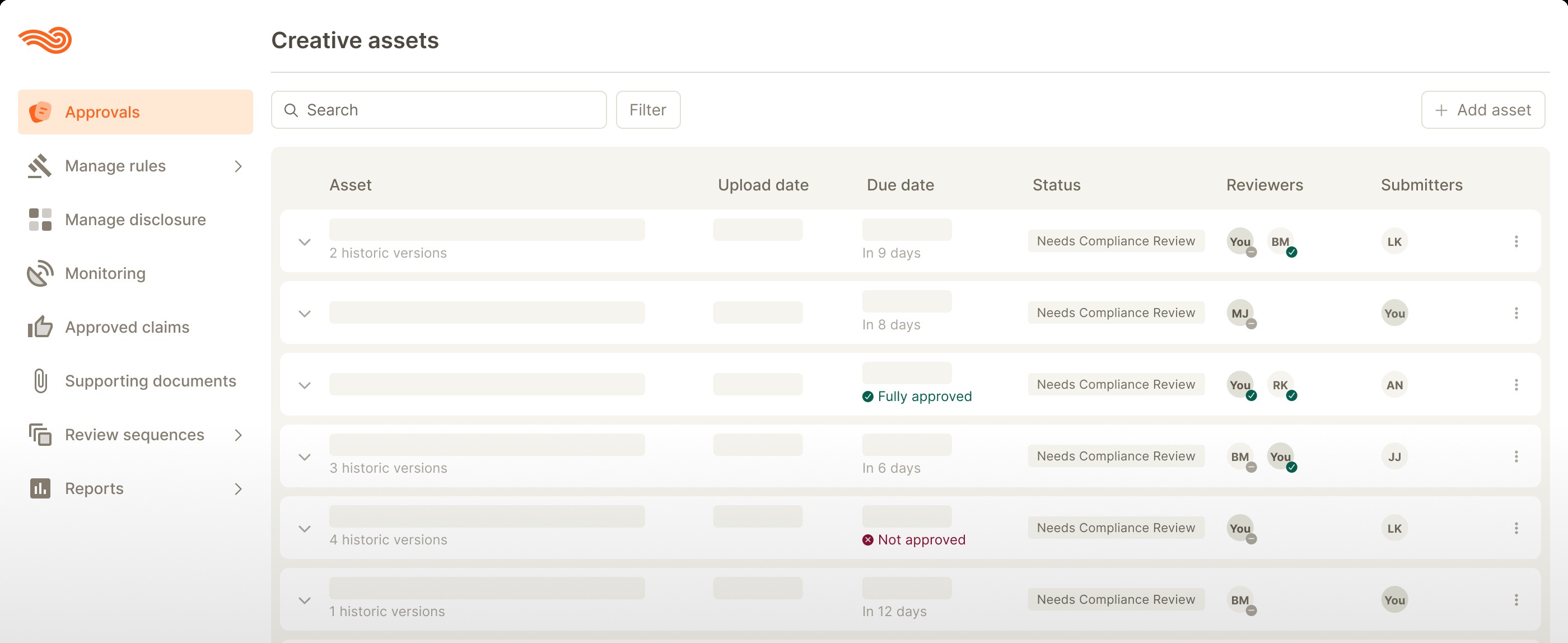
A crude compliance checker can search for forbidden words. That is rarely enough. Consider an investment claim: its meaning changes with the product, audience, supporting evidence, nearby disclosures and the firm that makes it. Blee lets teams apply regulatory frameworks alongside their own policies, approved claims and risk tolerances. Its AI reads drafts across formats, flags potential problems, and sends the asset through a configurable approval flow. Comments, revisions, decisions and versions become an audit trail instead of corporate folklore.
The distinction between a flag and an explanation has become part of the product. In August 2026, Blee introduced AI Reasoning, which puts the matched rule, relevant past decisions and a confidence level beside a flag. Its September Lightning Analysis announcement claims to make that full-context review ten times faster. These are Blee's own product claims; the more useful idea is the design choice. A reviewer who cannot see why a system objected is left to re-do the investigation. A reviewer who can see the rule and precedent can spend time deciding whether the objection is right.
The velocity of the business has outrun manual review.Mike Russell, Head of Global Legal Operations, Expedia Group
Publication is a beginning, too
An approved ad is not a fixed artifact. A partner may edit a landing page. An influencer may omit a disclosure. A product term may change while an old post remains live. Blee's content monitoring product watches websites, social media and partner or affiliate content after publication, looking for outdated claims, brand inconsistencies and changes to approved versions. This is where its pitch becomes broader than a faster queue: it wants to connect the version legal approved with the version the public actually sees.
That combination explains the customer list. Rocket Mortgage has mortgage claims. NerdWallet publishes a great deal of financial guidance and chose Blee for both review and monitoring. Betterment has retail, workplace and advisor businesses with different audiences. Marqeta described using Blee's risk detection, approval flows and monitoring in its go-to-market process. Blee has also named SoFi and Expedia Group, while its public materials cite PayPal and Brex. These are organizations for which a marketing sentence can be a legal event.
The product has moved nearer to the moment of creation. Blee announced integrations for Figma and Google Docs in 2026, so the first warning can appear while an asset is still easy to edit. That is an important change in the order of work. A correction made on a draft is cheap; the same correction after a designer has exported twenty sizes, a campaign manager has scheduled them and an agency has sent them to partners is considerably less so.
The business in the bottleneck
Blee sells enterprise software through direct sales and custom demos. There is no public price list, so a buyer's actual cost depends on a quote. A company hiring for an account executive describes experience selling six-figure SaaS deals as relevant, but that is a sales qualification, not Blee's tariff. The other cost is operational: a customer must assemble its rules, approved language and past decisions, then keep them current. A system cannot faithfully apply a policy that nobody has written down.
The company has alternatives. PerformLine and other monitoring products address content already in market; Red Marker, Red Oak, Warrant and Haast overlap with pieces of review, rules or approval. A company can also build a process from email, spreadsheets and a general-purpose AI model. Blee's argument is that pre-publication review, human routing, audit history and post-publication monitoring belong together. That matters most where volume is high, rules vary by product or market, and a mistake is expensive. A tiny team approving a few uncomplicated assets each quarter may find the setup heavier than the queue.
In September 2026, Blee announced a $20 million Series A, taking its reported funding to $27 million. It said annual recurring revenue grew tenfold between June 2025 and June 2026, without giving the starting figure. The money is intended for product development and expansion into more industries and geographies. The funding tells us investors see a market; it does not tell us the price of a seat, the accuracy of a flag, or whether every customer repeats Rocket Mortgage's result.
What a reader can copy is less mysterious than the AI. Measure the time from first submission to first useful response. Write down the claims and disclosures that reviewers repeatedly request. Put previous decisions where the next reviewer can find them. Move routine checks toward the creator, keep the final call with the accountable person, and look at the content again after it goes live. Even without Blee, that sequence turns a vague complaint about a slow legal team into a tractable workflow. The fastest writer in the room will keep getting faster. Somebody still has to be able to read what it writes.