The scariest object in a medical-device office may be a spreadsheet named risk_matrix_FINAL_v7_revised.xlsx. It looks harmless. Then an auditor asks which design input connects to which verification test, who approved the change, whether that person was trained and what happened after a customer complaint. Suddenly the spreadsheet is not a file. It is a crime scene.
Greenlight Guru exists for that moment. The Indianapolis software company organizes the controlled documents, electronic signatures, training records, design controls, risk files, supplier records, complaints, audits and corrective actions that surround a medical device. Its customers are not hospitals buying another clinical dashboard. They are the startups and manufacturers building devices, plus the quality, regulatory, engineering and clinical teams charged with proving that those devices were designed and monitored properly.
That distinction is the business. Generic quality software can serve aerospace, food, pharmaceuticals and factories. Greenlight Guru chose medical devices and learned the nouns: ISO 13485, ISO 14971, 21 CFR Part 11, CAPA, design history files, post-market clinical follow-up. The bet is that a buyer facing a regulated submission wants fewer translation exercises and more software that already resembles the job.
The first failure was paper
The origin story starts in 2006, when medical-device engineer and consultant Jon Speer noticed that paper quality systems were painful, risky and inefficient. Commercial QMS products had existed for years, yet Greenlight Guru says only about 30 percent of medtech companies used them at the time. The problem was not a shortage of databases. It was fit. Systems built broadly for enterprise compliance could become cumbersome for a small device team, while paper, email and shared drives made traceability a scavenger hunt.
Speer and David DeRam eventually founded Greenlight Guru in 2013. Their answer was a cloud QMS shaped around the device lifecycle. Documents could move through approval workflows. Training could follow document changes. Requirements, hazards, mitigations and tests could be linked. Quality events could point back to products. An audit trail could show who did what and when.
“As consultants, our time is our most valuable commodity, so wasting 20-30 minutes on getting a signature is extremely inefficient.”Kyle Rose, Rook Quality Systems
That quote catches the humble wedge. Greenlight Guru did not promise to invent the device or win FDA clearance by magic. It made the administrative joints less squeaky. A signature that takes half an hour sounds trivial until it happens across dozens of records, several products and a remote team. The value accumulates in minutes not wasted, versions not confused and evidence not reconstructed the night before an audit.
From quality system to lifecycle system
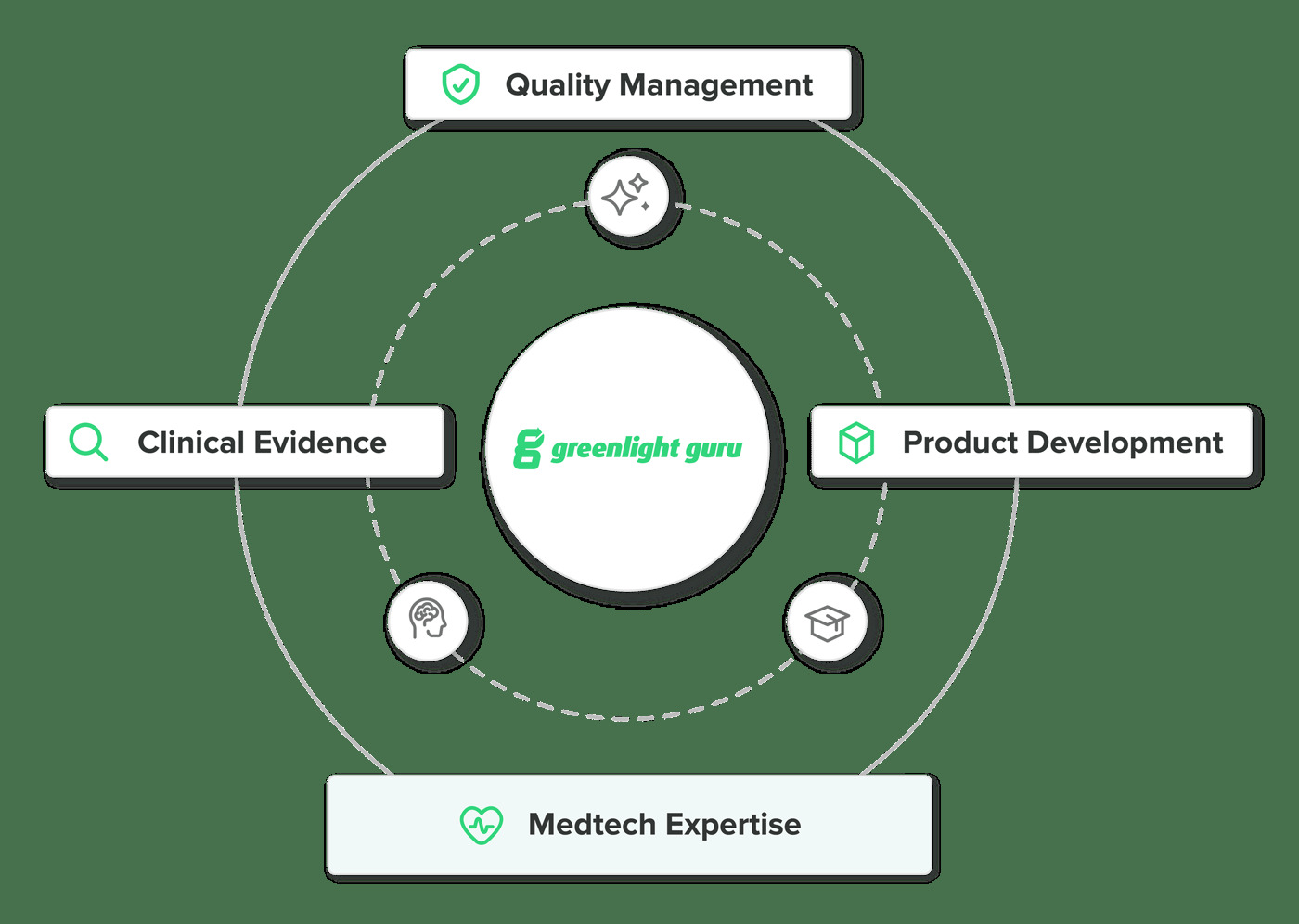
A QMS becomes more useful when it knows what the product team is building. Greenlight Guru’s current platform therefore has three large neighborhoods. Quality Management handles controlled documents, training, changes, CAPA, audits, nonconformances, complaints, suppliers and operations. Product Development connects requirements, design controls, software releases and risk. Clinical Evidence covers electronic data capture, clinical trials, post-market studies and patient-reported outcomes.
The connected-record argument
The expansion was partly bought. In 2022 Greenlight Guru acquired Vertex Intelligence, a data-science consultancy it had worked with for three years, and SMART-TRIAL, a Danish electronic data-capture platform built for devices and diagnostics. In 2025 it added Ultralight Labs, which focused on early-stage and software-enabled devices, then acquired Enzyme, another modern QMS provider. The sequence is coherent: bring intelligence in-house, add clinical records, improve the engineering handoff and consolidate adjacent customers.
The named customer roster includes PhotoniCare, Sonavex, Astrego, C2Dx, Canterbury Scientific, Puzzle Medical, Milliken and Oticon. These are not one identical customer. Some are racing toward a first submission. Others have commercial products, suppliers and post-market obligations. That range explains why the platform sells modules and services rather than one little app with one little price.
What it costs - and what the price is really buying
Greenlight Guru does not publish numeric list prices. Quality customers start with a required Core subscription, then choose additional functions. New Quality customers must also buy one-time onboarding. Clinical packages vary by active studies and sites. That is enterprise software behavior: pricing arrives after a conversation, not before a credit-card form.
Growth equity raised from JMI Equity in 2021. The capital funded a larger ambition than document control. Four acquisitions followed across AI, clinical evidence, product development and QMS.
Independent buyers and consultants describe annual bills in the mid-five figures, but those reports are not a price sheet and packages differ. The safer conclusion is simpler: this is not casual startup tooling. Greenlight Guru’s own customer quote admits the tension neatly. Daniel Powell of Spark Biomedical calls the software “expensive on day one” and “dirt cheap on day two,” arguing that implementation represents work a company would otherwise pay someone to build.
The comparison is not software versus zero. It is software plus onboarding versus people maintaining templates, chasing signatures, validating systems, migrating documents, preparing audits and fixing the gaps. Canterbury Scientific CEO Clive Seymour says work that once took six weeks became much shorter and that the cost was repaid in efficiency. A case study involving Fusion Innovations and implementation partner Rook Quality Systems reports a two-day FDA inspection with zero observations. Those are customer experiences, not universal guarantees, but they reveal the buying logic: the avoided mess is the ROI.
The software does not make you compliant
Here is where the clean demo meets the regulated world. A platform can enforce a workflow, preserve a signature and link a risk to a test. It cannot decide whether the risk analysis is thoughtful, whether the procedure fits the actual device or whether a team is hiding a cultural problem behind green dashboard lights. Customers still have to define processes, write accurate records, configure permissions, train people and own decisions.
This is also what fails first in weak implementations: the organization mistakes buying the system for building the system. If a company uploads confused procedures, assigns no accountable owner and treats onboarding as a calendar nuisance, it gets a tidier container for confusion. Greenlight Guru’s mandatory onboarding and paid expert services are an attempt to close that gap. They raise the entry cost, but they acknowledge that regulated software needs implementation, not merely activation.
The platform is a poor fit when the regulated complexity is too small to justify the spend, when a buyer demands transparent self-service pricing, or when an organization needs a broad cross-industry system more than medtech specificity. A tiny Class I device team with a handful of simple products may prefer templates and lighter tooling. A multinational already standardized on a large enterprise quality suite may value consistency over vertical elegance. And a team unwilling to maintain its own quality culture will not be rescued by AI chat.
What changed minds - and what to steal
Greenlight Guru’s best sales asset is not fear of regulators. It is contrast with lived frustration. Rook Quality Systems president Kyle Rose had previously seen an electronic system that was difficult to implement and barely used. In evaluating partners, his firm chose Greenlight Guru for its medtech exclusivity, product-development focus, usability and support. The change of mind was not “cloud is good.” It was “this system understands our exact work, and our people may actually use it.”
Pick a market whose vocabulary scares generalists. Build the product around its real artifacts, deadlines and handoffs.
If value depends on behavior change, onboarding is part of the product. Price and staff it accordingly.
Greenlight Guru surrounds software with templates, an Academy, a widely read blog and a podcast. Education becomes distribution.
Add adjacent jobs for the same customer: quality to product, product to clinical evidence, records to useful intelligence.
The company says its podcast has passed 300,000 listeners and its blog reaches more than 200,000 readers. Those numbers matter because compliance software has a long, educational sale. A founder does not wake up craving a CAPA module. She wakes up wondering how to pass an audit, structure a design history file or survive a changing rule. Greenlight Guru answers the question before asking for the demo.
Its AI strategy follows the same pattern. The current tools summarize controlled content, search QMS records with linked references, generate training quizzes, brainstorm device-specific design-control and risk ideas, and turn questions about training completion into charts. The useful framing is assistance, not autopilot. In a quality system, a fast wrong answer has unusually good documentation.
Greenlight Guru occupies a valuable middle: more specialized than a generic enterprise QMS, more integrated than a folder-and-spreadsheet stack, and more supported than self-serve software. Its business works when the customer’s cost of disorder exceeds the cost of structure. That condition is common in medical devices, where the product is only half the product. The other half is proving, carefully and repeatedly, that it deserves to exist.