Minjie Zheng had a complaint about throwing Pokéballs. Here was a digital world with three dimensions, and people were reaching into it by flicking a finger across a flat phone screen. At an early unveiling of Ommo in San Francisco, he used that mismatch to introduce his company. It was a good opening because you could understand the irritation before you understood the equipment. The world inside the display had depth. The gesture outside it had been flattened to fit the glass.
The proposed remedy involved a magnetic field generator small enough for a pocket and sensors attached to whatever needed tracking. Hands were an obvious candidate. A stylus could work, too. The early product plan included gloves for virtual reality gamers. Behind the demonstration sat a question that would keep Zheng occupied well beyond that particular audience: how should a computer know where a moving object really is?
There is something pleasingly inconvenient about that question. A software engineer can imagine a better interaction in an afternoon. Teaching a device to follow the fingers that perform it leads into physics, machinery and the cost of making things. Zheng’s career at Ommo follows that descent into the details. The interface is the inviting part. Underneath it, somebody has to account for the hand.
Before the magnet, the code
Zheng studied at Washington University in St. Louis between 2009 and 2012, graduating summa cum laude. His educational background spans computer science and electrical engineering. His professional experience includes Huawei and Riot Games, where he worked as a software engineer. Those are useful coordinates for his later work: software on one side, the physical systems that carry and interpret information on the other.
His public GitHub account adds a smaller, more personal artifact. Among repositories associated with creative coding and sensor software sits a project called stratego, described as a small project from freshman year. A founder’s biography usually arrives scrubbed into job titles. A little student project has the advantage of still looking like something somebody made because making it seemed worth the trouble.
By the time he was presenting Ommo, Zheng’s interest had become an argument about input. If digital objects occupy space, the hands manipulating them need a way to register in that space. A camera offers one answer, provided it can keep watching. That proviso becomes troublesome when a hand turns, fingers overlap or an object gets in the way. The gesture continues even when the view does not.
For Zheng, the attraction of a more natural interface therefore came with a demanding dependency. Before an application could do something useful with movement, the movement needed to be measured. It is an unusually literal version of a common engineering experience: the thing you want to build requires another thing to work first. Ommo went to work on that underlying requirement.
The view is optional
Ommo’s present approach uses permanent magnets to produce a field that sensors can measure. Algorithms calculate position and orientation from those readings. A sensor can sit on a tool or in a wearable, while the field provides a reference for locating it. The important distinction for the user is straightforward: keeping the sensor visible to a camera is no longer the condition for tracking it.
Six degrees of freedom sounds like a generous employee benefit. In tracking, it means three dimensions of position and three dimensions of rotation. Where is the object? Which way is it pointing? A system that knows both can describe much more than a point wandering across a screen. It can follow the pose of an object as that object moves and turns.
Zheng has emphasized the physics behind the technology. That emphasis is useful to keep beside the software vocabulary. A tracking system has to deal with actual materials and surroundings. Ommo describes its permanent magnet approach as less affected by conductive metals than conventional electromagnetic tracking, with algorithms to detect and compensate for ferromagnetic distortion. Those are engineering claims about a particular system, with a particular design.
The payoff is easy to picture without pretending the engineering is easy. Consider fingers closing around something. The instant they obscure one another may also be the instant an application most needs to understand the movement. Zheng’s business addresses that awkward overlap between an action becoming useful and an action becoming difficult to observe.
“The fundamentals of our technology are all based in physics.”
Minjie Zheng
The first patent, and the first unfamiliar conversation
Building the technology gave Zheng another task he had never done before: arranging its protection. Ommo was his first company, and he was approaching his first patent filing. He has described learning how to evaluate patent attorneys while looking for one. Searches and personal referrals formed part of the process. Technical experience did not come bundled with instructions for choosing every professional a young company might need.
A mutual friend introduced him to Michael Henry, whose background included physics and nuclear science and engineering. The technical fit mattered to Ommo. The company engaged Henry’s firm after their first meeting. In Zheng’s account, finding an adviser involved discovering how that adviser thought about the business as well as the invention. A conversation about a patent could also become a conversation about where the company intended to go.
The resulting public record supplies a firm milestone. On December 11, 2018, US patent 10,151,606 was granted for tracking position and movement using a magnetic field. Zheng and Fathollah Memarzanjany are named as inventors, with Ommo as assignee. The title is wonderfully plain. Years of technical work and discussion arrive at a phrase that tells you exactly what the invention is trying to do.
A later European patent, concerning rotation of a permanent magnet in a position detection system, names Zheng and Jonathan Feldkamp. Its grant was published in August 2023. Together, these records place Zheng inside the technical work, alongside collaborators. They give the founder story names and dates beyond the familiar photograph of somebody standing next to a company logo.
Tracking position and movement using a magnetic field
Rotating a permanent magnet in a position detection system
The work between an invention and somebody else’s product
Ommo is a company of several kinds of work. Its technology brings together magnetic field modeling, sensors, electronics, mechanical engineering and software. A customer has to be able to build with the result. That gives Zheng a job extending beyond explaining why the principle works. Other people need equipment they can integrate, operate and use again.
The company’s current product names make that ambition visible. Orbit is its general purpose tracking system. Axon is a wired sensor system. Kata addresses data acquisition, including the capture of human dexterity for physical AI. Ommo also provides documentation and a customer portal. Around the sensing principle sits the ordinary apparatus of a product business, which is where many elegant technical ideas acquire their less elegant daily obligations.
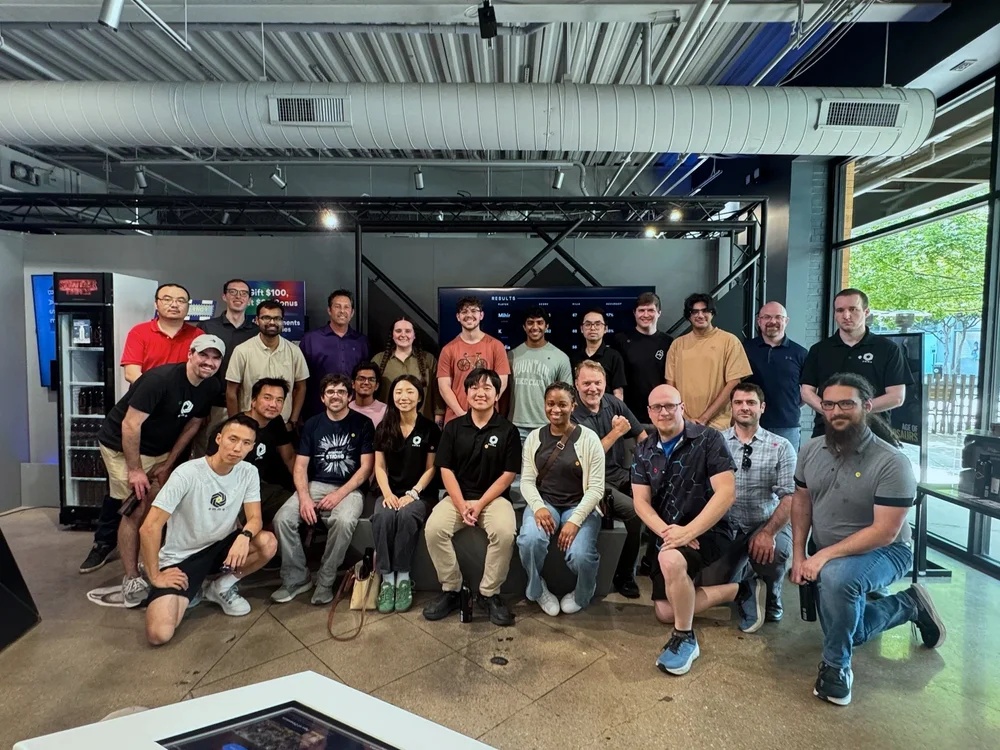
That breadth matters in a profile of Zheng because it keeps the scale of his responsibility in view. The founder who once introduced a glove concept now leads an organization offering several routes into the same tracking technology. The customer may care about a sensor, a developer interface or a mechanical constraint. The company has to make those concerns meet in equipment that fits the application.
The hands return, with different customers
By August 2026, Zheng was discussing robotics customers and a data collection glove. Ommo had announced a Series A financing round intended to support further development and manufacturing. The audience had widened from the early virtual reality proposition. The underlying interest in hands, movement and usable spatial information remained recognizable.
Ommo now describes a process connecting real world movement, simulation and verification back in the physical world. Human demonstrations can supply motion data. Measurements can help anchor a simulated environment. A later comparison can show where a machine’s behavior departs from the intended movement. For Zheng, the tracking work has become part of a larger effort to give physical AI a dependable spatial reference.
The appeal of that direction is concrete. A machine asked to manipulate something needs information about its own action while the action unfolds. More articulate instructions do not, by themselves, provide the missing coordinates. Ommo is offering a way to measure them. Its robotics work gives the original interaction question another audience, with its own tools and expectations.
The Pokéball opening now looks like a compact version of a much longer inquiry. Zheng began by asking why our gestures into digital space felt so indirect. His company followed the question into the equipment required to measure movement. The customers and product names have changed along the way. Somewhere in the middle of it all, a hand still moves, and a computer still needs to know where it went.