A power outage begins with an electrical fault. Then the secondary failures arrive. Customers call at once. A dispatcher tries to decide whether 200 reports are one broken device or 200 separate problems. Engineers need the network’s actual configuration, not last year’s tidy diagram. Crews need a route and a safe switching plan. The public wants an answer before the utility has one.
Milsoft Utility Solutions sells the software meant to make those people and systems agree. The privately held company, based in Abilene, Texas, is not a household name. Its users are the households’ electricity providers: electric cooperatives, municipal systems, public-power agencies, utility consultants and engineering programs. Milsoft says its products are used by more than 1,000 utilities and institutions around the world.
The company’s strongest idea is also its oldest. Build a detailed model of the distribution grid as it is constructed and energized, then let analysis, mapping, outage prediction, dispatch and field work consume the same model. It is less like buying a clever outage map than giving several utility departments one shared account of reality.
One model, three operating loops
The pencil became the product
In the 1980s, electrical engineer Wayne Carr was responsible for utility systems at Milford Engineering. Distribution analysis involved pencil, paper and calculator work. Carr began writing software to model circuits and sold it to electric utilities that wanted faster, safer planning. Leon Giesecke joined before finishing college to help with development, sales and support. Wayne and Carol Carr and Giesecke formed Milsoft Integrated Solutions in 1989.
This origin matters because Milsoft did not start by sketching a generic enterprise platform. It started with a specialized engineering calculation and followed the work outward. Luis Malave joined the development group in 1993. Outage management, interactive voice response, geographic information systems and field engineering followed. The addition of Automation Consulting in 2003 brought the Milsoft Utility Solutions name.
The enduring wedge was not a dashboard. It was a trusted circuit model that other jobs could use.
In 2019, the company moved further into the back office by acquiring Daffron & Associates for an undisclosed sum. Daffron brought customer information, financial management and work management. Milsoft could now pitch a much longer journey through a utility: model the feeder, manage a fault, notify the account holder, accept a payment and send the resulting work through finance.
What failed first was the workflow
The most revealing customer accounts are not about features. They are about small operational collapses. Warren Rural Electric Cooperative described unanswered calls and stacks of outage tickets before adopting automated customer service and DisSPatch. Milsoft’s TeleLink system absorbs routine account inquiries, outage reports and payments so representatives can handle the odd, difficult cases. During a storm, that is not merely call-center automation. The incoming calls become evidence for an outage-prediction engine.
The model can combine those calls with automated-meter events, SCADA data, billing records and the network topology. A cluster of signals downstream from the same protective device suggests where the break occurred. Dispatchers can represent switching changes, assign crews and publish selected information to a public outage viewer. FieldSyte carries the network and outage tickets onto mobile devices, including offline work when coverage is poor.
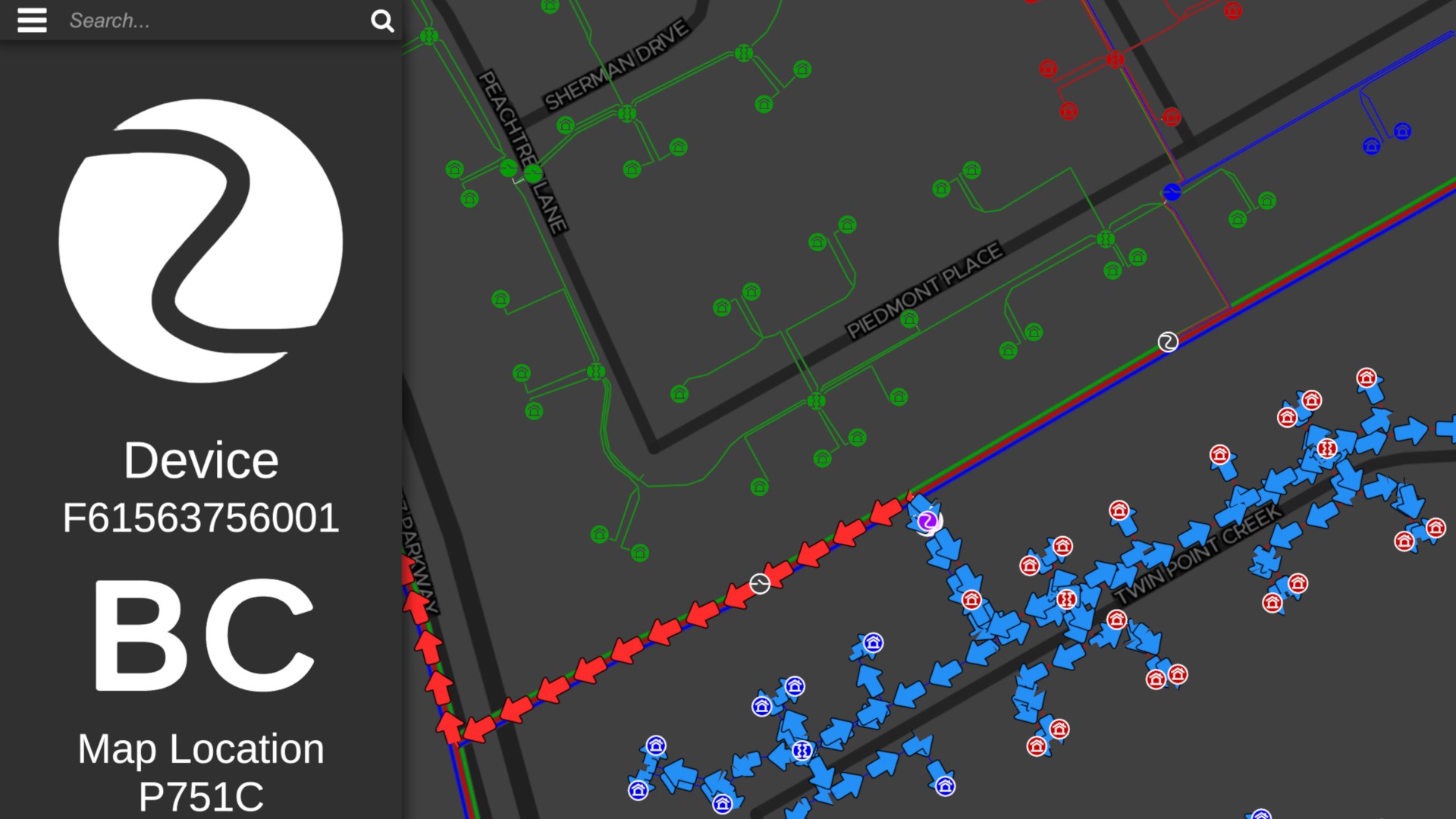
Data maintenance can fail more quietly. Kaukauna Utilities once updated its WindMil analysis model manually, about once a year for capital budgeting. The process was laborious and confidence in the model suffered. Its move toward ArcGIS Utility Network was intended to automate synchronization and make the model useful beyond the annual planning ritual. This is the unglamorous condition beneath every smart-grid promise: the digital grid must keep up with the physical one.
A suite that can be bought in pieces
Engineering analysis
WindMil and LightTable model loading, voltage, faults, protection and alternative system configurations.
Operations
DisSPatch, Crew Manager, outage prediction, switching, reporting and public outage views coordinate restoration.
GIS + field
WindMilMap, staking tools and FieldSyte maintain asset geography and send work to connected or offline crews.
Communications
Hosted IVR, texting and customer alerts automate calls, payments, planned-outage notices and restoration updates.
Enterprise
The Daffron-derived CIS, finance and work systems handle billing, cashiering, meters, accounts, assets and jobs.
Storm response
StormSyte supports mutual-aid coordination when a local workforce needs outside crews and shared logistics.
Milsoft sells both an integrated proposition and permission not to buy it all. A utility can choose the full environment or mix and match. That second part is important in a market full of durable incumbents. Utilities already own billing systems, meters, radio networks, vehicle trackers and SCADA. Replacing everything at once is expensive and risky. Milsoft documents integrations through MultiSpeak and other interfaces across AMI, CIS, mobile workforce, payments, statewide reporting and customer communications.
That interoperability is a competitive answer to Oracle, Siemens, Schneider Electric, GE Vernova, Hexagon and CGI at the broad end, and NISC, Futura, Survalent, OATI and ETAP in more specialized territory. Milsoft is smaller than the global conglomerates. Its counterweight is distribution-engineering depth, a modular catalog and decades inside public-power and cooperative workflows.
The rare receipt
Enterprise software prices tend to disappear behind demo forms. A 2024 City of Ames council packet provides an unusually clean window. Ames approved a five-year Milsoft agreement worth $252,686.39, including tax, for support from January 2025 through June 2029. The first half-year cost $28,076.27; each following full year is $56,152.53.
Hosted IVR, texting, customer outage alerts, DisSPatch and Crew Manager, plus WindMil, LightTable and a conversion tool.
Full-year figures include tax and an estimated $513.60 in variable call/text costs. This is one public support contract, not a universal price list.
Ames had purchased the original outage system in 2011. City staff called it critical to response time and reliability, then recommended a bundled renewal with no annual increase through 2029. That answers “what changed their mind” more honestly than a sales slogan: the utility was not changing its mind about whether to try Milsoft. It had accumulated 13 years of workflow around proprietary tools and judged continuity the practical, cost-effective choice.
Amicalola EMC shows a different expansion pattern. Already using Milsoft engineering analysis and outage management, it added Milsoft GIS to improve the circuit model, maps and facility data feeding those systems. The next product became easier to justify because earlier products had made a shared data foundation valuable.
The copyable playbook - and its boundary
For founders building vertical software, Milsoft offers a concrete playbook. Start with the technical object customers cannot afford to misunderstand. Let adjacent teams use that same object. Integrate with the equipment and databases already installed. Expand along the customer’s workflow, not along whatever category is fashionable. Finally, build feedback loops around real operators: Milsoft’s user conferences, training program and UserVoice forum, with more than 400 reported contributors, keep utility staff in the roadmap.
- 01Own the hard model. Milsoft began with electrical topology and analysis, where domain errors have physical consequences.
- 02Turn one source of truth into several jobs. Planning, outage prediction, dispatch and field work compound the model’s value.
- 03Make adoption incremental. Mix-and-match modules lower the political and technical cost of a utility-wide replacement.
- 04Sell readiness, not novelty. The product earns its keep when a storm compresses hours of normal work into minutes.
When this approach does not work
The shared-model advantage shrinks if a utility will not maintain accurate asset and connectivity data. A very small provider that only needs a public outage map may find the infrastructure excessive. A large multinational already standardized on another enterprise utility suite may prefer its incumbent. Integration also has conditions: identifiers must match, endpoints must be reachable, interfaces must be configured, and some legacy systems will still require custom work.
The company is still stretching the model. A 2023 agreement with the University of Pittsburgh’s Swanson School set out software research, graduate projects, code contributions and a student recruiting path. In 2026, Milsoft and Tri-Global Technologies demonstrated a six-minute staking workflow connecting an Asteri GNSS receiver to FieldSyte. One experiment reaches toward new algorithms; the other trims friction in a field task. Both fit the original habit: watch an engineer do difficult work, then shorten the distance between observation and action.
Milsoft’s story is not that software prevents storms or makes old infrastructure young. It makes a utility’s picture of the grid more coherent before the storm, then moves that picture through the people answering phones, studying faults and driving trucks. On an ordinary day, that coherence looks like fewer duplicate updates. On the worst day, it looks like knowing where to go.