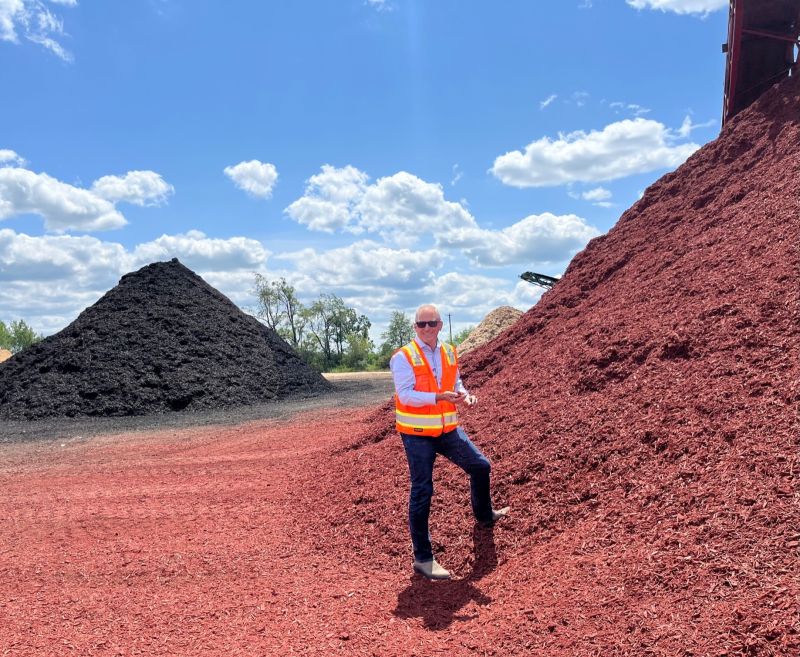
Mike Hachtman is standing beside a mountain of mulch. He has sunglasses on, a fluorescent vest over his shirt, and one foot planted against the slope. Behind him, a second heap rises beneath a blue Illinois sky. For an executive photograph, it is refreshingly short of executive furniture. The interesting thing in the picture has already finished one career and is getting on with another.
The setting is 48forty’s McHenry plant. Describing the photograph, Hachtman explains that pallets which can no longer be repaired can become useful wood byproducts. The heap makes his argument rather more efficiently than a conference slide: a pallet’s usefulness need not end when its days underneath a shipment are over.
Return journeys have occupied much of Hachtman’s working life. He founded Relogistics Services in 2011, building a business around the reusable packaging that travels through retailers’ distribution systems. A decade later, its acquisition took him into the chief executive’s chair at 48forty Solutions. Alongside that industrial story runs another, quieter one, involving Texas A&M, student opportunities and an Italian study center.
A pallet business and a scholarship might seem unlikely companions. Both, in Hachtman’s public life, raise a practical question: what allows something valuable to keep doing useful work? For the pallet, there are people to sort it and a destination for its next trip. For a student, the missing piece may be the money to participate.
Before the warehouse, the public square
Hachtman’s education brought together engineering and political science at Texas A&M. The combination offers a useful way into a career that has crossed industrial operations, public administration and trade associations. He belongs to the university’s class of 1986, an affiliation that would later appear on scholarship announcements beside his wife Anne’s class of 1990.
His earlier government work included serving as chief of staff at the Texas Railroad Commission. By 1997, he had entered the pallet industry. His career ran through Fraser Industries, PalEx and IFCO Systems, where he rose to senior vice president. The sequence matters because the later founder arrived with years spent inside the trade, its customer relationships and its changing corporate arrangements.
In March 2011, he appeared in a Reusable Packaging Association interview as IFCO’s senior vice president of sales and business development and the association’s vice chairman. He described an industry whose customers increasingly understood reuse. Acceptance brought a tougher assignment: providers had to keep demonstrating additional value. Reusable packaging still had to earn its place in the customer’s operation.
He also described a personal benefit of association work: learning about packaging systems beyond his own company’s offerings. Other members’ experience could suggest answers for IFCO customers. It is a modest, specific account of professional curiosity. A competitor’s knowledge could be useful, provided you were willing to listen.
The business after the delivery
Relogistics, founded that same year, focused on pallet and container management. Its work occupied the busy aftermath of delivery: the handling, sorting and return of reusable transport packaging. Retailers needed the goods arriving on pallets. They also needed a workable arrangement for the equipment left behind. Hachtman made that continuing obligation the center of a company.
The physical tasks explain why this business is about more than owning a supply of wooden platforms. Relogistics offers loading and unloading, pallet sorting and repair, container sorting and washing, and tracking and reporting. Each step has to happen somewhere, with labor and space assigned to it. The empty packaging has an itinerary, even when everyone else is looking at the merchandise.
At the time of the 2021 acquisition announcement, Relogistics served more than 60 U.S. locations. Its reported annual workload included 85 million pallets and 115 million reusable containers. Those are historical operating figures, a snapshot of the company Hachtman had built over its first decade. They describe repeated handling, rather than a count of objects he personally owned.
The distinction is useful. Relogistics sold the organization of a recurring job: managing packaging through another cycle of use. A distribution center could buy the work as a service, supported by reporting, rather than assemble every part of the operation itself. A business built around returns still has to deliver something immediate: room, availability and order at the dock.
- 01ReceivePackaging returns
- 02SortIdentify and inspect
- 03PrepareRepair or process
- 04ReturnReady for reuse
A reunion, with a larger job attached
In 2021, 48forty acquired Relogistics and named Hachtman CEO of the combined business. The deal joined a retailer-focused services operation to a pallet recycling network. It also reunited management teams that had previously worked under IFCO. For Hachtman, the transaction contained a familiar cast as well as a new title.
His May 2021 video message made that connection explicit. He was returning to an organization where he had spent his first 14 years in the industry. Relogistics would retain its name, logo and website. He explained the businesses’ different customer emphases and told existing partners that their company contacts would remain in place.
He also addressed the outside service providers on which the companies depended. A bigger network would continue to need their capacity and locations. That audience mattered: consolidation can look rather different from a small supplier’s yard than it does from the buyer’s boardroom. Hachtman’s message made room for those partners in the combined company’s plans.
Later that year, discussing consolidation, he said, “Smaller operators will continue to find opportunities in the market.” He described acquisitions as a way to fill geographic and service gaps, while acknowledging a continuing role for independent recyclers. His picture of the industry included companies that could compete for business and still help one another fulfill it.
“Smaller operators will continue to find opportunities in the market.”
Mike Hachtman · October 2021
Ninety days is longer than an orientation
The work depended on people staying long enough to learn it. In 2019, Hachtman identified departures during the first 90 days as a particular concern at Relogistics. His response began before hiring: candidates could watch employees performing the actual work before deciding whether to continue through selection. The job had a preview, with considerably less glamour than most recruiting brochures.
“Onboarding and retention are inexorably linked,” he said. New hires moved through training and productivity milestones, with managers recording progress. Leadership development extended toward shift leads and supervisors, the people in regular contact with hourly employees. Hachtman wanted them to explain the reason for the work as well as demonstrate its mechanics.
The approach placed responsibility on management to make expectations understandable. Recognition and opportunities to advance belonged in that explanation. His account was concerned with the ordinary details of a working week: how a person learns, who checks in, and whether the effort leads somewhere. A national service operation still meets its workforce one supervisor at a time.
The classroom had an Italian address
Away from the pallet business, the Hachtmans directed some of their giving toward education beyond a conventional classroom. In 2016, Mike and Anne provided $100,000 to endow two Texas A&M scholarships associated with the Santa Chiara Study Center in Castiglion Fiorentino, Italy. One carried their family name; the other honored Paolo Barucchieri, the center’s former director.
Both supported College of Architecture students fulfilling their semester-away requirement there. Hachtman spoke about Barucchieri’s lasting influence on Aggies who had studied in the town. The gift helped other students gain access to European art and architecture firsthand. His eldest son, Will, was then an environmental design student preparing to study at the center in spring 2017.
The intention had a second life closer to home. Mike and Anne also established an endowed fund supporting Texas A&M’s Aggie Experience Fund, alongside other donors. The program helps students pay participation costs for recognized organizations and activities. Its scope includes student leadership, campus programs, clubs and other experiences whose price can stand between an interested student and an opportunity.
The first grants reached 346 students in spring 2022. The figure belongs to the overall program, supported by several gifts. It gives the idea a useful scale: hundreds of students received help taking part in the life around their classes. The learning opportunity could be on campus, with no passport required.
By fall 2026, recipient Yashaswini Paleru had joined four engineering organizations, including TAMU RoboMasters, with the fund’s support. An endowed gift had become participation in specific groups, with people to meet and skills to practice. There is a pleasingly practical quality to that outcome. An invitation becomes more useful when someone can afford to accept it.
The return trip, and the handover
Hachtman’s industry commitments also extended beyond his companies. He served as chairman of the Reusable Packaging Association and chaired the National Wooden Pallet and Container Association in 2021. The roles placed him among businesses with overlapping interests in packaging, research and advocacy. His public LinkedIn activity later included industry visits and support for wood packaging’s case in Washington.
In 2022, for example, he described visiting all six Pallet Consultants locations after the company joined 48forty. The following year’s McHenry photograph offered a different view of the same industrial world. Together, the posts show the places behind the corporate names: teams at individual locations, and the material that passes through their hands.
His tenure ended during a consequential change at the parent company. On January 15, 2026, 48forty announced a restructuring that reduced its debt by more than 80% and brought in $75 million of new capital. The announcement also confirmed Hachtman’s retirement and named Dave Russell interim CEO. In July, Tony Brooks became chief executive.
The restructuring belongs in the account alongside the acquisitions and operating scale. It marks the financial circumstances of the handover, without turning a company balance sheet into a claim about Hachtman’s personal finances. His farewell thanked employees, customers and partners. Nearly five years after becoming CEO of the combined business, he was passing its management on.
The McHenry picture remains an apt image to leave with. Hachtman stands beside material that has carried goods, worn out and found another use. Elsewhere, the funds he and Anne helped establish are paying toward students’ next experiences. The settings differ, but the practical interest persists: arranging the next useful journey, and making sure there is a way to take it.
Follow the next journey
Profiles, conversations and further reading.
- Mike Hachtman on LinkedIn
- Relogistics: services and operations
- Watch Hachtman’s 2021 industry video message
- The 2021 conversation on pallet-industry consolidation
- Employee training and retention, in detail
- The scholarships at Santa Chiara
- The Aggie Experience Fund
- The January 2026 retirement and restructuring announcement
- Tony Brooks’s July 2026 appointment