The order arrived on the fax machine. In 2003, Mike Cannon-Brookes and Scott Farquhar discovered that American Airlines had bought their software without either founder having spoken to anyone there. For two young Australians trying to sell across the Pacific, this was useful information. A customer could find the product, decide it solved a problem and pay for it while its makers were asleep. The sales meeting had apparently been cancelled. Nobody seemed to mind.
There are several ways to read what followed: as the rise of Atlassian, as a long partnership between university friends, or as the making of a software billionaire who began interfering with the electricity business. Start with the fax, though, and a particular habit comes into view. Cannon-Brookes keeps asking whether an elaborate arrangement is necessary. Sometimes the answer becomes a product. Sometimes it becomes a very expensive argument.
A computer at the back of the catalogue
His first computer came through an unusual route. His father’s banking career took the family around the world; Mike went to boarding school in England and accumulated frequent-flyer points travelling between school and Australia. Offered a rewards catalogue, he found little use for its grown-up attractions. At the back was an Amstrad PC20. A child who had no need for wine could make rather better use of a computer.
He typed programs from magazines and played games. Later, in Sydney, he wanted to become an architect. A scholarship to study business information technology at the University of New South Wales helped send him elsewhere. The interesting continuity is the attraction to making something. The material changed from imagined buildings to software; the wish to arrange things more satisfactorily survived.
At UNSW, Cannon-Brookes met Farquhar. They entered the same scholarship course in 1998. By 2002 they had founded Atlassian, financed with a $10,000 credit card. Their initial business supplied support for other companies’ software. Answering questions at inconvenient hours offered a brisk education in the shortcomings of that arrangement.
The bug tracker they were using irritated them, so they made one themselves. Jira emerged from the work they were already doing. Its name played on Gojira, the Japanese name for Godzilla, with a nod to the existing tracker Bugzilla. A monster-film joke became part of the administrative vocabulary of offices around the world. Corporate software occasionally permits itself a sense of humour, provided it can still track the ticket.
Sydney was part of the business model
Selling enterprise software from Australia meant confronting distance immediately. The customers they wanted were often in America. Building a conventional sales operation would cost money the founders could otherwise spend on the product. They chose to make buying simple enough that the customer could proceed alone.
The American Airlines order made that choice tangible. The idea had crossed the ocean before a salesperson did. It is easy to forget how much of a business can be an inherited ritual: the introduction, the presentation, the negotiation, the wait. Remove enough of those steps and a small company gets a different way to compete.
Atlassian added Confluence in 2003 and reached its thousandth customer in 2005. The two founders won the Australian EY Entrepreneur of the Year award in 2006. The company listed on Nasdaq in 2015 under TEAM, an unusually literal stock-market shorthand for what it sold. Trello joined in 2017; Loom followed in 2023. The product family expanded from tracking software issues to helping people organise, explain and coordinate work.
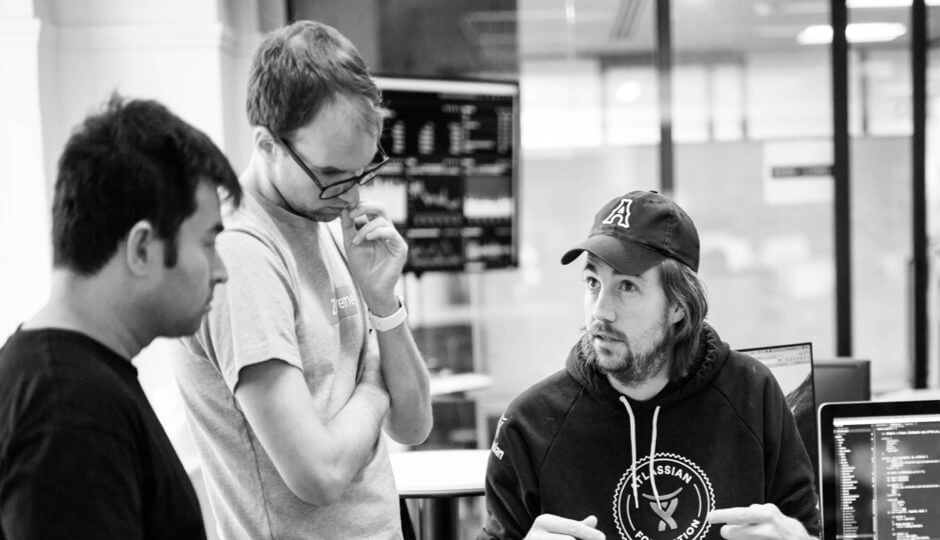
Cannon-Brookes has remained based in Sydney. In September 2026 he described a working day beginning before a 5 a.m. laptop opening, with coffee already accounted for. Australia gives him a view of customers outside Silicon Valley’s immediate orbit. It also supplies the time-zone arithmetic. An independent vantage point can come with a rather antisocial alarm clock.
For more than two decades, Farquhar shared the chief executive job. He stepped down at the end of August 2024, leaving Cannon-Brookes as sole CEO from September. Farquhar continued as a director and special adviser. The change matters to the story: the partnership that built the company remains part of its history, while responsibility for the operating decisions now sits with one chief executive.
A public question, a hundred-day answer
In March 2017, Cannon-Brookes took an interest in Tesla’s claim that batteries could help with South Australia’s electricity problems. He challenged the proposition on Twitter and offered to work on funding and political support if Tesla could deliver. Elon Musk answered with a deadline: installation within 100 days of signing the contract, or the system would be free.
Here was an unusually legible infrastructure proposal. People who would never read a technical tender could understand a clock. The exchange turned a difficult energy debate into a question with a number attached, and a publicly visible promise.
Cannon-Brookes helped bring attention and support to the proposal; Tesla and its partners had to build it. The resulting Hornsdale Power Reserve entered operation in December 2017, ahead of the promised deadline. Giving the software founder his part in the story requires keeping the other participants in the picture. A tweet can open a door. Engineers, contractors and governments still have to walk through it.
“Give me 7 days to try and sort out politics & funding.”
Mike Cannon-Brookes, Twitter, March 2017
The episode also explains why energy became more than an outside interest. Software had taught him that an awkward process could be redesigned. Electricity presented a much larger set of awkward processes, with capital, regulation and physical equipment attached. The attraction is understandable. So is the difficulty: a grid has consequences that cannot be fixed by shipping another version overnight.
The shareholder who opposed the split
By 2022, his involvement had reached AGL Energy. Cannon-Brookes and Brookfield made takeover approaches, which AGL rejected. A different route followed. Through Grok and its affiliates, he acquired an 11.28% interest and campaigned against AGL’s proposed separation into retail and generation businesses.
The distinction was practical. A failed bid leaves someone outside the company. A substantial shareholding gives that person a vote and a platform from which to ask other owners to join. Cannon-Brookes argued that the split would undermine value and make a faster transition away from coal harder. AGL’s board favoured the demerger. The disagreement concerned what the company should become, and how quickly.
On 30 May 2022, AGL withdrew the plan, saying it was unlikely to secure the required shareholder support. Its chairman and chief executive announced departures. Later that year, all four director candidates backed by Grok were elected. The campaign had moved from proposing a purchase to changing the board of a company he did not control outright.
A minority holding became the starting point for a successful campaign against the proposed demerger.
This was a less tidy form of intervention than a hundred-day promise. It involved shareholder persuasion, board appointments and competing commercial judgements. The result demonstrated that ownership can be an instrument of climate advocacy. It also made his position examinable: he had committed capital to the argument, and the investment would have to live with the outcome.
Sunlight has a long way to travel
SunCable takes the export idea literally. The Australia-Asia PowerLink proposal would generate solar electricity in the Northern Territory, supply customers in Darwin and send power to Singapore through subsea cables. Grok completed its acquisition of SunCable’s assets in September 2023 after the company’s administration and a dispute between its earlier backers.
Singapore’s Energy Market Authority granted conditional approval in October 2024 for imports of 1.75 gigawatts. The proposed subsea route is approximately 4,300 kilometres. Those figures give the ambition dimensions: a substantial electricity supply travelling a distance that makes a software download look comfortably uncomplicated.
Approximately 4,300 km of proposed subsea cable. Conditional approval is a development milestone; the project remains a proposal.
There is a large distance between permission to develop a proposal and electricity reaching a customer. Singapore’s approval required further technical and commercial conditions, together with approvals in the relevant jurisdictions. The regulator’s 2024 announcement placed expected commercial operation after 2035. Financing, construction and delivery remain the work through which the promise must pass.
Cannon-Brookes’s aspiration is for Australia to become a renewable energy exporter. SunCable offers a concrete expression of it, but an unfinished one. Keeping the future tense is essential to understanding this part of his life. His software business has products people can buy today. His electricity export project asks investors and governments to back what might be built.
Even the team is being redesigned
Back at Atlassian, the next change is already under way. On 6 October 2026, in Amsterdam, Cannon-Brookes introduced the Agentic Multiplayer Protocol, or AMP. The proposal gives AI agents identities, permissions and a visible place alongside people in shared work. Atlassian wants the information accumulated in its products to help those agents act with context.
The company is making a familiar bet in a different technological setting. Jira once helped people see what needed doing and who was doing it. AI agents add another participant to that arrangement. The questions of ownership, visibility and review become more pressing when the participant can act automatically.
There is a harder side to the transition. In March 2026, Cannon-Brookes announced cuts of approximately 1,600 jobs, about 10% of the workforce, to fund further investment in AI and enterprise sales and strengthen the company’s finances. He acknowledged that AI changed the skills and number of roles required in some areas. An ambition to improve teamwork does not make the consequences of a reorganisation disappear.
Elsewhere, his interests have kept a recognisable attachment to teams. He joined the Utah Jazz ownership group in 2020. In 2021 he bought a third of Blackcourt, the company holding 75% of the South Sydney Rabbitohs. The sports investments place him alongside figures such as Ryan Smith, Russell Crowe and James Packer. They also give the spreadsheet an occasional scoreboard.
Giving has a structure too. Atlassian’s founders committed a portion of equity early, and the company contributes 1% of profit, equity, tools and employee time to social impact. Its Foundation works with nonprofits, including education organisations. Boundless Earth, which Cannon-Brookes founded, combines philanthropy, investment and advocacy around Australian climate solutions. These are arrangements meant to keep operating beyond a single donation.
The fax machine is a long way behind him now. Yet the live questions have a family resemblance to the one it answered: can the customer buy more easily; can a battery arrive sooner; can a shareholder change a company’s direction; can Australian sunlight find a market overseas? Cannon-Brookes has accumulated the resources to pursue much larger versions of those questions. The interesting part is watching what happens after he asks.