A pair of blue jeans is an oddly demanding customer. It must look familiar on the rack, soften with wear, and fade in ways people have learned to love. Change its color too much and you have made a different product. Michelle Zhu helped build a company around a more particular ambition: keep the blue, change how it gets made. The wardrobe could remain pleasantly oblivious while the factory received something new.
For Zhu, the factory was never an abstraction at the far end of a shopping trip. Her parents ran an apparel business. Childhood visits to garment manufacturers in China showed her the industry behind the clothes, including the discolored waterways around production sites. Years later, as Huue’s co-founder and founding CEO, she returned to that world with an unusual business partner: a scientist teaching microbes to make indigo.
There is a pleasing reversal here. Fashion sells the next thing. Zhu and her co-founder, Tammy Hsu, were trying to make a familiar thing differently. Their work depended on a kind of invisibility: a dye that could enter existing manufacturing without making the jeans announce that a biotechnology company had been involved.
A childhood behind the clothes
Zhu’s family moved from China to the United States when she was three. Her parents established apparel brands in Los Angeles, and denim figured prominently in their streetwear business during the late 1990s and early 2000s. Summer trips back to China included factory visits. The business had an appealing public face, but she also saw what making the merchandise left behind.
That background gave her a connection to fashion without making her career inevitable. She earned a bachelor’s degree in business administration at Washington University in St. Louis. Her working life developed through strategy and operations, across consumer products and technology. The route back to apparel would run through the business side of a laboratory.
Hsu brought the scientific opening. At the University of California, Berkeley, she had been working on a biological approach to indigo production. Fashion companies were already asking about the research. When she shared her thesis work with Zhu, the prospect of turning it into a company gave Zhu a reason to return to the industry she knew from childhood.
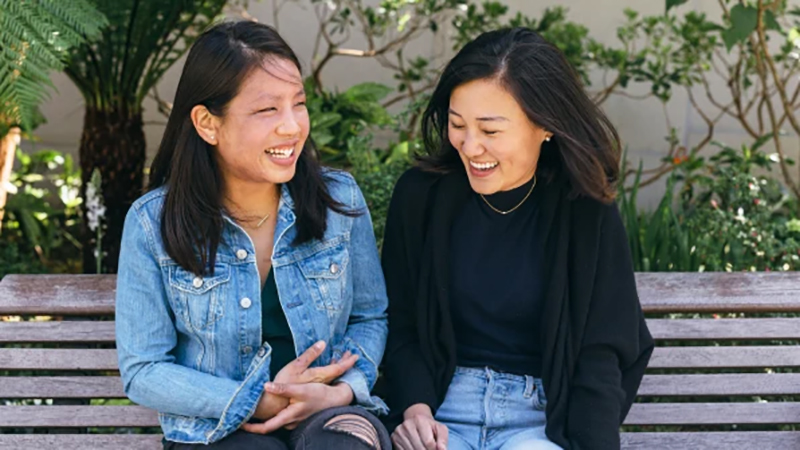
The businessperson in the biology company
The division of labor mattered. Hsu developed the core technology; Zhu handled the work that makes a promising technology into a business. Fundraising, operations, and business development fell within her remit. In a 2020 account of the young company, she was its sole nontechnical team member. Someone had to make the business work while the scientists made the blue.
Huue emerged in 2019 from that pairing. The founders joined IndieBio, the biotechnology accelerator, and started testing whether laboratory results could travel into textile production. Complementary expertise gave them two different questions to answer at once: could the biology deliver, and could an established industry use what it delivered?
Their partnership is an instructive detail in Zhu’s story. Her contribution did not require presenting herself as the inventor of the science. It required understanding what the science might become, bringing resources to it, and connecting it with the people who could put it to work. The boundary between those jobs is where a good deal of company building happens.
A deadline dyed blue
One early test had a date attached. During the IndieBio program, Huue worked with Berkeley Lab’s Advanced Biofuels and Bioproducts Process Development Unit, or ABPDU, to produce enough indigo for a demonstration. The goal was tangible: blue cotton yarn made using industrial dyeing equipment.
The collaboration moved quickly. Work began on April 9; the laboratory delivered purified product by May 30. By June 17, the team had enough to dye yarn, ahead of the June 25 Demo Day. Zhu presented that yarn at the event. A piece of thread made a more demanding exhibit than a slide promising that thread would eventually exist.
- APR 09Scale-up project begins
- MAY 30Purified dye delivered
- JUN 17Enough dye for cotton yarn
- JUN 25Prototype at Demo Day
An early collaboration with Berkeley Lab’s ABPDU.
The episode captures the practical work underneath the biotechnology story. A useful pigment has to survive the journey from a research bench to equipment designed to make fabric. For Zhu, the business case could become stronger each time the team put a physical sample in front of someone.
Jeans have opinions
The biology starts with a question about nature: how does a plant make a particular color molecule? Huue studies those pathways and engineers microbes to reproduce the relevant chemistry. Fed sugar, the microbes produce pigment through fermentation. The pigment can then be recovered for use as dye.
Indigo gave the company a precise target. A blue colorant alone would not do. The objective was a bio-identical indigo that preserved the performance denim manufacturers expected. Familiarity was a product requirement. A customer buying jeans was unlikely to offer generous allowances because the dye had an interesting origin story.
“We are creating a biosynthetic solution that is a one-to-one drop-in replacement into the textile supply chain.”Michelle Zhu, 2022
That phrase, drop-in replacement, carries much of the commercial logic. Huue wanted manufacturers to use a different source of indigo within their existing production systems. Avoiding a requirement to replace equipment could make adopting a new ingredient more practical. The scientific change was substantial; the requested change in factory behavior was deliberately restrained.
Nature’s pathways↓02
Engineered microbes + sugar↓03
Fermentation & pigment recovery↓04
Indigo for denim production
In her conversations about the work, Zhu repeatedly returned to performance and collaboration. A textile supply chain contains people with equipment, specifications, schedules, and customers of their own. Persuading them takes more than a persuasive environmental argument. A new material has to earn its place in their working day.
From a sample to somebody else’s machines
Capital and partnerships helped Huue pursue that translation. In 2020, the company won the U.S. deeptech category of the Female Founders Competition backed by M12, Mayfield, and Pivotal Ventures. The founders described plans to use the funding to expand the team and meet the needs of their first brand partners.
Recognition followed. Zhu appeared on Inc.’s 2021 Female Founders 100 and the 2022 Forbes 30 Under 30 list for Manufacturing and Industry. Huue’s technology was included among TIME’s Best Inventions of 2021. Those distinctions brought attention to a business whose product might otherwise remain unnamed on a clothing label.
In July 2022, Huue announced a $14.6 million Series A led by Material Impact. HSBC Asset Management’s Climate Tech VC participated, alongside existing backers including SOSV’s IndieBio, iGlobe, Jennifer Doudna, and Jamie Cate. The purpose was commercial scale-up. Fermentation had to become production, with the consistency and capacity that industrial customers require.
By 2023, the story had reached a further checkpoint. Zhu announced a partnership with Artistic Garment Industries, known as AGI Denim, and designer Jonathan Cheung to bring Huue’s indigo into commercially available fabrics for the first time. For a founder returning to apparel, fabric was a particularly apt measure of progress. The business was coming back around to clothes.
The other thing she was building
Zhu’s account of company building also pays attention to the people doing it. Her professional interests include teams that combine high performance with consideration for the individuals involved. Former colleagues have publicly described her accessibility, willingness to listen, and attention to employees. Those observations give some substance to a leadership vocabulary that can otherwise become decorative.
When she announced her departure from Huue in December 2024, she included company values alongside technical and financial milestones. One was “curiosity above knowing.” In a company working across biology, textiles, and commercial development, that is a useful instruction: nobody arrives knowing all three.
Her departure note also described thousands of meters of fabric produced on industrial machines and $25 million in capital raised during the journey. She was closing a chapter after nearly six years, with the company continuing under new leadership. The accounting included both what the team had made and how she hoped they had worked together.
Leaving the blue in place
After Huue, Zhu worked independently with founders on strategy and operations. In a subsequent public career update, she announced that she was joining the commercial team at Ode with Anthropic, working with companies on AI transformation. She described bringing empathy and a concern for commercial outcomes to her consulting work, and wanting to get closer to a fast-changing technology.
It is a change of subject with a recognizable occupational thread. At Huue, Zhu worked between a technical possibility and an organization’s ability to use it. Her later work again puts business adoption in the foreground. The interesting part of the technology has company: the people expected to make something useful with it.
There is also Daisy, the dog Zhu credited in 2020 with reminding her to get outside and enjoy quiet time. The detail belongs in the story because its scale is so wonderfully modest. A founder can spend the working day contemplating industrial production and still need a dog to suggest a walk. Even a business devoted to color benefits from looking up occasionally.
Follow the thread
More conversations, company work, and career updates.
Huue’s website ↗Michelle Zhu on LinkedIn ↗Listen: Using Bacteria to Dye Jeans ↗Listen: Conscious Chatter, episode 274 ↗The early yarn demonstration ↗Zhu’s Huue departure announcement ↗