Lisa Drakeman’s twenty-fifth wedding anniversary found her in a windowless London conference room, surrounded by bankers, lawyers, and the documents required to take a company public. Around midnight, she opened a bottle of sparkling wine. The celebration was brief. Everyone went back to work.
It was 2000. Genmab, the Danish company she led, was preparing its initial public offering. The financing window could close; the commas still needed attention. A silver anniversary had somehow acquired a legal team.
Later that week, a lawyer took Drakeman, her husband Donald, and members of the IPO group to a café in Shepherd’s Market. She explained that she did not particularly like wine. The first bottle did little to change her opinion. The lawyer tried again, choosing a bottle of Jacques Prieur 1989 Montrachet.
The second bottle gave her a new subject.
“One taste prompted an epiphany: I did not dislike wine. I just had not been drinking the right wine.”
Lisa Drakeman, recalling the London dinner
The observation was narrow enough to be useful. She had mistaken a limited experience for a settled preference. Years of tasting and study followed. Eventually, she would teach other people to find the styles they enjoyed. The story of the bottle belongs alongside the story of the offering: each opened a door she had once had little reason to imagine walking through.
A doctorate with an unexpected destination
Drakeman’s original classroom was at Princeton. Her doctorate, awarded in 1988, concerned the history of American religion. She taught there before moving into business. A biotechnology chief executive was an unlikely entry on that particular syllabus.
Her husband had helped found Medarex. In 1990, while she was teaching religion, he asked her to help at the company. She went on to lead business development. When Danish investors were establishing Genmab, they asked her to head the new venture.
In a later account of her career, Drakeman credited graduate study with sharpening her analytical skills and teaching her how to acquire unfamiliar knowledge. A doctorate gives you a subject to investigate. It also gives you repeated practice at discovering how much you still need to understand.
She eventually helped Princeton graduate students consider careers beyond universities. Entrepreneurship workshops she helped organize fed into Pathways with a Ph.D., an earlier initiative in the university’s wider career-development efforts. Her own experience gave that work a practical premise: a degree’s field need not determine every field in which its holder can work.
“I didn’t know I was an entrepreneur. Working in biotech was a happy accident!”
On discovering entrepreneurshipThere is something refreshing about the admission. The retrospective business biography often arranges every childhood activity into evidence of a coming CEO. Drakeman leaves room for surprise. A person can discover an aptitude after accepting the work.
The work behind the billion
Genmab was founded in 1999. Its early life required the ordinary machinery of a company taking shape: investors, partnerships, people, decisions, and enough capital to keep the work moving. Drakeman became its founding chief executive and a board member.
In June 2000, the company raised $40.5 million in a private financing led by Index Ventures. New investors included Apax Europe IV and the Lombard Odier Immunology Fund. The transaction gave the young company more resources and a broader investor base before its public offering later that year.
By the end of 2000, Genmab reported more than DKK 1.75 billion, then equivalent to approximately $220 million, in cash. For a business founded the previous year, that was a substantial change in its ability to plan. The late-night London paperwork had consequences well beyond the conference room.
Capital raised during her tenure as Genmab’s founding CEO, which ended in June 2010.
Genmab received the international category of the James D. Watson Helix Award in 2005 and Scrip’s Biotechnology Company of the Year award in 2007. Drakeman received BioNJ’s Sol J. Barer Award for Vision, Innovation and Leadership in 2009. She retired from the CEO role and the board on June 15, 2010.
At Cambridge in 2013, she discussed a less ceremonial part of entrepreneurship: being refused money. You can believe you have done the work well and still find that an investor considers the project a poor fit. The refusal arrives without necessarily resolving the merits of the idea.
Her advice was to “keep going.” She also offered a question: would abandoning the project leave you unhappy because something important remained unfinished? The question gives persistence a reason. It asks the founder to examine what is at stake personally before returning to another pitch.
Back to school, with a different syllabus
After retiring, Drakeman settled in Hilton Head Island, South Carolina, and took wine study seriously. She became a Certified Sommelier through the Court of Master Sommeliers and a Certified Specialist of Wine through the Society of Wine Educators. Her WSET Diploma in Wines came with Merit, following an Advanced Level qualification with Distinction.
Her website, Find Your Wine Styles, addresses the diner who becomes nervous when the sommelier approaches. That is a useful audience to remember. A restaurant list can make a perfectly articulate person feel they have wandered into an oral examination for which everyone else received the reading.
Drakeman’s teaching makes the questions smaller and more manageable. Her Sauvignon Blanc guide compares styles across regions and provides phonetic help with French names. It includes easy food pairings, too. Someone can move from uncertainty to a glass and a plate without first mastering an entire vocabulary.
Her short videos cover opening sparkling wine, recognizing tannins, serving temperatures, and whether a bottle needs aging. The format treats everyday uncertainty as a reasonable starting point. Expertise becomes useful when it can travel across the table.
The dinner is part of the lesson
At Cambridge, Drakeman has combined her two professional educations in a single evening. She described speaking as a former CEO at the business school’s annual biotechnology entrepreneurship event, then leading the wine dinner that followed.
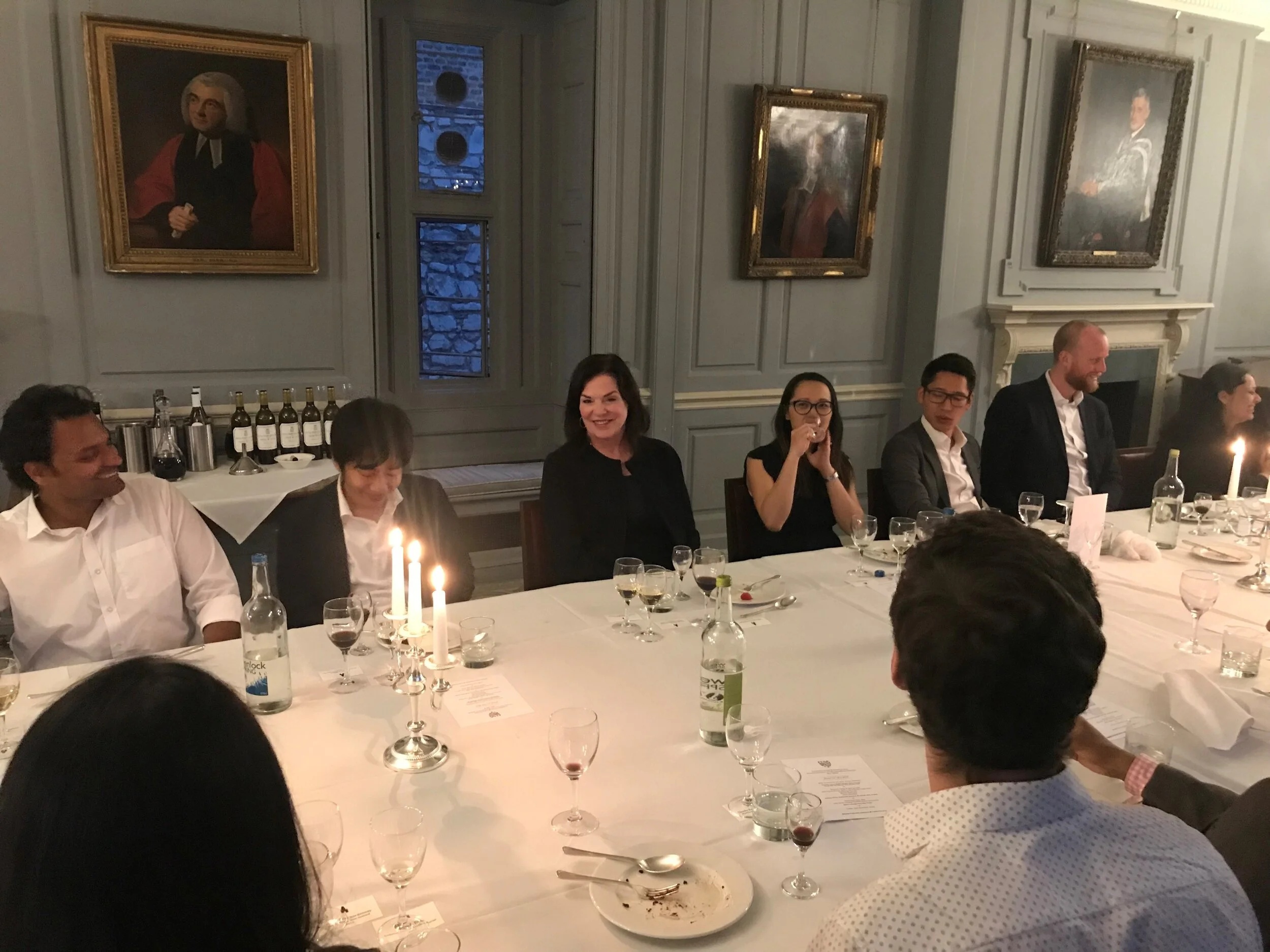
The seventh annual event, in 2019, focused the meal on how social interaction can strengthen business relationships. Gonville and Caius College supplied a setting in which she could discuss port’s place in British university traditions. The dinner was part of the curriculum.
At Wadham College, Oxford, she began leading tastings in 2016. Those evenings brought students and academics together around comparisons: a grape expressed in different places, or different styles set alongside one another. Rather than tell an audience what it ought to like, the format gave people something to notice.
Closer to home, Convivio began offering wine dinners in 2012. Its declared combination is friendship and wine. The 2019-2020 series paired wines with menus created by Matt Jording, chef and owner of Hilton Head’s Sage Room. A visit from Master Sommelier Michael McNeil brought another teacher to the table.
The local gatherings also became something that could travel. Virtual Princeton alumni tastings connected participants across regional associations. By 2023, Drakeman was sharing practical guidance with other organizers: select a theme, find an expert, prepare a tasting guide, and think through the differences between an online event and an in-person dinner.
The guidance is pleasingly concrete. A host needs a location, a theme, wines that fit it, and some thought about how guests will take part. An online tasting removes the need for geographic proximity. An in-person gathering offers the pleasure of being together, while bringing the less romantic questions of reservations, attendance, and payment. Even a happy hour requires somebody to think about the details.
Her concern with bringing people together extends beyond wine. Through friendships with older Princeton alumni, she became an honorary member of the Class of 1935 and helped sustain its reunion traditions. It is an appealing footnote to a career full of dates: she belongs to a class that graduated decades before her own doctorate.
History returns to the table
Retirement from Genmab did not end her interest in how companies work. In 2022, Oxford University Press published From Breakthrough to Blockbuster: The Business of Biotechnology, written with Donald Drakeman and Cambridge scholar Nektarios Oraiopoulos. The book examines entrepreneurial firms in an industry with substantial costs and uncertainty.
The author’s stated hope was that the book would help readers decide whether entrepreneurship suited them. Experience had become material for another kind of teaching. The question of who might become an entrepreneur remained open to people who had never expected the title.
In September 2025, she and Donald published “The Wine Key to the Constitution.” Their essay followed Thomas Jefferson’s wine correspondence into the history of church-state arguments. In November, “A Toast to Religious Exemptions” paired another historical discussion with Thanksgiving wines.
Those essays also preserve an element of play. A historical argument can arrive with a suggestion for the dinner table. Readers are invited to consider a document and a bottle within the same sitting. It is a recognizable extension of the university dinners: a serious subject introduced through an occasion people might actually look forward to.
These collaborations bring the historian and the wine educator into the same piece of writing. The business career sits between them, with its own habits of asking questions, evaluating evidence, and explaining an unfamiliar subject to someone else.
Drakeman once thought she knew what she thought about wine. A different bottle complicated the answer. She gave the complication years of attention. For someone whose working life has crossed so many fields, that may be the most recognizable habit of all: finding that there is more to learn, and making time to learn it.