Five or six new colleagues. A coffee. Permission to ask the chief executive anything. Jan G. J. van de Winkel has described holding these meetings every two weeks, with an understanding that the conversation stays in the room. For a company builder whose working life stretches from a Dutch university to international boardrooms, it is a remarkably modest piece of equipment. No elaborate leadership apparatus is required. Someone does, however, have to listen.
By 2026, van de Winkel had spent more than a quarter of a century at Genmab, the company he helped establish in 1999. He became president and chief executive in 2010. Those dates supply the conventional outline: scientist, founder, executive. The coffee meetings offer a more interesting way into the story. As his responsibilities have expanded, he has kept returning to an encounter small enough for an individual voice to carry.
A founder can become a distant historical figure inside his own company. His name survives in the anniversary presentation; somebody else handles the questions. Van de Winkel’s approach gives newcomers a chance to meet the person behind the title. The invitation is simple. The consequences depend on whether people feel free to take it up.
The professor takes a second job
His education began with sustained attention to science. He completed a master’s degree at Radboud University in Nijmegen in 1985 and a doctorate there in 1988. Utrecht became another enduring base: he has held a professorship there since 1996. His career has crossed institutional boundaries while retaining that academic connection.
There is a pleasing complication in a chief executive who remains a professor. One position asks him to make decisions and carry responsibility for them. The other belongs to a world in which questioning an answer is part of the work. Holding both titles does not automatically reconcile those demands. It does place them side by side on the same business card.
His route into industry included Medarex Europe, where he served as vice president and scientific director before Genmab. That experience gave him an international setting in which to move beyond academic work. The future founder was learning how a scientific team operated inside a business, before helping to create a business of his own.
A company assembled from a team
Genmab’s origin has a detail that complicates the usual startup mythology. Van de Winkel’s research team had already worked together at Medarex Europe. The new company drew on an existing group, with European investors helping to establish a different business direction. Expertise and working relationships arrived together.
Looking back in 2017, he described the distinction in commercial terms: Medarex concentrated on its technology platform; Genmab concentrated on products. The difference mattered because it determined what the organization would try to become. A platform can support somebody else’s enterprise. Building around products creates a different set of ambitions and obligations.
He spent Genmab’s first eleven years leading its scientific work before taking the chief executive’s job. That is a long apprenticeship inside one institution, particularly for somebody who helped found it. His story contains fewer abrupt reinventions than the job titles suggest. Each role grew out of knowledge accumulated in the previous one.
That continuity makes the 2010 transition worth pausing over. A scientific founder moving into general management brings detailed knowledge of the work. He also inherits decisions that extend well beyond his original expertise. The subject has changed, even if many of the colleagues are familiar.
The office has a floor plan, too
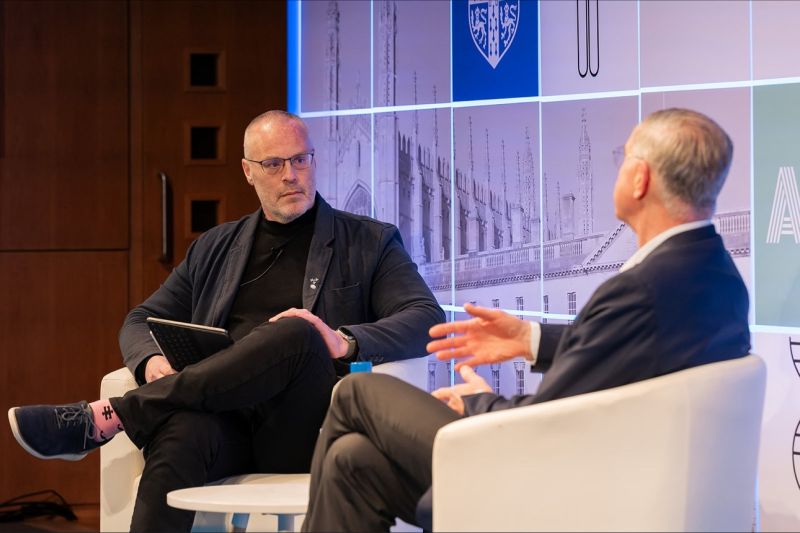
His interest in contact extends beyond scheduled meetings. He has described spreading management across different floors, encouraging encounters between leaders, researchers and other employees. The physical arrangement carries a proposition: people should have opportunities to exchange ideas during the ordinary working day.
It is a practical response to a familiar organizational problem. Put everyone with authority together and they can become very efficient at talking to one another. The rest of the company develops a separate conversation. A staircase cannot solve hierarchy, but a floor plan can make certain encounters more likely.
Van de Winkel has also made unusually specific claims about knowing colleagues personally, saying he knew nearly all their names and, in many cases, the names of family members. Those are his own descriptions of his attentiveness, rather than an independent census of his memory. What matters to the portrait is that he considers such knowledge relevant to leadership.
There is something quietly demanding about that preference. An organizational chart can be updated by somebody else. Remembering a person requires an investment of attention. His chosen examples make the everyday social life of the company part of the executive’s work.
A culture with a reply button
In a public reflection on company culture in 2022, he wrote about trying to answer colleagues’ questions and emails, acknowledging their time and effort. He also encouraged other members of the global leadership team to hold coffee and lunch sessions across departments. The habit was something he wanted others to practise.
That detail changes the scale of the idea. A founder’s personal accessibility has a natural limit. A practice shared by other leaders can reach further. The useful question becomes whether contact survives as responsibility spreads across more people, locations and layers of management.
His own account connects culture with how work is done and why people do it. The emphasis is consistent with the way he talks about teams: individual ambitions have to coexist with a common purpose. It is a view of company life in which responding to an email belongs in the same conversation as setting a strategy.
“never stop learning”
Jan van de Winkel, 2025
The student keeps the corner office
Asked in 2025 what he would tell aspiring entrepreneurs and scientists, van de Winkel put continued learning among his central recommendations. Curiosity and adaptability run through his account of leadership. He presents a changing world as a reason to keep revising how one thinks.
The advice has particular weight coming from somebody with such a long tenure. Longevity can produce an impressive archive of useful experience. It can also make an old answer feel more reliable than it deserves. His stated preference for learning leaves room for the possibility that yesterday’s successful approach will need adjustment.
He has described Genmab growing from fewer than twenty people in its early period to more than 2,600 colleagues by late 2025. That dated comparison helps explain why a founder would need to remain a student. The organization at the later end of that span presents a different management problem from the one at the beginning.
The sentiment also makes a lifetime achievement award slightly awkward in an agreeable way. Such an award suggests a completed body of work. His advice still concerns the next question. There is no graduation ceremony from curiosity.
Twenty-five years before the first acquisition
In May 2024, Genmab completed its acquisition of ProfoundBio in an announced $1.8 billion cash transaction, subject to the stated adjustments. It was the company’s first acquisition. A founder who had helped build an organization over twenty-five years was now welcoming another company into it.
The number is conspicuous. The change in his job is more revealing. Buying a company brings expertise and colleagues into an existing institution. The leadership challenge includes deciding how those people will work together, which knowledge to preserve and how to make the combination useful.
By then, he had already been discussing a larger commercial role for Genmab. The company had developed through collaborations and was building capabilities to take greater responsibility for its own business. An acquisition gave that intention a concrete expression, with a price and a closing date attached.
For van de Winkel, the familiar vocabulary of teamwork now applied to people who had built their working relationships elsewhere. A founder’s culture meets a fresh test when joining the team involves bringing a team of your own.
The next chapter comes with a balance sheet
The Merus acquisition followed in 2025. Genmab’s annual report records a December 12 acquisition date and total purchase price of $8.017 billion, funded with cash and $5.5 billion of debt financing. The company described the transaction as accelerating its move toward a model with greater ownership of its products.
This is a different scale of responsibility from the early research group. Ownership gives a company more control over its direction, while financing adds commitments of its own. The founder’s long perspective now shares a page with obligations that require careful execution in the present.
It also gives the story an unresolved quality. Decades of work explain how van de Winkel reached this point; they cannot establish the outcome of the next phase. The acquisitions are completed events. Their place in the longer history will depend on what the combined organization does afterward.
- Build the scienceResearch expertise and partnerships
- Share the responsibilityJoint development and commercial work
- Own more of the journeyAcquisitions and broader capabilities
Business evolution, shown schematically. Stages overlap.
A new boardroom, the same questions
In March 2026, Novo Nordisk’s shareholders elected van de Winkel to its board. He became chair of its research and development committee, adding another setting in which his scientific background and executive experience would be used. BioNJ honored him in February with its Dr. Sol J. Barer Award for Vision, Innovation and Leadership; Danish Bio named him CEO of the Year that spring.
The honors mark a career that has become legible in several places: the Netherlands, where he studied and retains his academic connection; Denmark, where Genmab was founded; and New Jersey, part of his international working life. They recognize accumulated experience. His daily responsibilities still require him to put it to use.
Return, then, to the coffee table. It is a small scene beside an acquisition balance sheet, and an unglamorous one beside an awards ceremony. Yet it poses a question those larger events cannot answer for him: can the person leading the organization keep hearing the people inside it? Van de Winkel has made room in his calendar to find out.
Keep the conversation going
Explore his work, public conversations and career milestones.
- Genmab ↗
- Jan’s LinkedIn profile ↗
- Career and current board role ↗
- Founding Genmab: a conversation in 2017 ↗
- Leadership and the coffee meetings ↗
- Office arrangements and biography ↗
- Jan’s reflection on company culture ↗
- Learning and the founder’s journey ↗
- ProfoundBio transaction announcement ↗
- Genmab’s 2025 annual report ↗
- 2026 board election ↗
- BioNJ’s February 2026 celebration ↗
- Danish Bio’s 2026 CEO award ↗