A medicine can ask a great deal of a person before it does anything useful. Remember the tablet. Refill the prescription. Find a private moment. Return to the clinic. Gilead Sciences has spent much of its history trying to subtract from that list. Its latest approved HIV prevention injection, Yeztugo, stretches the interval between maintenance doses to six months. That change in the calendar helps explain the company better than a tour of its laboratories.
- Gilead makes prescription medicines, with HIV at the center of its business.
- Its recurring idea: make effective treatment easier to live with.
- Price, access and failed trials complicate the progress.
01 / The calendar is part of the medicine
Founded by physician Michael Riordan in 1987, Gilead became an antiviral specialist. In 2006, it and Bristol-Myers Squibb secured approval for Atripla, the first once-daily, single-tablet HIV regimen. Three medicines went into one pill. The clever organizational detail was that the ingredients belonged to different companies. Simplifying the patient’s routine required cooperation between businesses that also competed.
Biktarvy followed in 2018, combining three HIV medicines in a daily tablet. Yeztugo, approved in June 2025, addresses prevention rather than treatment. It blocks HIV’s capsid, the protein shell involved in the virus’s life cycle. Across the PURPOSE 1 and PURPOSE 2 trials, at least 99.9% of participants receiving lenacapavir remained HIV negative. That is a trial result, not a promise of perfect protection.
maintenance doses.
Yeztugo maintenance schedule. Initial oral dosing and HIV testing are also required.
The distinction matters. Yeztugo is neither a vaccine nor a cure. People need HIV testing before initiation and each subsequent injection; missed appointments and undetected infection can create resistance risks. Daily generic oral PrEP and ViiV Healthcare’s Apretude, administered every other month after initiation, remain alternatives. Fewer dosing days offer a practical advantage for some people. They do not settle every clinical decision.

The same concern with daily burden continues in Bixlenvo, approved in the United States in August 2026 for eligible adults whose HIV is already suppressed. It combines bictegravir and lenacapavir in a daily tablet, including an option for people switching from complex regimens. Treatment simplification remains a live development program, even as prevention moves toward longer intervals.
02 / The cure that changed the customer pool
Gilead’s hepatitis C business supplied a stranger lesson. In 2011, it agreed to buy Pharmasset for approximately $11 billion, acquiring the program that became sofosbuvir. Sovaldi received FDA approval in 2013, enabling short treatment courses with high cure rates in combination regimens. Here was a pharmaceutical success that could remove people from the future treatment pool.
The company later acknowledged the commercial consequence: cures, competition and generics contributed to declining hepatitis C revenue. A chronic prescription can recur for years. A successful finite course ends. The analogy for other businesses is uncomfortable: solving the customer’s problem thoroughly may mean finding a different source of growth.
There was another obstacle. Sovaldi launched at a U.S. wholesale price of $84,000 for a 12-week course, before rebates. A Senate Finance investigation found that Gilead underestimated the access restrictions payers would impose. Gilead defended its pricing as responsible and thoughtful. The dispute exposed a collision between value over a lifetime and money available in an annual budget. Clinical usefulness did not guarantee permission to receive treatment.
“Gilead responsibly and thoughtfully priced Sovaldi and Harvoni.”
Gilead’s response to the Senate pricing investigation, 2015
03 / The cash engine, and the expensive detour
Today, the business still revolves around HIV. Gilead reported $29.443 billion in total revenue for 2025; Biktarvy alone contributed approximately $14.3 billion. Patients use the medicines, clinicians prescribe them, distributors move them, and insurers or public programs often pay. Gilead’s expertise spans medicinal chemistry, clinical development, regulatory work and manufacturing. A discovery must survive every stage before becoming a repeatable business.
One HIV tablet generated nearly half the company’s annual revenue.
Buying new capabilities became part of the answer. Gilead agreed to pay approximately $11.9 billion for Kite in 2017, entering cell therapy, and acquired Immunomedics for approximately $21 billion in 2020, adding Trodelvy. Kite’s CAR T therapies involve engineering a patient’s immune cells to attack specified blood cancers. Trodelvy couples an antibody to a cancer-killing drug. Both expand the scientific toolkit beyond antivirals.
The purchase price buys an opportunity to prove something. It cannot buy a favorable trial. In February 2024, Gilead stopped magrolimab development in blood cancers after trials showed futility and increased death risk. Later that year, Trodelvy’s U.S. bladder cancer indication was withdrawn after its confirmatory study missed the overall-survival endpoint. Its other approved uses were unaffected. Evidence changed the plan; enthusiasm had to follow.
Liver disease offers another route to growth. Livdelzi, first granted FDA accelerated approval in 2024, treats eligible adults with primary biliary cholangitis, an autoimmune liver disease. Its arrival broadens a portfolio often associated with infections. For Gilead, the market extends from managing viruses to treating cancers and conditions in which the immune system contributes to damage.
04 / Approval is only the halfway point
Gilead’s access strategy now includes six royalty-free lenacapavir manufacturing licenses covering 120 high-incidence, resource-limited countries. Signed in 2024, before U.S. prevention approval, they put manufacturing preparation ahead of regulatory certainty. In September 2026, Gilead expanded them to include an investigational once-yearly formulation. That version remains unapproved. The useful move to copy is the timing: prepare delivery while testing the product.
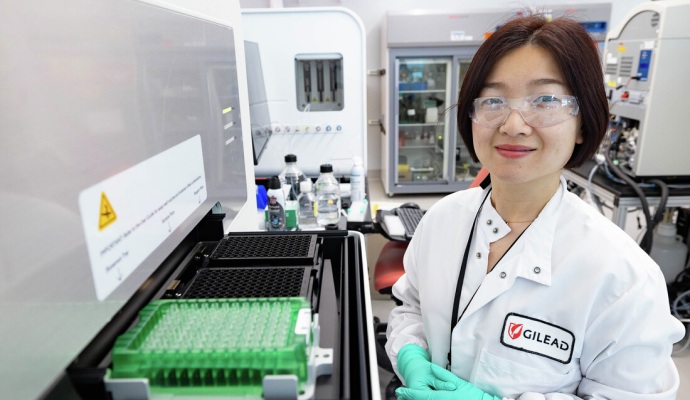
The company describes a culture built around integrity, inclusion, teamwork, accountability and excellence. Those values meet their practical test in decisions about trials, supply and access. In the second quarter of 2026, HIV sales rose 12%, while cell therapy sales fell 14% amid competition. The antiviral strength is real; success in adjacent fields remains harder to secure.
For patients and caregivers, the practical starting point is a conversation about eligibility, treatment goals and coverage. Gilead’s portfolio offers choices across very different diseases; the appropriate option depends on the diagnosis and the individual. The lesson extends beyond medicine: count the work a product leaves for its user. Then count the institutions that can block it. A longer-acting injection helps only if someone can obtain it, test appropriately and return when needed. Gilead can change a dosing calendar in a laboratory. Getting that time back into a person’s life takes a much larger collaboration.