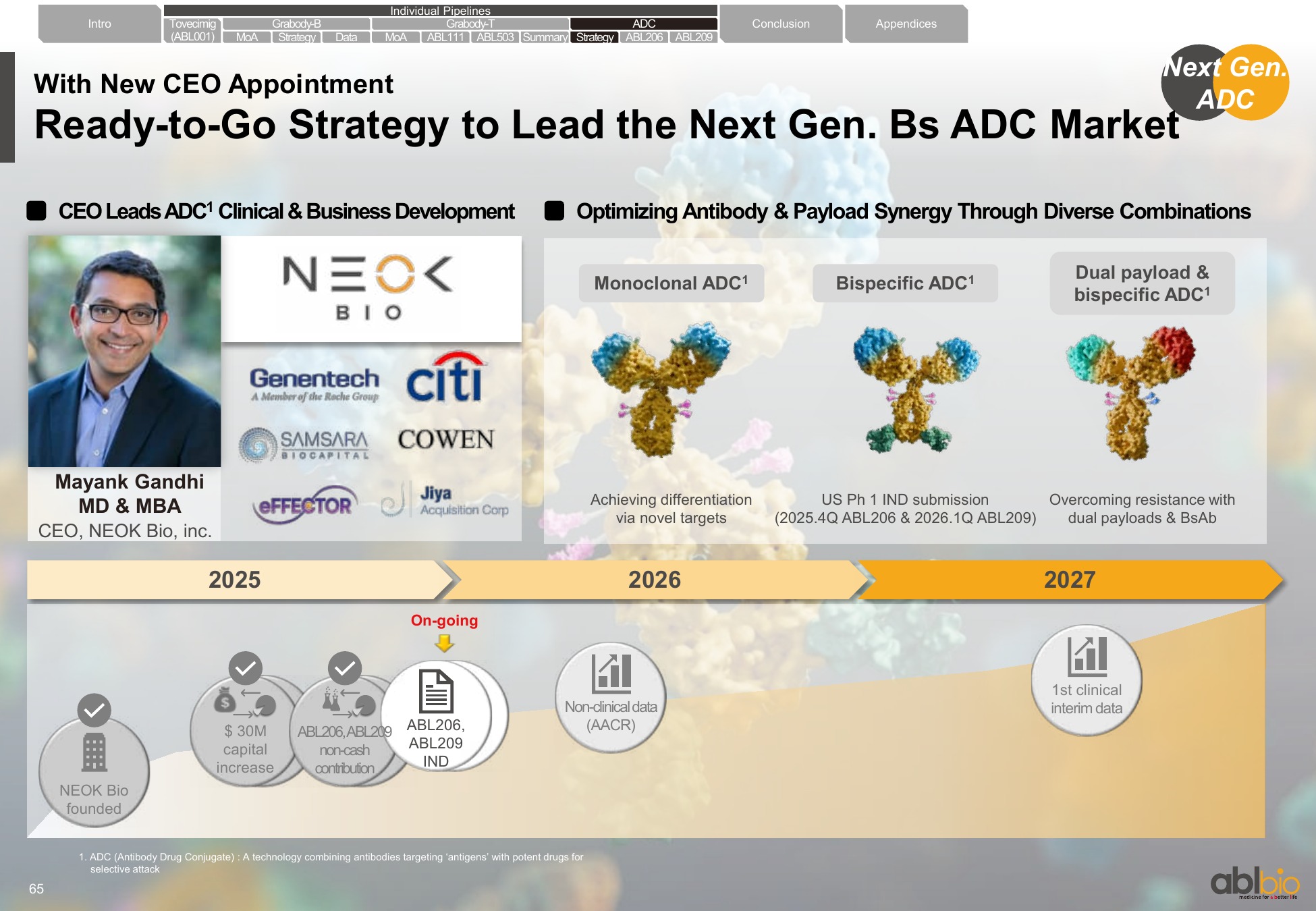
The useful thing about Mayank Gandhi's résumé is not its length. It is the number of different seats from which he has watched the same difficult process. He trained as a physician at the University of Mumbai. He studied business at Case Western Reserve. He evaluated biotechnology and medical-technology companies as an equity research analyst. He worked across oncology business development, commercial operations and medical affairs at Genentech. Then came corporate development at Jiya Acquisition Corp., a chief business officer role at eFFECTOR Therapeutics, and finally a founder's chair at NEOK Bio.
Each stop added a different question. Does the biology make sense? Will the market believe the evidence? Can a large organization move the program? Can a small one finance it? What must happen between a promising molecule and a patient receiving it? Gandhi's career reads less like a climb than a deliberate tour of the rooms where those questions are answered.
At NEOK, they converge around a compact proposition. Conventional antibody-drug conjugates, or ADCs, use an antibody to recognize a target on a tumor cell, a linker to carry the cargo, and a potent payload intended to do the killing. NEOK's two lead candidates use bispecific antibodies. Each recognizes two targets instead of one. The wager is that an extra point of recognition can help the medicine bind more selectively, internalize more effectively and reach tumor cells that do not all display the same biological signpost.
“Drug development is not easy but we are committed to our mission and are building an execution-focused team at NEOK.”Mayank Gandhi
A career built from adjoining rooms
Gandhi's medical training gave him one vocabulary, and his MBA gave him another. After school, he moved into equity research, covering biopharmaceutical and medical-technology companies at Citigroup, Cowen & Co. and Avet Capital. An analyst lives in the uncomfortable gap between a company's story and the evidence beneath it. The job rewards sharp questions, comparative judgment and a resistance to being seduced by presentation slides. Those habits travel well.
At Genentech, Gandhi crossed from examining companies to operating inside one. His roles spanned three functions that often regard the same program from distinct angles: medical affairs asks how evidence connects with clinical practice; commercial operations considers how a product may reach its market; business development decides which external opportunities deserve time and capital. The common work is translation. A scientific claim must survive contact with physicians, regulators, partners, budgets and schedules.
Five lenses on one industry
Jiya Acquisition Corp. put him nearer the machinery of financing and transactions. eFFECTOR, where he became chief business officer in 2022, put business strategy inside a public clinical-stage biotech. By the time he co-founded NEOK, Gandhi had spent years looking at drug development from the clinic, the spreadsheet, the deal table and the operating meeting. A founder cannot remain in any one of those chairs for long. The day keeps moving the chair.
The two-target thesis
NEOK launched publicly in November 2025 with $75 million in Series A financing and ABL Bio as its principal investor. The arrangement joined a California clinical-development company with a Korean specialist in antibody engineering. The lead assets already had histories inside ABL. ABL206 became NEOK001; ABL209 became NEOK002. The new names were tidy. The underlying constructs were deliberately less so.
NEOK001 recognizes B7-H3 and ROR1. NEOK002 recognizes EGFR and MUC1. These are pairs of proteins found across several solid-tumor types. Rather than hunt for a novel target simply for novelty's sake, NEOK selected clinically studied targets and combined them. The platform also uses a linker-payload technology from Synaffix, now part of Lonza. In other words, Gandhi's company is not asking one invention to carry the whole argument. It is assembling antibody engineering, target pairing and linker chemistry into a single test.
The appeal of dual targeting is easy to sketch and hard to prove. A tumor can be heterogeneous. One cell may express a target strongly while its neighbor displays less of it. A bispecific antibody offers another grip. NEOK also argues that recognizing a particular pair may improve selectivity and reduce binding away from the intended site. Yet adding another target adds design demands as well. Gandhi has cautioned that moving from one to many is not a simple matter. Biology does not award points for a clever diagram.
“We feel like we'll be able to overcome these limitations and have more stable, homogeneous ADCs.”Mayank Gandhi
The unglamorous advantage
The public milestones came quickly. FDA clearance for NEOK001 arrived in January 2026. NEOK002 followed in March, six weeks later. Preclinical data for both programs appeared at the AACR annual meeting in April. By May 27, first patients had been dosed in both Phase 1 trials. The sequence moved NEOK from a launch announcement to a clinical-stage company in less than seven months.
Launch Jan 2026
IND 1 May 2026
Phase 1 x2 2027
Data expected
Gandhi talks about this progress with an operator's preferred noun: execution. The word can sound bloodless until one considers what it contains. Manufacturing has to be ready. Regulatory packages have to hold together. Trial sites need contracts, staff and calendars. Patients have to be identified. Data systems must work before data exists. In biotechnology, the distance between an approved plan and a dosed patient is crowded with opportunities to lose a month.
That helps explain one of Gandhi's more pointed public observations. He has argued that the United States loses time and cost competitiveness because of problems people created and can therefore repair. His example is clinical-site activation. Why, he asked, should an academic site need 12 months? His proposed remedy was standardized contract language, so every sponsor and site does not rebuild the same agreement for every molecule.
It is a pleasingly prosaic suggestion from someone developing elaborate biological constructs. The molecule may need two targeting arms; the contract probably does not need twelve months. Gandhi's argument exposes a general founder's truth: technical ambition does not excuse operational clutter. Often it makes simplicity elsewhere more valuable.
Even the company's name carries this preference for compression. NEOK expands to New Era Of Knowledge, four words packed into four letters. The knowledge in question is distributed. Antibody engineering comes through ABL Bio. The linker-payload system comes through a licensed technology. Clinical, manufacturing, nonclinical and program-management specialists surround a small central organization. Gandhi's role is not to pretend that one office invented every component. It is to make the components arrive in the correct order, with responsibilities visible and decisions made before delay becomes habit.
This is where his unusual route looks less unusual. An analyst learns to compare claims. A business-development executive learns to connect assets and partners. A medical-affairs operator learns that evidence needs an audience capable of using it. A founder has to do all three while watching the runway. NEOK's organizational design is therefore part of Gandhi's thesis. The company can remain focused because it sits inside a wider network of technical experience. Small, in this context, describes the payroll more accurately than the working system.
Where the claim meets the clinic
NEOK's early data came from preclinical models. The Phase 1 studies have a different job. They begin by examining safety, tolerability and dosing while gathering early signals of activity. Initial readouts from both programs are expected in 2027. Until then, verbs such as “may,” “aim” and “designed” are doing honest work. They keep a hypothesis from dressing up as a result.
Gandhi appears to understand the boundary. His public descriptions explain the shortcomings NEOK intends to address, then return to milestones that can be checked: an IND clearance, a first patient dosed, a future data readout. The rhetoric is less interesting than the structure. Each claim is attached to a coming test.
His network also reflects that structure. ABL Bio founder Sang Hoon Lee brings years of bispecific-antibody engineering and sits on NEOK's board. Jerry Lee, an ABL founding member who has overseen finance and partnerships, is also a director. Around them is a group of advisors covering chemistry, manufacturing and controls, clinical development, program management, clinical operations and nonclinical work. Gandhi sits at the intersection, translating among specialists and keeping the sequence moving.
The aspiration is clear: improve the therapeutic window of ADCs, address tumor heterogeneity and build a clinical company around dual targeting. The outcome is not. That uncertainty is not a blemish on the story. It is the story's engine. A biotechnology founder's real product, for a long while, is an organized series of questions expensive enough to answer properly.
Gandhi has spent his career collecting ways to ask those questions. Medicine supplied the human context. Equity research sharpened the evidence filter. Genentech showed the internal machinery. Corporate development connected science with capital. NEOK now puts the collection to work. Two targets may prove better than one. Five professional lenses already look more useful than a single view.