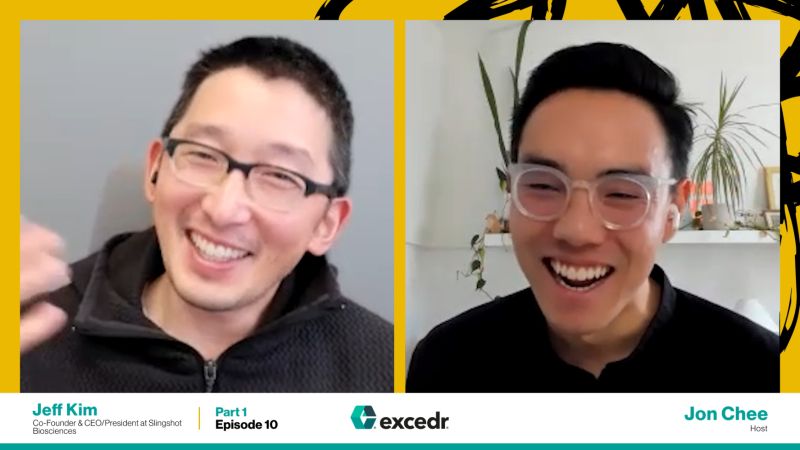
Jeffrey Kim’s father arrived at his son’s Princeton graduation with a small gap in the briefing. At the molecular biology ceremony, he wanted to know why they were there. Kim had to explain his major. His parents had encouraged him to explore so freely that the precise destination had apparently escaped the family itinerary.
It is a good opening for a career that resists the tidy retrospective. Kim became a scientist, a musician and a company founder. The connections make sense once you follow them. They would have been considerably harder to put on a university application.
At Slingshot Biosciences, which he co-founded in 2012, he helped turn an idea for synthetic cell mimics into a manufacturing business. He led the company as CEO before moving into an advisory and board role in 2025. Along the way came another startup, Radiant Genomics, and its acquisition by Zymergen. Yet the interesting thread runs beneath the job titles: Kim likes to discover how something works by trying to build it.
The education before the degree
His parents immigrated from Korea. In Kim’s account, household frugality meant doing jobs themselves, including plumbing and electrical work. A repair was also an education. You learned what was inside the wall because someone had to deal with what was inside the wall.
That kind of upbringing gives curiosity a practical consequence. Asking a question can lead to a tool, a failed attempt, another attempt. Kim later connected those early experiences to his working life: learning a process closely enough to locate the difficulty, then deciding how to solve it.
The freedom had its comic moments. He remembers poor handwriting grades and a childhood argument that typing made elaborate penmanship unnecessary. The handwriting lesson was supposed to teach him one skill; he was already conducting a small review of whether the skill deserved the time. One imagines the teacher would have preferred a neater objection.
“I always questioned why I was doing things.”
Jeff Kim
Music offered a more welcome discipline. He learned instruments including piano, trombone, guitar and cello. After Princeton, he pursued music in New York while working in a laboratory. There were recording projects and a DJ residency, alongside the less glamorous business of making a living.
Two kinds of improvisation in New York
Kim worked with Tarun Kapoor at Rockefeller University and later earned his doctorate there, joining Sean Brady’s laboratory. His scientific interests included biochemistry and metagenomics, the study of genetic material gathered from communities of organisms. Music continued alongside the experiments.
The appealing point about this overlap is its ordinariness. A person can spend a day doing technical work and still need a room full of musicians. The second activity need not arrive with a productivity justification. Kim nevertheless found that his artistic life fed the creativity demanded by research.
He became part of an artists’ community in New York, including time living in Long Island City. The arrangement put laboratory work and creative work within the same life, rather than on opposite sides of a grand career decision. His later businesses came after that period of trying things, meeting people and developing a taste for work whose outcome was still open.
That taste matters in science. An experiment comes with a procedure, but the procedure does not promise an interesting result. Choosing the next question requires judgment. So does recognizing that a useful technique from another field might belong on your own bench. Kim’s career repeatedly returns to that crossing of boundaries.
- PrincetonMolecular biology
- RockefellerResearch + music
- AmyrisIndustrial biotechnology
- Two startupsRadiant + Slingshot
The laboratory meets the loading dock
Amyris brought him to California and to biotechnology at industrial scale. He worked on jet fuel development. The setting offered a different kind of problem from a university laboratory: making a process work was only part of the job. It also had to work at a useful scale.
That distinction follows a scientist into company building. An elegant experiment can tolerate attention that a repeatable manufacturing process cannot. A business has to account for equipment, supply, delivery and the customer waiting at the other end. These details have little patience for elegance on its own.
Kim co-founded Radiant Genomics with Oliver Liu. Radiant worked in functional metagenomics, developing technology and genetic libraries for finding useful molecules. Its early premises included a California basement. Kim is particular about the description: an above-ground space with a concrete slab, rather than the subterranean cupboard the word might suggest.
He remembers building and buying used equipment, and collecting discarded equipment often enough that a trucking company mistook him for a professional mover. It is an excellent detail for a founder’s biography. The machinery had to get to the laboratory before anyone could do anything clever with it.
Radiant’s acquisition by Zymergen was announced in January 2018. The announcement named Kim and Liu as founders and said the entire Radiant team would join. Zymergen wanted the metagenomics technology and genetic libraries: a way to search more of biology’s chemical possibilities.
The acquisition also placed Kim’s work inside a larger effort to combine biology, computation and manufacturing. Radiant had built something another company wanted to incorporate into its own platform. That is a concrete achievement, with a different texture from an idea receiving applause in a conference room.
The napkin acquired a long future
Slingshot began in the same year as Radiant, 2012. Kim later recalled a handful of founders sketching the idea on a napkin. Alongside him were Anh-Tuan Nguyen, Jeremy Agresti and Oliver Liu. The company’s materials describe a founding team bringing together experience across biology, chemistry and engineering.
A napkin is wonderfully accommodating. There are no delivery dates printed on it. Turning its contents into a company introduces all the details that the sketch can leave out: who will make the product, whether it behaves consistently, and how to produce another batch.
Slingshot’s subject was the cell mimic: a manufactured particle designed to reproduce selected properties of a cell. The useful trick was specificity. Reproducing the properties an instrument needs to measure is a more bounded engineering problem than reproducing everything a living cell does.
The patent record makes the idea tangible. A publication titled Hydrogel Particles with Tunable Optical Properties lists Kim, Liu, Agresti and Nguyen as inventors. It describes particles whose optical properties resemble those of a target cell. A related patent describes using tunable hydrogel particles as calibration reagents.
For an instrument, resemblance has a practical meaning. Light scattering and fluorescence can be measured. A manufactured reference with selected, repeatable characteristics gives researchers something to compare against. Slingshot combined polymer chemistry and manufacturing to pursue that repeatability.
The company spent years developing the platform before its first product suite launched in 2020. Its July 2021 announcement disclosed a $23 million Series A led by Northpond Ventures, with ARCH Venture Partners and Anterra Capital participating. The money supported commercialization and further platform development.
From Slingshot’s founding to the launch of its first product suite. Eight years rarely fit on the napkin.
A company has to learn new parts
Those dates help correct the visual shorthand of the startup story. The sketch is memorable; the intervening work occupies most of the calendar. Slingshot had to reach manufacturing milestones before introducing the products. Capital arrived after a substantial period of technical development.
Kim’s own account of the company’s growth is unusually attentive to the team. In his 2025 reflection, he thanked co-founders, customers, partners, family and investors. He described adding operational leaders and completing the onboarding of a new leadership team. The company that began with a handful of people needed more people who knew how to run it.
There is a useful tension here for anyone who enjoys doing things personally. A founder’s willingness to tackle an unfamiliar task can keep a young company moving. As the company grows, the same habit needs company: colleagues with their own expertise, authority and judgment.
In May 2025, Slingshot appointed Glenn Bilawsky CEO, succeeding Kim. Kim remained a senior advisor and board director. The announcement credited him with inventing and leading development of the company’s core technologies. He said he would continue supporting the business.
“I’m proud of how far Slingshot has come.”
Jeffrey Kim, May 2025
His stated ambition was to see the technology scale and have wider impact. Stepping into a different role gave that ambition an organizational form. A founder can remain connected to the work without keeping every responsibility attached to his own desk.
By October 2026, Slingshot’s board page still listed Dr. Jeffrey Kim as founder and board director. The title is one concise description of where that long experiment led. The fuller description includes instruments, laboratories, a loading dock and a father pleasantly surprised by a biology degree. Kim’s career has made room for all of them. The practical question running through it remains invitingly small: how does this thing work?