At dinner with an instrument maker, a problem was posed almost as a joke: if someone could make a synthetic cell, a stubborn calibration problem might disappear. Jeffrey Kim thought he could. Within weeks, he had bought equipment, made prototypes in a basement operation and sent validation lots to the prospective customer. The customer liked them enough to discuss buying the young company. It looked, briefly, like the world's tidiest startup story: invent a cell, sell the company, go home.
The deal collapsed. Slingshot Biosciences did not. Kim later said the failure made him ask a more interesting question: why had the buyer wanted the technology so badly? Conversations with other laboratories revealed that the first customer's problem was a symptom. The broader difficulty was the absence of dependable reference material wherever people measure cells.
- Slingshot manufactures nonliving cell mimics for flow cytometry and cell-based assays.
- Its customers include instrument makers, academic labs, diagnostic developers and cell therapy manufacturers.
- The appeal is repeatability: a control whose scatter, fluorescence or biomarker signature can be specified and made again.
- It disclosed $34 million in financing across its 2021 and 2023 Series A rounds.
A ruler made of biology bends
Flow cytometry sends cells past lasers and reads their light scatter and fluorescence. The result can tell a researcher which immune cells are present, whether a marker is expressed, or whether a manufactured cell therapy product meets its quality criteria. But the instrument must first be checked against something known. That "something" is the control. If it changes from lot to lot, donor to donor, or even passage to passage in a cell culture, the scientist may be left wondering whether the sample changed or the yardstick did.
The usual substitutes each make a bargain with uncertainty. Biological cells resemble the sample, but they can be scarce, perishable or variable. Polystyrene beads are repeatable and convenient, but they do not always behave optically or chemically like cells. Slingshot's answer is a polymer-based mimic engineered to reproduce selected cell properties while remaining a manufactured reagent. It is an imitation with an unusually useful flaw: it is not alive. It cannot divide its way into a new phenotype while nobody is looking.
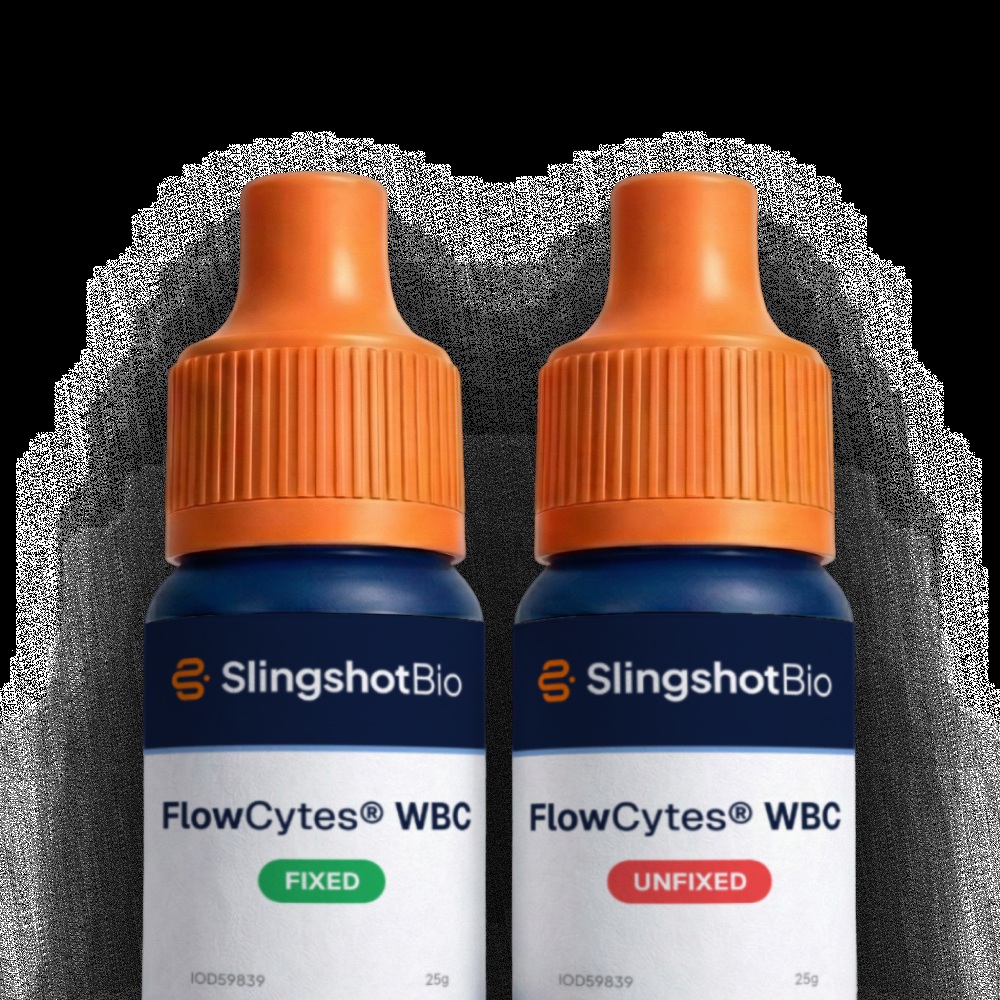
The product is therefore narrower than its name may suggest. A synthetic control is not a substitute for a living cell in an experiment that requires metabolism, growth or a response to treatment. It is a reference for a defined measurement. That constraint is what gives the business its shape: choose the property a lab needs to verify, then engineer a stable particle that displays it.
The trick is to make the reference repeatable; the biology under study remains free to surprise you.
From one instrument to the whole assay
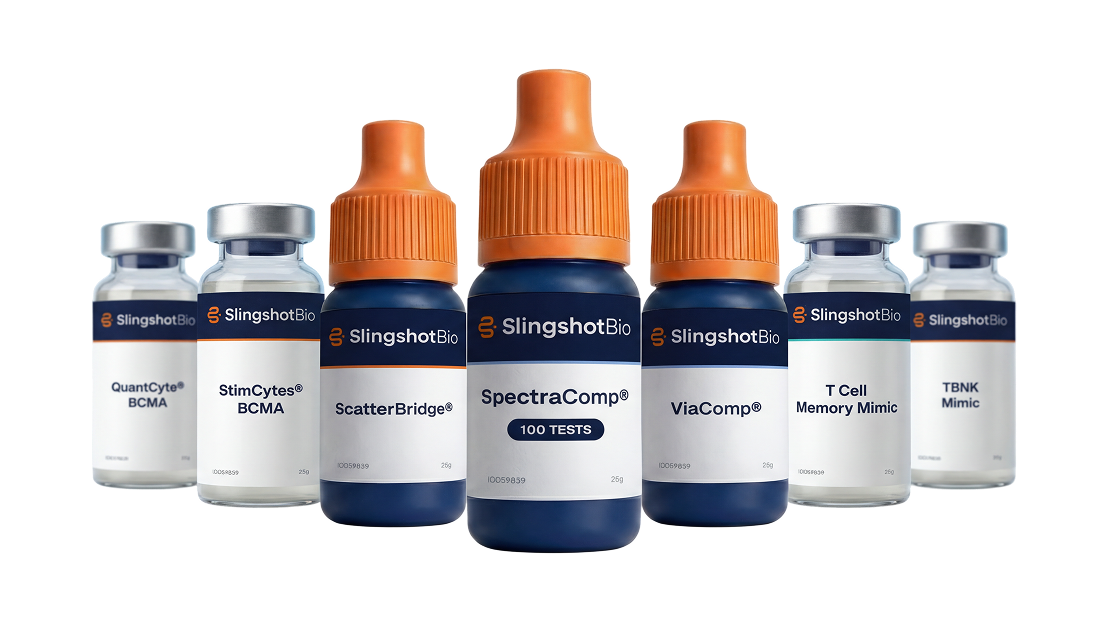
Slingshot's catalog reads like an itinerary through a cytometry workflow. FlowCytes help standardize forward and side scatter, the light patterns used to position cell populations on a plot. SpectraComp provides single-stain controls for separating overlapping fluorescent signals. ViaComp addresses viability dyes; its 2026 Ultra XT Amine format also combines antibody and viability dye compensation in one vial. TruCytes carry biomarker signatures for immunophenotyping and assay validation. Newer potency-oriented products, including StimCytes, speak to cell therapy development.
The names are commercial, but the pattern is scientific: each vial answers a specific question about whether a measurement can be trusted. The company sells catalog reagents and custom controls when the relevant marker or cell profile is particular to one customer's assay. Its public store listed SpectraComp at $338 and ViaComp Ultra XT Amine at $395 in September 2026. Bespoke work has no published price. Those figures explain the business better than an abstract label such as "platform": Slingshot sells repeatable reference materials as laboratory consumables, then extends the chemistry to special cases.
The expensive question is downstream
For a university core lab, an unreliable control wastes instrument time and makes training harder. For a diagnostics developer, it complicates validation. In cell therapy manufacturing, the stakes extend to comparing assays across operators, instruments and sites. A control that behaves the same way in each setting can make deviations easier to interpret. This is the market Slingshot found beyond its first instrument maker: pharma and biotech companies, contract research organizations, reference labs and academic facilities running cell-based tests.
One case shows how specific the work can become. Prolocor is developing a flow cytometry test that measures FcγRIIa on fixed platelets to help assess thrombosis risk. It used custom TruCytes as an internal control in analytical validation, seeking more precise and linear results than variable biological controls could easily provide. Another customer, Cellares, announced in 2025 that it would integrate TruCytes biomarker controls into Cell Q, its automated quality-control testing system for cell therapy manufacturing. In both cases the synthetic cell is a supporting actor. That is exactly the point.
“Why did they want to buy this company that I was operating out of my basement for so much money?”Jeffrey Kim, reflecting on the early acquisition proposal
Kim's answer was to broaden the premise without abandoning the original. Slingshot raised a $23 million Series A in 2021, led by Northpond Ventures, and an $11 million Series A3 in 2023, co-led by ARCH Venture Partners and Northpond. The company said the second round would accelerate commercialization for cell and gene therapy. A cell therapy-focused portfolio followed in 2024, with further potency and gating controls announced in 2025. It was a costly move from a neat instrument fix to an industrial supply problem, though Slingshot has not disclosed the cost of developing any one mimic.
The market for certainty
The company is selling into a field with plenty of alternatives. A lab can still use donor samples, cultured cell lines, fixed cells or conventional beads, often from larger reagent suppliers. Slingshot's claim is that a manufactured mimic combines cell-like behavior with lot-to-lot consistency. The claim matters most where the control must travel across sites, survive storage, or stand in for a rare biological material. It matters less when the experiment needs the messiness of a living response. Knowing that boundary is useful to a buyer: first define what must be controlled, then ask whether a nonliving mimic reproduces that particular signal well enough.
By February 2026 the company was describing hundreds of customer organizations worldwide and announcing faster access in the UK and EU. In September it appointed Nimisha Srivastava CEO. She had joined as COO after helping scale automated synthetic DNA and RNA production at Twist Bioscience. Her brief is less romantic than the basement prototype and arguably harder: turn precise chemistry into reliably available products for a growing market.
There is a lesson here for more than cytometrists. Kim's first buyer presented a task; the failed sale forced him to investigate the reason behind it. The repeatable part of that story is not the happy accident at dinner. It is the next act: ask who else suffers from the same underlying constraint, make a control for a well-defined job, and be honest about what it cannot imitate. Slingshot's cells are compelling precisely because they know what they are for. They are there to stay still while science moves.