A company that sells visibility has an awkward lesson to teach its founder: sometimes the sensible thing is to let an opportunity pass. Michael Transon’s career has repeatedly brought him back to that decision. A customer wants to buy. A service seems close enough to the work already being done. The revenue is real. So is the distraction, although it tends to submit its invoice later.
Transon is the founder and CEO of Victorious, the San Francisco search agency he began as a solo consulting practice in 2013. Search is a business of invitations: come to this page, consider this company, make this purchase. Running the agency has required him to become more selective about the invitations he accepts. His public account of that education is unusually useful because he allows the mistakes to remain in the picture.
The first useful refusal
He graduated from Arizona State University with a marketing degree in 2012. Freelance assignments grew into a business; friends and close contacts helped with the workload. The early arrangement carried the familiar conveniences of knowing everyone before hiring them, followed by the less convenient discovery that friendship and supervision ask different things of a relationship. He later described the need for clearer boundaries.
Jim Collins’s Good to Great gave him a vocabulary for choosing what kind of company to build. His ambition shifted toward an organization that could endure. The practical question was what deserved its concentrated effort. Offering several adjacent marketing services gave a young business ways to earn money. It also gave its people several different businesses to learn how to run.
In 2016, Victorious narrowed its focus to SEO. The decision has a deceptively tidy appearance in a company history. Specialization means declining work that a customer is perfectly prepared to pay for. It asks the founder to believe that a more coherent company is worth the immediate inconvenience of a smaller menu. The menu, of course, never objects to getting longer.
The discipline did not become permanent simply because it had worked once. Transon has described accepting poorly matched customers during the demand surge of 2021 and 2022. Some lacked the resources to support a specialist engagement. The lesson concerned capacity on both sides of the contract: an agency can have a plan, and a customer can have good intentions, while the work still lacks what it needs to succeed.
Three points in the working life of Victorious. The recurring decision: where to put the team’s attention.
A skeptic with a microphone
By 2019, Transon was writing about how buyers should evaluate an SEO agency. His advice placed expertise throughout the organization, including the sales conversation, and asked customers to check references. There is a revealing choice in that subject. He was addressing the point at which confidence is easiest to sell and hardest for an outsider to assess. A prospect needs some way to distinguish a capable team from a capable pitch.
That problem has followed him into AI search. On The Search Signal, the Victorious podcast he hosts, he describes himself as “a bit of a professional skeptic in an industry that sells a lot of certainty.” The line suits an agency owner whose customers must make decisions before the underlying platforms have finished changing. Certainty would be a convenient product to stock. It would also need frequent returns.
His current public biography describes Victorious as a five-time Search Agency of the Year and a remote team working across traditional and AI search. Those credentials provide a setting for his commentary. The more interesting question is how an established specialist responds when the thing it specializes in starts changing shape. Years of experience supply useful habits; they also supply assumptions that need inspection.
In his August 2026 episode about Google’s AI Mode, Transon argues that the conversational interface will become a primary way people search. He presents that as a direction businesses should prepare for. A company can retain a visible position in conventional results while the answer above those results changes what a buyer needs to click. For an agency accustomed to connecting visibility with website visits, that is a substantial complication.
What the machines read about you
Transon’s response begins with a familiar business exercise: decide what the company should be known for. In his September discussion of brand entities, he returns to Collins and the intersection of capability, economic purpose, and work a team cares about doing. That definition then has to survive contact with the company’s pages, listings, reviews, and outside coverage. A clear sentence in a strategy document has limited authority over a disorderly public record.
He recommends examining existing material against the subjects the business intends to own. Some pages belong. Others need improvement, combination, or removal. This is the founder’s old focus problem expressed through a website. A business that keeps saying yes to unrelated subjects may eventually leave both people and machines unsure what its particular competence is.
His August episode on informational content considers another complication: the reader may be an AI system assembling an answer for somebody else. He asks whether a competitor could put its logo on a piece of content without anyone noticing the mismatch. It is a useful editorial test because it removes the branding and asks what remains. A great deal of corporate prose would travel comfortably in another company’s suitcase.
The proposed remedy is specific knowledge: original experience, verifiable detail, and material that reflects the company producing it. Transon treats the connection between informational authority and later recommendations as a working hypothesis. That qualification matters. An attractive theory can guide an experiment without becoming a promise to the customer. Keeping those two things separate is part of the work.
“Search used to be treated mostly as performance marketing. And AI search is really turning this into brand building.”Michael Transon, The Search Signal
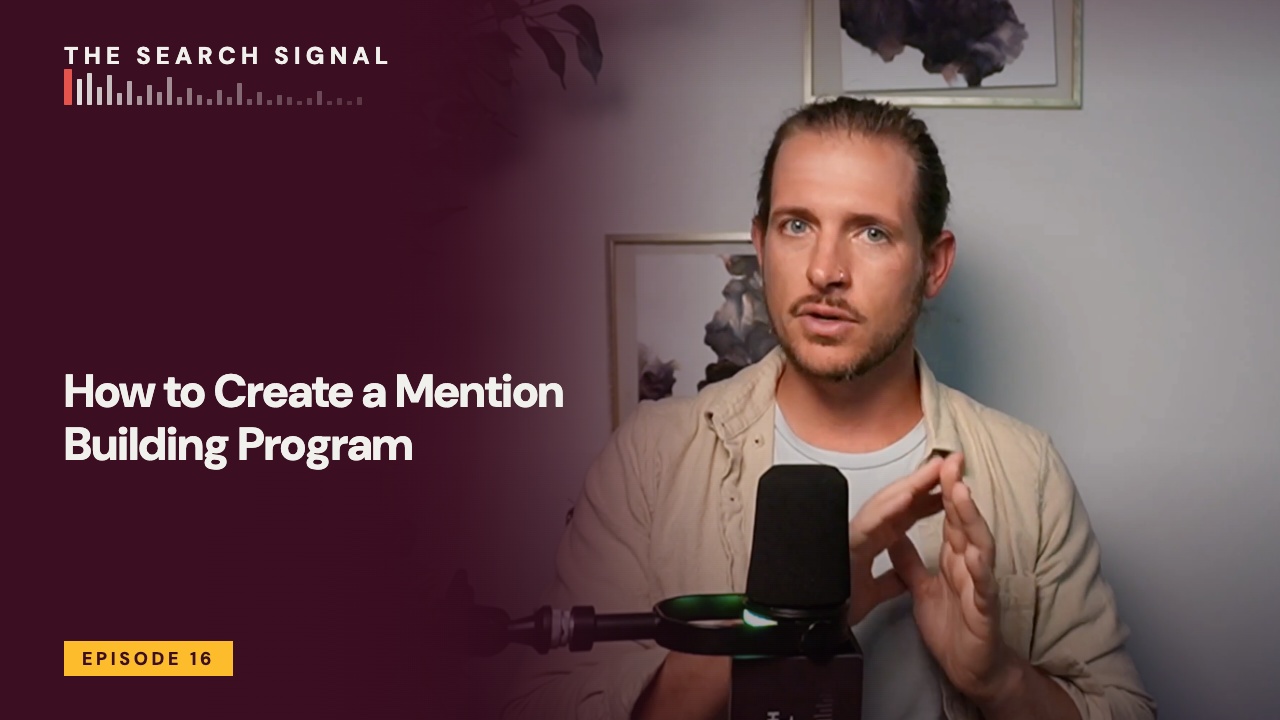
By October, his attention turns explicitly to mention building. The company website is only one part of what an assistant can read. Other people’s descriptions, independent publications, and coverage of a company’s expertise become part of its discoverability. His episode separates broad mention building from link building and targeted citation outreach. Each gives a team a different unit of work, rather than one grand instruction to become famous by next Thursday.
That emphasis connects search to older habits of reputation. A business becomes associated with a subject because people encounter it doing or explaining something useful. AI adds another intermediary between that public record and a prospective customer. The obligation to contribute something worth repeating remains recognizable, even when the route to the buyer changes.
The number has a boundary
For someone selling search services, measurement is where this argument becomes uncomfortable. Transon’s September episode on reporting starts from a reversal: marketers grew accustomed to more precise attribution, while AI conversations make parts of the customer’s research less visible. A private exchange can influence a decision without sending a conveniently labeled visitor to a website.
He proposes tracking leading and lagging indicators together. Mentions and citations help describe visibility; business outcomes help show what happened afterward. Neither side deserves to impersonate the entire journey. A prompt tracker samples answers to selected questions. Its percentage describes that sample. This is a modest sentence with substantial consequences for the claims an agency should put on a slide.
CitationsWhat selected answers show
ConversionsWhat happens closer to the sale
A conceptual view of Transon’s reporting approach. These are complementary signals, not a complete record of every buyer’s journey.
The restraint also appears in his technical advice. In October’s technical SEO episode, he argues that much established work still applies and asks teams to make deliberate decisions about crawler access. Important pages should explain themselves. The attraction here is practical: before buying a new category of solution, understand the task, the existing machinery, and the reason for changing it. Novelty can be remarkably persuasive when it arrives with an invoice.
The expensive part is judgment
Transon’s latest commentary on fabricated online authority brings these ideas together. He argues for original research, identifiable expertise, and independent mentions that withstand scrutiny. The commercial temptation is easy to understand: if outside references influence answers, manufacturing those references looks like a shortcut. His position favors the work that remains costly to produce honestly, and therefore gives another person a reason to trust it.
This leaves an agency founder with a demanding proposition. He must persuade customers to invest in expertise while acknowledging that the resulting influence will not always be perfectly traceable. He must adapt the methods while preserving a reason for the company to exist. And he must keep deciding which work belongs inside that company.
The thread running through Transon’s career is that repeated choice. A solo practice needs customers. A specialist needs focus. A search agency facing AI needs enough skepticism to revise its assumptions and enough conviction to act before every answer is settled. Saying no remains part of the job. The useful question is what the refusal makes room to do well.
Continue the conversation
Victorious · Michael on LinkedIn · The Search Signal on YouTube
The reporting episode · The content episode · Articles and research commentary · The Agency Growth Club conversation