The revealing part of Voices of Search happens before anyone presses play. In a 2022 interview, Benjamin Shapiro described taking an anchor consulting client and turning that client into a sponsor of his second podcast. The relationship survived. What the client bought changed. Instead of buying some of Shapiro’s time, it could support a conversation with the people it wanted to reach.
- Free interviews for SEO and content marketing practitioners.
- Paid campaigns for brands that want those practitioners’ attention.
- A repeatable production idea: one recording can supply several episodes.
The client on the other side of the microphone
Shapiro had already started MarTech as a side project to help his consulting business. In his account to Scott Clary, the earlier show taught him that an audience could become a business in its own right. Sponsorship revenue overtook consulting revenue. Voices of Search gave that model a second, more tightly defined subject: the work of getting found online.
The distinction matters. Those early experiments belong to the MarTech story; they are not Voices of Search growth figures. What carried over was a choice about customers. A listener needed useful information. A vendor needed access to listeners. An interview could serve both, provided it remained worth hearing.
Launched on August 17, 2018, Voices of Search belongs to I Hear Everything. Its subject is search engine optimization and content marketing. Its audience includes the people who must explain why a website lost visibility, decide which content deserves investment, and persuade another team to fix a technical problem. Those are recurring jobs. They supply recurring questions.
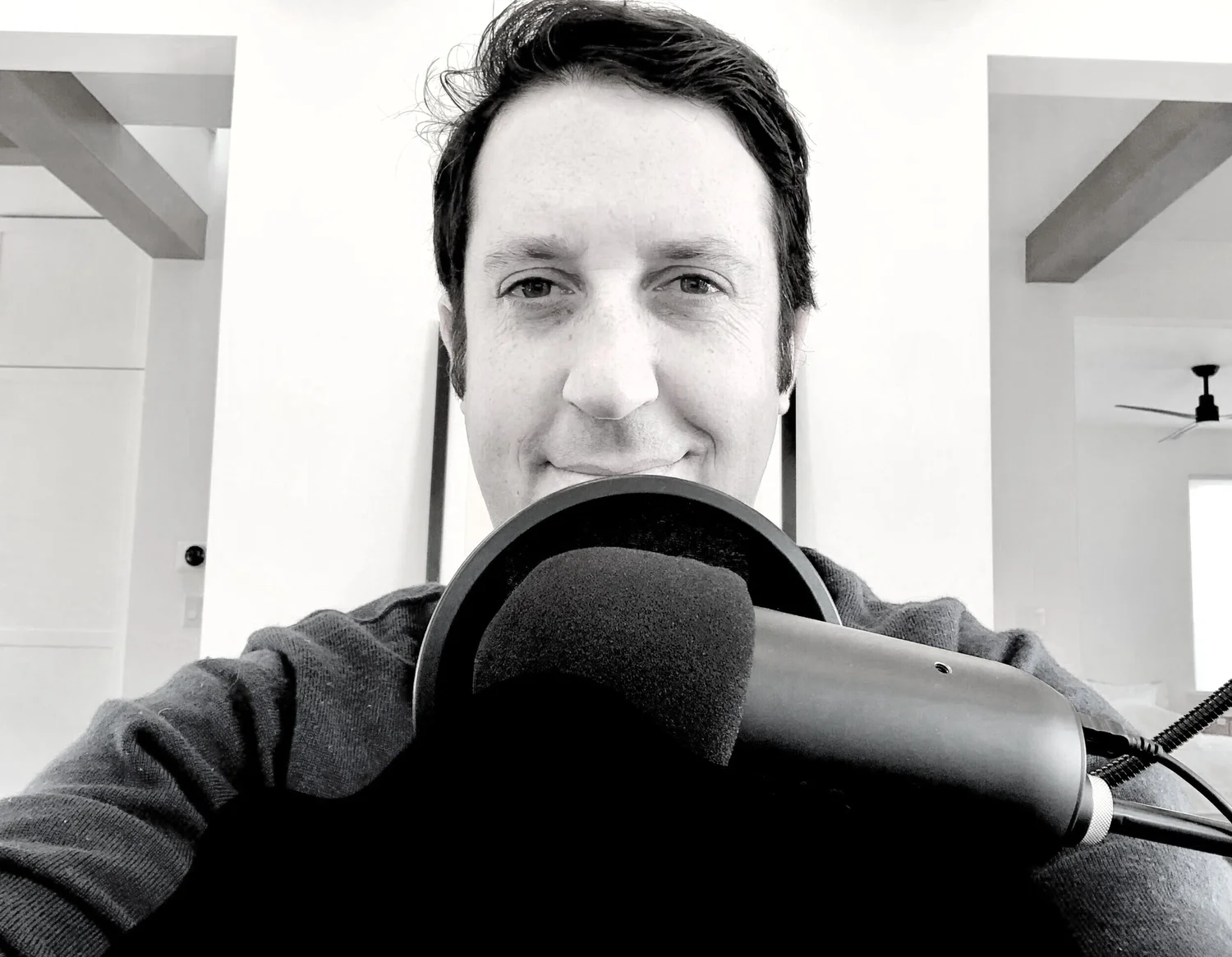
One conversation. Several products.
The company’s thematic content offer makes its production logic visible: a 90-minute recording session becomes a five-episode sponsored series, listed at $5,000. That is an editorial packaging decision as much as a scheduling decision. A broad interview can be broken into specific questions, each with its own reason to click.
It also creates several opportunities to distribute the same expertise. The guest gets multiple appearances. The publisher gets a sequence. The listener can pick the relevant problem. For someone building a specialist publication, this is the useful part to copy: organize the recording around separable questions before asking them.
The archive has another job. The audio advertising page offers dynamically inserted host-read ads across more than 1,000 episodes. Old conversations can carry new advertising. Its listed unit costs $5,000 for 50,000 impressions, implying a $100 cost per thousand impressions before discounts. That arithmetic describes the rate card, not what every advertiser pays.
Then come the bundles. Published prices rise from $10,000 for thought leadership to $15,000 with audio advertising and $20,000 with direct response. The commercial progression is clear: help someone hear a brand, then help that person take a next step. Download and visitor targets are the seller’s advertised package terms, not independently measured outcomes.
This is a media business with marketing services attached. Its sponsorship explanation describes Podsights attribution and UTM tracking, connecting listening with website activity. Attribution gives buyers something to examine. It still requires judgment: a recorded visit does not, by itself, establish that a podcast caused a sale.
The listener pays in minutes
For the audience, the attraction is access to practitioners. Jordan Koene and Tyson Stockton are recurring guest hosts with search industry experience. Previsible’s 2022 review says it produced more than 100 Voices of Search episodes that year. This is a continuing contribution, rather than an occasional celebrity appearance.
The archive shows how specific that expertise can get. CoStar’s Craig Harkins discusses SEO as product management. TextNow’s Elliot Tsai challenges the assumption that paid search should be SEO’s preferred partner. These conversations address how work gets organized, as well as how pages get ranked. A tool dashboard cannot supply that conversation.
Its competition for attention includes SEO publications, newsletters, webinars and other podcasts. The reason to choose Voices of Search is the interview and the regular rhythm. Reading may be quicker when you need one precise answer; listening can be useful when you want the reasoning behind a decision.
“Record once a week. Publish daily.”I Hear Everything’s current production pitch
Regularity has a cost. On Apple Podcasts, one August 2023 reviewer complained about episode length and advertising. Another review objected to brief sound bites. These are individual reactions, but they expose the publisher’s problem: listeners disagree about the right length. More inventory and more releases can put pressure on the attention that makes the inventory valuable.
Take one idea back to work
Recent conversations follow search into AI discovery. The October 2026 series with MANSCAPED’s Siiri Lee examines ownership across marketing, PR, content and engineering. The question has widened from where a page appears to how a business coordinates the information people and AI systems encounter.
The show also invites listeners to submit SEO questions, and accepts speaker applications. That gives practitioners a route into the discussion, beyond subscribing. For an editor, those questions can be useful signals: the language people use to describe a problem is often more revealing than the topic label. For a listener, asking a focused question is a way to make the next conversation more relevant.
A practical listening habit follows: pick an episode tied to a live problem. Write down one claim, the conditions behind it, and a small test your team can run. Assign an owner and a measure. This is our suggested workflow, rather than a company product. It keeps a useful conversation from becoming background noise.
The advertising model needs similar discipline. It suits a buyer whose customers overlap with search practitioners, whose offer is clear, and whose team can follow up on interest. A broad consumer brand may find the audience too narrow. A listener without implementation time may collect ideas without changing anything. The microphone opens the conversation. Someone still has to do the work.