Some school projects fit on a folding table. Michael Topolovac’s involved an unmanned submarine. In 1985, the Torrey Pines High School senior won the John D. Isaacs Memorial Sea Grant Scholarship for investigating how to reduce drag on a submersible he had designed and built. The small vessel had already done useful work: it had given him a problem interesting enough to pursue.
The award recognized research at the California state science fair. By the time the Sea Grant account appeared, he was a freshman at Stanford. Before there was a company, a sales pitch or a software subscription, there was a teenager trying to make a machine move through water more efficiently. Business would supply plenty of resistance of its own.
An unusual school project
His underwater education widened in 1987-1988, when he became the North American Rolex Our World-Underwater Scholar. The experience introduced him to underwater photography and to practitioners including Stan Waterman. It also helped produce the idea for Light & Motion, the company he began while at Stanford.
This was a useful apprenticeship for a product designer. Photography asks you to notice what is there. Working underwater adds a somewhat firmer requirement: the equipment has to function. A handsome object that fails below the surface offers limited consolation to the person carrying it.
Topolovac would earn a Stanford degree in product design. Light & Motion made underwater imaging equipment and bicycle lights, putting his interests into objects other people could use. Its products belonged to a world of housings, illumination and components, where an appealing sketch still had to survive assembly.
There was also a customer problem. Elijah Woolery, who worked as a designer and design engineer at Light & Motion, later described a company seeking a fairly elusive audience of underwater photographers. He recalled Topolovac’s warning against treating the founder as a substitute for the market. Personal enthusiasm can get a product started. It cannot answer every question about who will buy it.
- 01 / LIGHT & MOTIONLight, water, hardwareEquipment for seeing and recording.
- 02 / ARENAThe product recordInformation for making things together.
- 03 / CRAVEObjects people useEngineering meets industrial design.
The parts acquire a social life
A manufacturer’s product exists twice: once as the object, and once as the information required to build it. The second version needs the right components, suppliers, prices and revisions. It has rather less charisma than an underwater camera. It also has considerable power to ruin one.
Topolovac and Eric Larkin co-founded the company that became Arena in 2000. Originally called Bom.com, it addressed the bill of materials, the organized record of what goes into a product. His experience making hardware supplied the background for a business about the information surrounding hardware.
By February 2001, the proposition was concrete. Manufacturers accustomed to spreadsheets could use a hosted system to share a whole-product bill of materials with colleagues and suppliers. Design changes and product data would have a common home. A browser provided the entrance.
“There is no central repository for BOM data at most companies,” Topolovac said that year. Think of the resulting office choreography: several people can be diligently updating several documents, while nobody is quite certain that everyone has the same version. Being industrious is little protection against being out of sync.
Later in 2001, Bom.com’s offering included relationships between CAD files, lead times, manufacturers, prices and suppliers. A supplier-access module let customers control which components or assemblies an outside partner could see. Collaboration needed doors as well as windows.
The company also added sourcing and cost analysis. A manufacturer could examine component costs and purchasing information earlier in development. That matters because a parts list is full of choices disguised as nouns. Each component carries consequences for price, availability and the work someone else must perform.
By January 2003, the old name was getting cramped. The company could handle supply-chain management, cost analysis, collaboration and change workflows. Bom.com became Arena Solutions. “We really outgrew what we were,” Topolovac explained. It is a pleasingly practical reason for a rebrand: the business had accumulated more verbs.
That December, Arena announced its hundredth customer. One customer, Radio Systems, described coordinating two development sites, five contract manufacturers and numerous suppliers. The appeal of a shared system becomes easier to grasp when the people building your product do not all work within shouting distance.
The cloud, at dial-up speed
Read Topolovac’s explanation of Arena in 2005 and the historical distance arrives in kilobytes. He said its interface sent pages of roughly five to ten kilobytes, with heavy computation happening at the back end. The application, he argued, could work over a dial-up connection. You needed internet access; you did not need an extravagant pipe.
That detail gives the early cloud argument some texture. A manufacturer buying enterprise software could otherwise inherit servers, databases, desktop configuration and the people needed to tend them. Arena concentrated that work at the provider. The customer used a browser.
The approximate page sizes Topolovac described when explaining Arena’s lightweight web interface. Small pages made remote collaboration more accessible.
He also defended subscriptions as an incentive to keep delivering. Customers renewing a service could leave if it disappointed them. In his telling, the commercial arrangement made the vendor’s continuing performance part of the bargain. It was an argument about accountability as much as software delivery.
The interesting quality of this pitch is its attention to the buyer’s working conditions. Bandwidth, maintenance and budgets appear alongside the product’s capabilities. For someone trying to get a factory’s information in order, those details determine whether an application is usable at all.
Knowing when to give up the chair
In January 2008, Arena announced Craig Livingston as its next chief executive. Topolovac had led the company for eight years; the announcement said he would continue on its board. Eric Larkin remained chief technology officer. The company then counted more than 300 manufacturers as customers.
A founder’s name can stay attached to a company long after the daily job changes. That distinction matters here. Topolovac was Arena’s founding CEO, and the company later became part of PTC. Those events sit in different chapters of the story.
He described the transition in unusually direct terms. He thought Arena needed more experienced general management, sales and marketing leadership. He saw his strengths in products and the early stages of a business. Recognizing the fit had changed allowed him to raise the question himself.
“I’m more of a product guy, early stage guy.”
Michael Topolovac, 2015
After Arena, he spent several months in Bali and invited friends to join him. It was a chance to make room for people after years absorbed in a company. The next business could begin with a little more perspective about what he wanted to spend his days doing.
Back to objects, with Ti Chang
CRAVE brought him back to consumer products. He had noticed an opportunity in pleasure products whose design and shopping experience could leave potential customers feeling poorly served. A previous investor’s response was instructive: this venture did not look like the software business he knew how to fund. Changing categories also meant changing the conversation around the company.
Ti Chang brought an independent design practice and her company Incoqnito. CRAVE acquired that business in 2011, and Chang became a co-founder. Her industrial design work was central to what the partnership made. Topolovac’s background in engineering and company building gave the pair another set of tools.
With Vesper, a necklace that also functions as a vibrator, the engineering problem was one of packaging. Batteries, motors and electronics had to occupy a slender form. User testing prompted repeated efforts to make it smaller. The finished object depended on the less visible negotiation between components and proportions.
That is where his seemingly distant businesses meet. Software for managing products and the engineering of a wearable object both require careful decisions about how pieces relate. In one, the relationships appear in a record. In the other, someone wears the result.
CRAVE also took its workshop approach on the road in a converted Airstream, creating opportunities for people to assemble a product. A conversation that might feel abstract or awkward could begin with a practical task. There is something usefully disarming about being given parts and asked to make them fit.
Looking through the other end
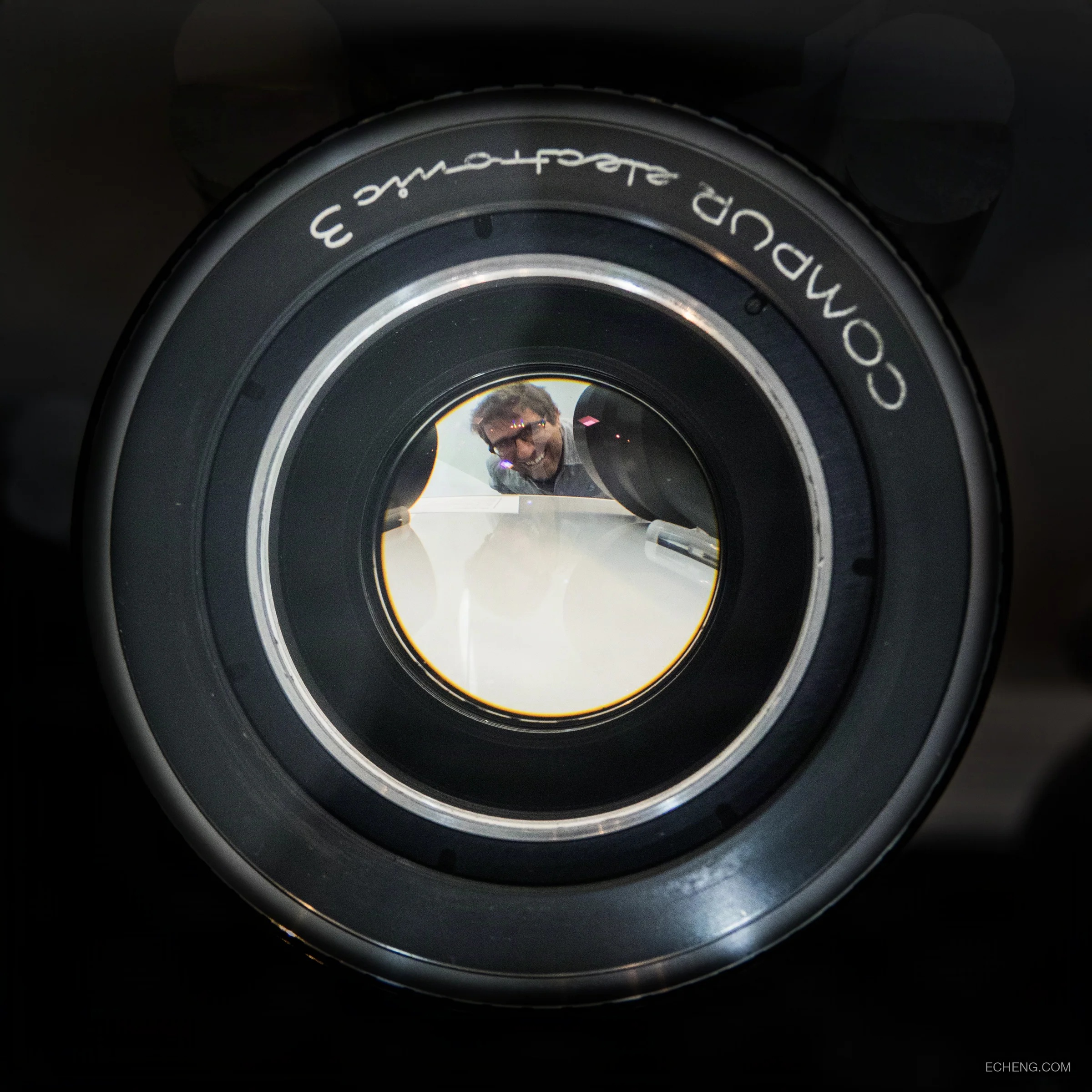
Photography continued alongside the businesses. For the CRAVE Portrait Project, Topolovac photographed participants at San Francisco’s 2017 Folsom Street Fair, then photographed them again in everyday clothes. Published in 2018, the paired portraits put two presentations of the same person next to each other. The viewer had to do a little more looking.
The method suited a business interested in making conversations about pleasure more approachable. It also gave the photographer a task separate from selling an object: show the person beyond a first impression. The two pictures resist the easy satisfaction of believing that one outfit tells the whole story.
Meanwhile, the ordinary demands of manufacturing remained. In April 2021, Topolovac described stocking critical chips and components ahead of the shortage confronting CRAVE. A compact, carefully designed product still depends on getting its electronics. Taste cannot substitute for inventory.
Earlier that year, PTC announced the completed acquisition of Arena. The company ended 2020 with approximately $50 million in annualized recurring revenue. The browser-based product record had traveled a considerable distance from Bom.com, continuing through leadership changes and long beyond its founding CEO’s tenure.
Topolovac’s career is easier to understand when those continuities remain in view. The school submersible needed to move through water. Manufacturers needed to agree on their product data. A necklace needed room for its components. Each problem asked for attention to something specific, and each imposed its own terms. He has spent a working life taking those terms seriously, then finding another object worth investigating.
Continue the conversation
Profiles, company sites, interviews and further reading.