Michael Saoud had seen enough waiting. In 2014, he visited an operation where a forklift could pull up to a hydrogen station and be ready to move again in 90 seconds. For someone responsible for keeping a cold-storage business running, it was a rather persuasive demonstration. He called his brother David. The purchase, he decided, should happen.
Eight years later, telling the story onstage at a Plug symposium, he gave the predicament a memorable name: “battery jail.” A warehouse full of expensive equipment could still find itself waiting for the equipment to become useful again. The cold made the problem worse. The business needed more working hours; its batteries kept requiring time off.
That little episode offers a way into Saoud’s working life. His career has unfolded among frozen food, loading docks, warehouse systems and the awkward moments when an order cannot move. Alongside David, his brother and fellow co-CEO, he has grown FreezPak Logistics by repeatedly confronting those moments. A container, unlike a corporate presentation, cannot be moved by enthusiasm.
A family business, before graduation
The brothers’ introduction to logistics came through their father’s food distribution business. They worked in it as youngsters, then started FreezPak in 2001 while still in college. Their father suggested frozen storage as the distribution business changed. They began with leased space in a family facility and subsequently bought a building in Paterson, New Jersey.
The origin has an appealing lack of ceremony. There was an existing trade to understand, a family already involved in it, and a suggestion that opened up another line of work. Michael eventually graduated from Kean University with a business degree. FreezPak was already a practical education: whatever the classroom timetable said, customers still needed their products handled.
The division of responsibilities helps explain the partnership. Michael’s responsibilities centered on operations, while David handled administration and sales. One side makes the promise to the customer; the other must make sure the building can keep it. Both carry consequences for the same shipment.
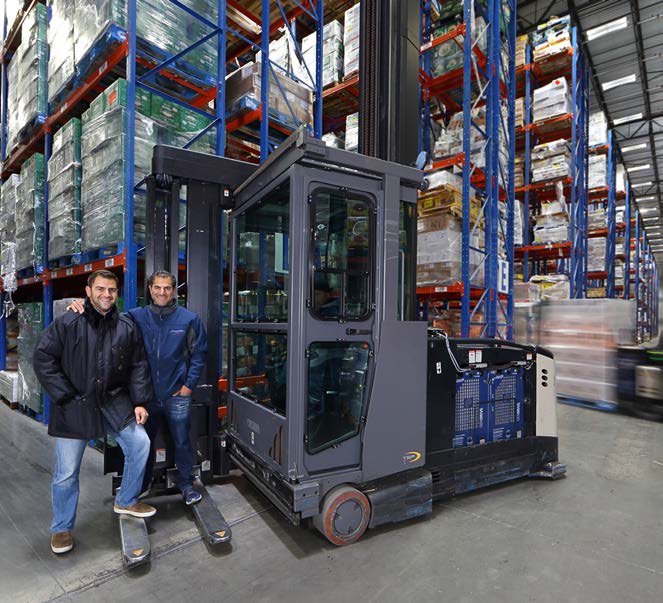
It is tempting to tell a family-business story as a story about inheritance alone. Here, the useful details are the tasks inherited alongside the opportunity: knowing how distribution works, understanding what a customer expects, and finding a place for the next load. The brothers’ subsequent investments kept returning to those tasks, even as the buildings became more complicated.
The room that paid to disappear
A warehouse’s floor plan can make an equipment choice surprisingly expensive. Batteries need charging arrangements and space. That space has an alternative use: holding goods. When FreezPak planned its Carteret facility, the choice of power system therefore reached beyond the forklift itself. It affected what the building could accommodate and how the operation would spend its time.
The March 2015 equipment announcement called for 25 fuel cells, outdoor hydrogen infrastructure, two indoor dispensers and a ten-year hydrogen supply agreement. It also described a larger pallet freezer and loading dock because the design would dispense with a battery room. A decision about fuel had become a decision about real estate.
That relationship is central to Saoud’s work. A truck sitting at a charger occupies more than a square on a plan. It changes the availability of equipment for the next task. A power system that keeps it working can alter the rhythm of receiving, storage and dispatch. The useful unit of progress becomes a completed movement.
A conceptual view of the operating choices behind FreezPak’s investment.
The commitment lasted beyond the first installation. In October 2022, Plug and FreezPak announced an agreement covering nine additional sites and nearly 400 lift trucks. The announcement reported that FreezPak had recovered up to 5,000 square feet of usable space per location and reduced electricity bills by 31.5% after switching. Those were company-reported operating results, tied to that period.
The same history includes difficulty. At the 2022 symposium, Saoud acknowledged that the first year had been tough. That admission belongs beside the enthusiasm. Installing a different system is an operating commitment, with an early period when the hoped-for improvement has to become ordinary daily work. His account gives the decision some texture: conviction came before the full experience of running it.
“Our customers look to us for progressive technology.”
Michael Saoud · On customer expectations
The robots arrive with a job to do
Power was one part of a larger set of changes. In the plans for FreezPak’s fifth location, announced in 2020, the company described automated storage and retrieval, robotics and same-day order fulfillment. Its design team had started investigating automation in 2014. The work involved fitting machines into a business that already had customers and orders to process.
Michael’s part in that work is unusually specific. By 2024, he had spearheaded the deployment of 131 robots in markets across the United States. His responsibilities encompassed warehouse operations and the introduction of software. This is a business graduate’s career spent close to systems that must perform physical jobs.
Robots deployed across U.S. markets under Michael Saoud’s leadership.
Software and machinery meet in an unglamorous place: the next instruction. A pallet needs a destination. An operator needs an assignment. A completed task needs to register before another one follows. In a warehouse, an idea about efficiency eventually becomes a sequence of actions. The sequence is where a customer’s order either advances or waits.
Saoud’s operating responsibilities make that connection part of his job. The robot count is a visible marker, but the underlying work also includes the less photogenic decisions about software and workflow. A machine can arrive with a brochure. The warehouse still has to find a useful place for it between the incoming goods and the outgoing order.
Then the operator became a developer
In 2021, the FreezPak founders established Saoud Development, which owns and develops cold-storage facilities for the operating business. That added land, funding and construction to a story that began with leased space. A growing warehouse company could now shape more of the building in which its work would take place.
When the Suffolk project was announced, Michael described the shift toward purchasing land, obtaining entitlements and constructing facilities. The Virginia plans joined storage capacity with dock space, container connections and transport access. The proposed building stood 75 feet tall. The arrangement brought the operator’s requirements into the development process.
The location also made the wider business strategy concrete. Suffolk put the company close to the Port of Virginia. FreezPak’s work includes services around the stored goods: unloading containers, cross-docking, repacking and transportation. A customer’s shipment has several jobs attached to it. Bringing those jobs together gives the warehouse a role before and after the period in storage.
The Virginia undertaking also involved public investment and local employment. The project represented a $77.5 million investment and 80 planned jobs. A $175,000 state grant supported Suffolk’s part in securing it. Those details place the brothers’ expansion inside a community’s own plans for work and development. A freezer may look self-contained from the road. Getting one built involves a considerable number of people outside its walls.
Development creates another set of commitments. Local approvals have to be secured. Partners have to agree. The building has to suit the work it is meant to contain. For Saoud, it extends a familiar question to a larger scale: what must be arranged now so that a customer’s product can move when it arrives?
Dinner jackets, then another port
In June 2023, Michael and David won an EY Entrepreneur Of The Year New Jersey award. They later finished as national finalists. The photograph from the regional announcement shows the brothers in dinner jackets, holding their awards. It is a change of costume from the warehouse, though the partnership remains the same.
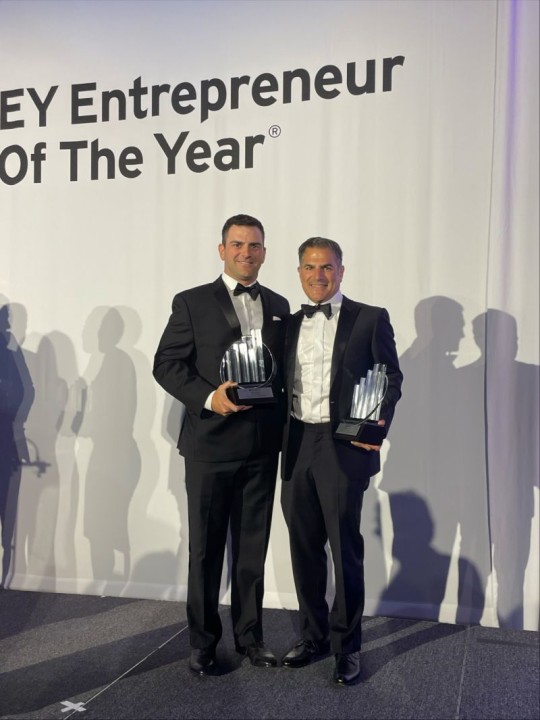
When David described their national finalist finish, he thanked FreezPak’s employees and named several people who had helped along the way. The acknowledgment widened the cast beyond the two founders. Their names sit together at the top of the company, but the operating business depends on teams carrying out the work across its locations. In June 2024, the brothers appeared together again, this time on a corporate-growth panel in New Jersey.
The business kept adding geography. In December 2024, FreezPak announced its first West Coast facility, a Los Angeles operation with 20,000 frozen and cooler pallet positions. Its location, approximately 20 miles from the Los Angeles and Long Beach ports, connected the company’s port-focused approach to another coast.
Jacksonville’s opening announcement followed in April 2025, describing 272,000 square feet and more than 50,000 pallet positions. In 2026, an opening in Fall River, Massachusetts, extended the network’s service to New England. Another 2026 announcement brought the story back to Elizabeth, New Jersey, with up to 9.85 million cubic feet of capacity.
- Los AngelesFirst West Coast facility announced
- JacksonvilleSoutheast opening announced
- Fall RiverNew England opening announced
The widening map gives the early forklift story a different scale. Every new building presents another place where equipment, people, instructions and customer expectations must work together. Expansion multiplies those operating questions. The photograph with the awards records a moment of recognition; the announcements that followed describe more work to be done.
Saoud’s public career offers a consistent set of interests: the family business, the working warehouse and the customer waiting at the other end of a movement. His decisions have reached from a forklift’s power supply to the development of facilities near ports. The distance between those things is smaller once you spend time considering how goods move.
Back at that demonstration in 2014, the attraction was immediate. Equipment that had stopped could get going again. Years of investment and expansion followed, but the proposition was small enough to measure with a watch. Ninety seconds, then back to work.