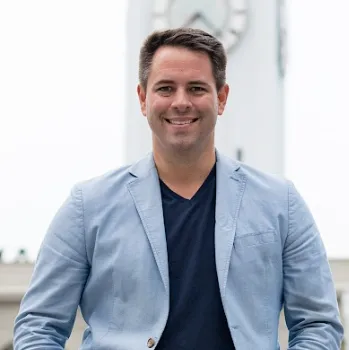
The Rocket Scientist
Running the Cloud's Plumbing
At 19, Michael Reid was drawing aerospace trajectories at Queensland University of Technology - calculating rocket paths, dreaming of flight. The aviation industry in Australia had other plans. No jobs. Zero prospects. A degree in the world's coolest engineering discipline, and absolutely nowhere to use it.
So he pivoted. His first tech boss handed him a Cisco certification manual he had never asked for. Reid had never heard of Cisco. He passed anyway. And that unlikely detour - from aerospace to routers, from trajectories to traffic routing - launched one of the more consequential careers in enterprise networking.
Today, Reid runs Megaport, the global Network-as-a-Service platform that operates invisibly inside the world's most important data centers. The company connects enterprises to clouds - AWS, Azure, Google Cloud Platform, Oracle - in roughly 60 seconds, at speeds up to 100 Gbps, across more than 1,000 data center locations in 26 countries. The plumbing nobody sees. The infrastructure everything depends on.
"Where a 10 Gbps circuit once sufficed, customers now ask for 100 Gbps to train or run inference for a defined window."
- Michael Reid, CEO of MegaportReid took the Megaport CEO role on May 15, 2023. His predecessor, Vincent English, had built the company from the ground up - a founder's arc. Reid inherited a different mandate: profitability. Megaport had been burning cash since its ASX listing, famously growth-first in a market that had rewarded exactly that. By the time Reid arrived, the market had stopped rewarding it.
He kept one executive from the prior leadership team. One. Then rebuilt everything else - the product suite, the sales organization, the go-to-market structure. Within twelve months, Megaport posted a net cash inflow of $28 million, reversing a $34.5 million outflow from the prior year. In FY24, the company recorded its first-ever profit after tax. Customer Lifetime Value hit $2.1 billion in FY25, up 50% year-on-year. The stock moved accordingly.
15 Years at Cisco
Reid joined Cisco in April 2008 - the financial crisis, as he has noted, not the most auspicious timing. It turned out to be irrelevant. He spent the next 15 years building one of the more varied internal careers in the company's history: managing banking and finance clients in Sydney, running Cisco's Northern Australia region (which spans Queensland, the Northern Territory, and Papua New Guinea), then relocating to San Jose to lead worldwide acquisitions.
That acquisitions role is where the numbers get interesting. Reid integrated six companies into Cisco, a role that required equal parts deal structuring, cultural translation, and operational nerve. Most acquisitions fail at integration. Reid's track record became a credential in its own right.
The final act of his Cisco tenure was ThousandEyes - a SaaS network visibility business Cisco had acquired that monitors and troubleshoots digital networks across clouds and the internet. Reid joined as Chief Revenue Officer and hit the accelerator. He grew the team from 150 to nearly 400 employees - roughly 300 hires in a single year during the pandemic, when the broader job market was in chaos. ARR grew 2.4 times. ThousandEyes became, by Cisco's own characterization, the world's largest cloud, SaaS, and internet visibility platform.
The ThousandEyes years gave Reid something specific: the operational instinct to scale fast in a market that rewards whoever gets to density first. He brought that instinct to Megaport, where density - the number of data centers and cloud on-ramps on the platform - is the moat.
"Software-defined control atop pre-provisioned capacity represents the necessary industry direction for handling AI-driven compute arbitrage."
- Michael Reid, Investment Reports InterviewNetworking for the Inference Era
Ask Reid about AI and he identifies three distinct pressure points. First: budgets reopened. After a period of post-COVID belt-tightening from 2022 into 2024, board-level pressure to "do something with AI" pushed CEOs to their CIOs to modernize security, software, and networks. The projects that had been deferred came back, faster and larger.
Second: the compute farms. Dedicated AI training and inference facilities are appearing at scale, and they need massive data movement. The 10 Gbps circuits that served enterprises for years are suddenly inadequate. Customers arrive at Megaport asking for 100 Gbps - not as a future aspiration, but as an immediate operational requirement, often for a defined training window. Elastic, on-demand bandwidth - Megaport's actual product - becomes the necessary delivery mechanism.
Third: the AI providers themselves. Hyperscalers and AI infrastructure companies need rapid global deployment. Megaport's platform, with its 26 carrier licenses, 6,000 fiber routes, and API-first architecture, positions it as a distribution layer for exactly that expansion.
The thesis Reid is executing: networking automation shifts from exception to standard. Enterprises that once provisioned circuits through weeks-long procurement processes now expect cloud-style self-service - spin up, spin down, pay for what you use. Megaport built that model before AI made it obviously necessary. Reid is now capitalizing on the tailwind.
Brisbane to San Francisco
Colleagues call him "Chopper" - a nickname that captures something about his decisiveness, or perhaps his willingness to clear the decks. He is an international commuter by necessity: Megaport's headquarters sits in Brisbane, its CEO lives in San Francisco, and the network spans 26 countries. He listens to the All-In podcast, This Week in Startups, and Uplink to track markets and technology. He is most easily reached on LinkedIn.
His leadership philosophy - articulated in several interviews - centers on finding and igniting talent rather than credentialing it. He has promoted people into functions they had never held before, then mentored them through the learning curve. The ThousandEyes hiring blitz during COVID was, in part, a stress test of exactly that philosophy at scale.
In 2019, CEO Magazine named him Sales Executive of the Year - recognition that came before the Megaport chapter, when he was still operating inside a much larger machine. The award signaled something about how he was seen inside Cisco: as a builder, not just a manager. Someone who grew things.
On Day 1 as Megaport CEO, Reid posted publicly on LinkedIn: "I'm honored and grateful for the privilege." It read like an understatement, given what was in front of him. He had walked into a company mid-reinvention, with the market watching and the clock running. What he delivered - profit, growth, and a transformed organization - is the kind of outcome that turns a career milestone into a case study.