A billboard has a peculiar disadvantage in the advertising business: nobody clicks it. People pass it on their way to somewhere else. They might remember the car, the coffee, the shoes. They might buy something later. For an advertiser accustomed to counting clicks, this is an inconvenient arrangement. Michael Provenzano built his second company around making that journey easier to understand.
His first advertising company, Invite Media, helped buyers bid for online display ads. Google bought it in 2010. The next opportunity required looking up from the browser. There were screens in elevators, taxis, shopping centers and airports, and businesses trying to sell the advertising space on them. Provenzano saw room to bring software into those transactions. The surroundings changed; the problem of connecting a buyer with the right audience remained.
By January 2025, T-Mobile was announcing an agreement to acquire Vistar Media for approximately $600 million in cash, subject to closing adjustments. At announcement, Vistar's network connected more than 1.1 million digital screens, nearly 370 media owners and more than 3,000 brand advertisers. Those numbers describe a marketplace, rather than a collection of billboards owned by Provenzano. His business supplied the machinery that helped other people buy, sell and manage advertising.
The transaction closed on February 3, 2025. For a founder who had already sold one advertising technology company to Google, it made an unusually tidy pair of milestones. But the useful part of his story lies between the two sales: years spent persuading an established industry to change its habits, while learning which habits deserved to survive.
Before the screens, a relay baton
Provenzano grew up in Houston and attended Memorial High School. His college athletic record contains a detail that rarely appears in an executive biography: he was a 400-meter district champion in 2003 and part of a district championship 4 x 400-meter relay team in 2004. At the University of Pennsylvania, he ran a leg of the 4 x 100-meter relay at the 2005 Penn Relays.
He studied materials science and engineering, earning a BSE. His LinkedIn education dates run from 2004 to 2008 and include Penn's men's track and field team. The degree concerned the properties of materials; his eventual work concerned the movement of advertising budgets. A career is allowed a change of subject.
At Invite Media, his fellow founders included Nat Turner, Zach Weinberg and Scott Becker. The company developed technology for buying display advertising across exchanges. Its sale to Google arrived just two years after Provenzano graduated. He briefly worked at Google afterward, carrying experience of the online advertising market into the next venture.
One of the people who crossed that bridge with him was Mark Chadwick, Invite's former chief architect. Jeremy Ozen, another Penn connection, joined them in creating Vistar. Provenzano and Ozen began working on the concept in 2011; the company was founded in 2012. That distinction puts a little daylight between having an idea and starting the organization that must make it work.
A row house is a perfectly serviceable headquarters
Vistar's early geography was split. Chadwick built the engineering operation in a Philadelphia apartment near Rittenhouse Square while the business side worked in New York. Provenzano later described the journey in an article title that began with a software team in a Philadelphia row home. Before there was a global platform, there was a relatively small place in which people had to build one.
The setting matters because Vistar's task was practical. A screen owner could have digital equipment and still rely on laborious ways of selling the space. An advertiser could admire a location and still struggle to connect that purchase to business results. Software had to make those exchanges easier for both parties. A clever buying tool was only useful if there was something available to buy.
By 2015, Vistar had raised a $1.5 million seed round and grown to about 30 staff. Provenzano said the business had been profitable the preceding year. The engineering team moved from the apartment into a Center City office. These are modest details alongside a later acquisition price, but they show an organization learning to support itself before the headline became large.
Provenzano's early account of the market was decidedly unsentimental. Other companies had already tried to bring technology to outdoor advertising and failed. Owners had unsold space; prospective advertisers needed convincing. Vistar's approach included using location data to understand shopping behavior and movement, then helping assess what happened after an audience had an opportunity to see a campaign. The sale required evidence as well as a screen.
- 2010Google buys Invite Media
- 2012Vistar Media is founded
- 2024Adstruc joins Vistar
- 2025T-Mobile acquisition closes
The customer gets a vote
There is a recurring theme in Provenzano's public explanations: the people already doing the work have information the software builder needs. In a 2018 interview, he discussed media owners' concerns about automated buying. They wanted more revenue, certainly. They also wanted control over prices and the advertisements appearing on their inventory. Automation would have to fit those concerns into its design.
That is a less glamorous assignment than promising to replace an industry. It involves understanding why a seller needs an approval, why a buyer needs a familiar workflow and why a technically possible transaction might remain commercially awkward. Provenzano's company worked across the buying and selling sides, along with the software used to run screen networks. Each side brought its own definition of a successful product.
His 2022 account of Vistar's expansion included Canada, Australia and New Zealand, Singapore, Southeast Asia and the United Kingdom. The acquisition of Amsterdam-based Sage+Archer extended its European presence. He also joined the Geopath board, discussing quality data and shared standards as ingredients in a market advertisers could trust. Growth meant coordinating more participants across more places.
The creative possibilities interested him too. In 2023, he described campaigns that could change with the weather or time of day, and urged brands to learn what the medium could do. A public screen occupies a particular place at a particular moment. Its message can respond to that setting. The software, in this telling, gives the creative department more useful choices.
“Everything starts with a drink”
The expansion into traditional outdoor advertising came with an origin story short enough to fit on a cocktail napkin. At a World Out of Home event, Provenzano was catching up with PJX Media CEO Rick Robinson. Vistar had been interested in the static side of the business. He asked whether Robinson might consider selling Adstruc, PJX's planning platform.
“Everything starts with a drink,” Provenzano joked when explaining the deal. Vistar announced the acquisition in April 2024. Behind the casual beginning was a specific customer request: buyers wanted to handle more of their outdoor advertising in one place. Digital transactions accounted for only part of their work, so a platform devoted to them could leave a substantial part of the day untouched.
This was also a return to a problem Vistar had previously approached imperfectly. Provenzano acknowledged that an earlier free planning tool had not been brought to market correctly. Buying Adstruc brought an established workflow and people who understood it. The anecdote is revealing because the founder allows an unsuccessful attempt into the explanation. The route to a product can include an earlier product that did not land.
Robinson brought expertise in traditional outdoor advertising; Provenzano brought a technology organization able to put more resources behind the platform. Their conversation shows how relationships enter a software business through the side door. Sometimes the next useful feature begins with a client request. Sometimes it begins with a question asked over a drink.
Three words the staff know by heart
When Provenzano wrote to announce the T-Mobile agreement, he returned to a familiar sequence: people, product, revenue. He admitted that the team made fun of him for repeating it. There is something reassuringly ordinary about the image of a chief executive whose employees can finish the sentence before he does.
The order describes his stated operating philosophy. Hire people who can do the work, let them build a product worth buying, and revenue follows. In his account, Vistar's culture values competition and autonomy. His gratitude extended to early customers willing to stay involved while telling the company plainly when its work disappointed them. Those customers supplied both opportunity and correction.
The people around him have described similar habits. Invite co-founder Scott Becker's public recommendation emphasizes his methodical approach to removing inefficiency. Another former colleague, Christine M., describes someone who listens, works alongside the team and helps others lead. Those are colleagues' assessments, but they fit the recurring emphasis in Provenzano's own descriptions of building a business.
His interests also extend beyond the company he runs. A 2023 World Out of Home speaker profile identified him as an investor in BrandVerge, with previous interests including Dextro and AdTheorent. The connections run through advertising, marketplaces and software. His public career keeps returning to the systems that help a market function, and the people prepared to build them.
“people, product, revenue”Michael Provenzano's operating philosophy, in that order.
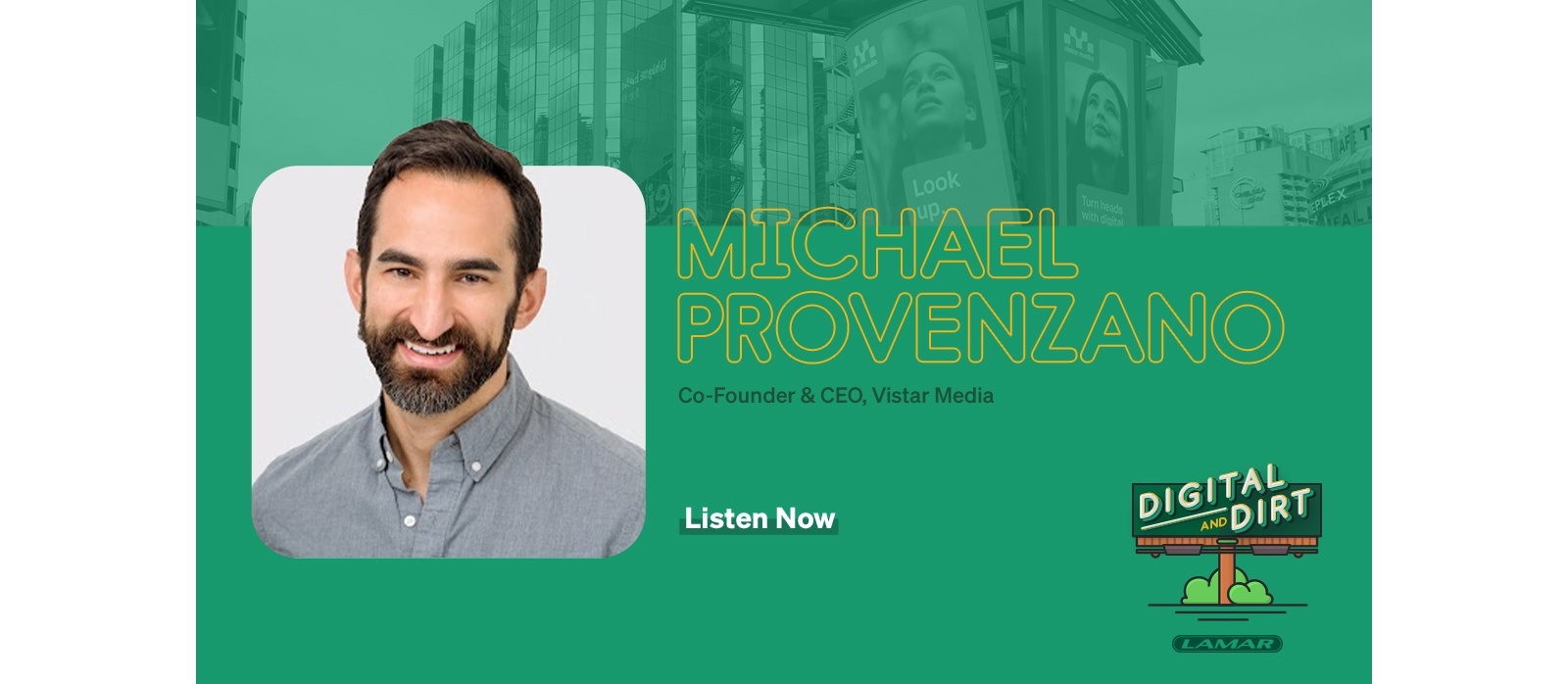
Episode artwork: Lamar Advertising.
The next journey is still outside
T-Mobile arrived with an existing working relationship. Vistar had already supplied technology across its buying platform, selling platform, device management and retail media operations. The acquisition deepened a partnership that was already being tested in actual use. Provenzano's stated ambition was to expand what the combined businesses could offer customers and partners around the world.
By October 2026, that relationship had produced a further product integration. Vistar announced thousands of audience segments powered by T-Mobile's first-party carrier data, available through its demand-side platform. T-Mobile turns consented signals into aggregated audience scores; Vistar matches them with available outdoor inventory. The purpose is to help advertisers choose screens where their intended audiences are more likely to be.
Provenzano remains listed as Vistar's CEO and co-founder. The work now sits inside a larger organization, with the original question still recognizable: how can a brand make a better decision about reaching people as they move through the world? The billboard still cannot offer a clickable button. Provenzano has spent much of his career building the systems around that small inconvenience.