Consider the wall of a sports bar. The television has a job: show the game. The chalkboard has another: sell the special. Between them sits an awkward commercial question. How do you reach the people who came for the first without becoming the thing that interrupts it?
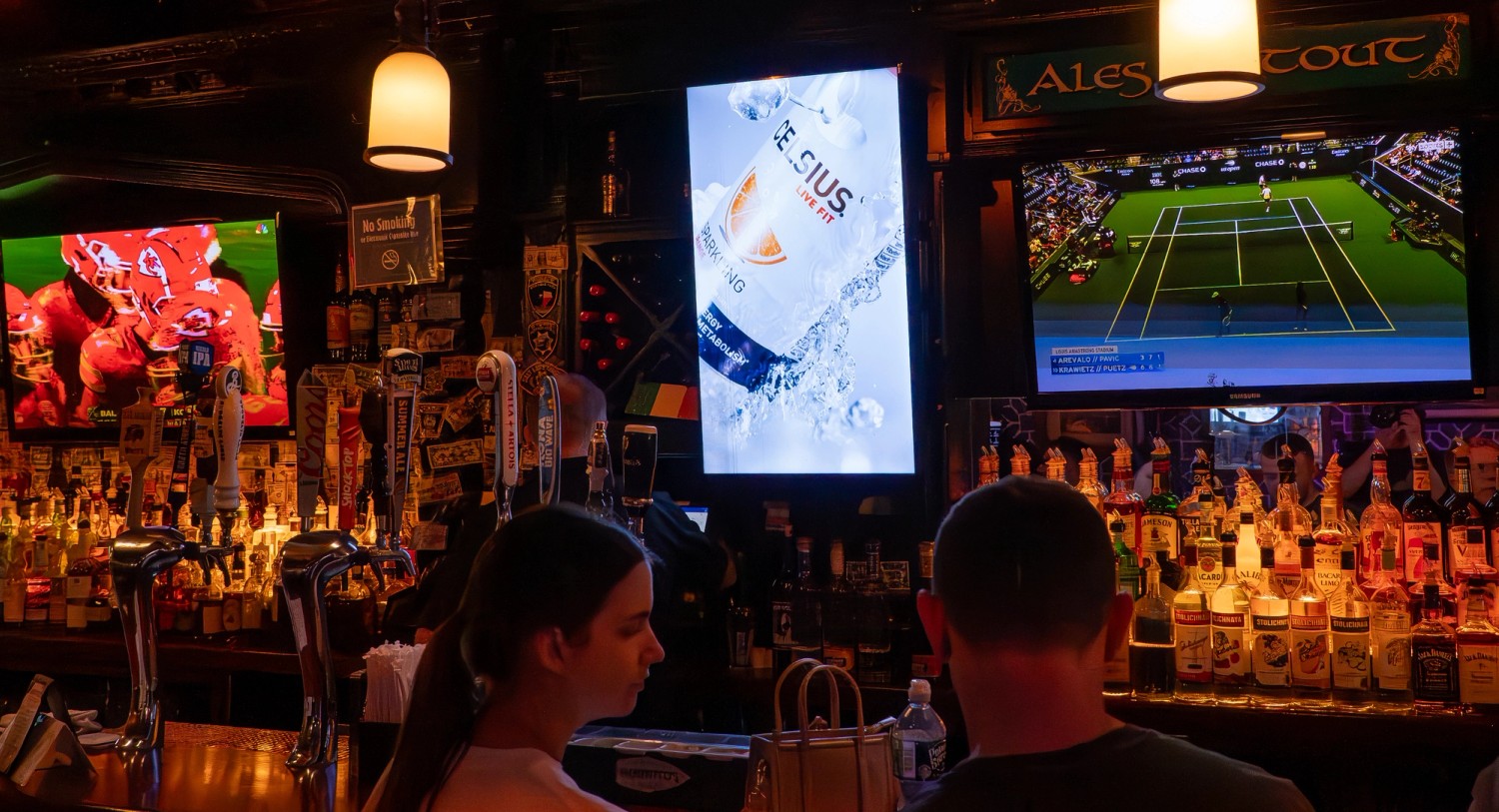
TVM’s answer is a screen turned sideways. Its vertical displays sit inside bars and restaurants, carrying sports information, venue promotions and advertising. The distinction sounds cosmetic until you notice what it permits. The game can keep running. The bar can announce happy hour. An advertiser can join the room.
- Venues get screens, installation, software and support at no cost, under TVM’s advertised offer.
- Brands buy access to a network TVM says spans 3,000 U.S. sports bars.
- The useful lesson: give the host a reason to welcome the advertising.
A useful screen earns its wall
For a venue operator, the product begins with a small task: telling customers what is available. TVM’s app lets staff update food and drink specials, happy hours and events remotely. Its sports feed adds scores, odds and game-day information. A display becomes part menu, part noticeboard, part companion to the television.
The earlier TVM Play offering makes that practical ambition especially clear. It described templates for promotions, cocktail menus and draft lists, alongside an Instagram hashtag widget. Those are ordinary jobs. That is their appeal. A bar owner has a reason to use the system even before a national brand buys an advertisement.
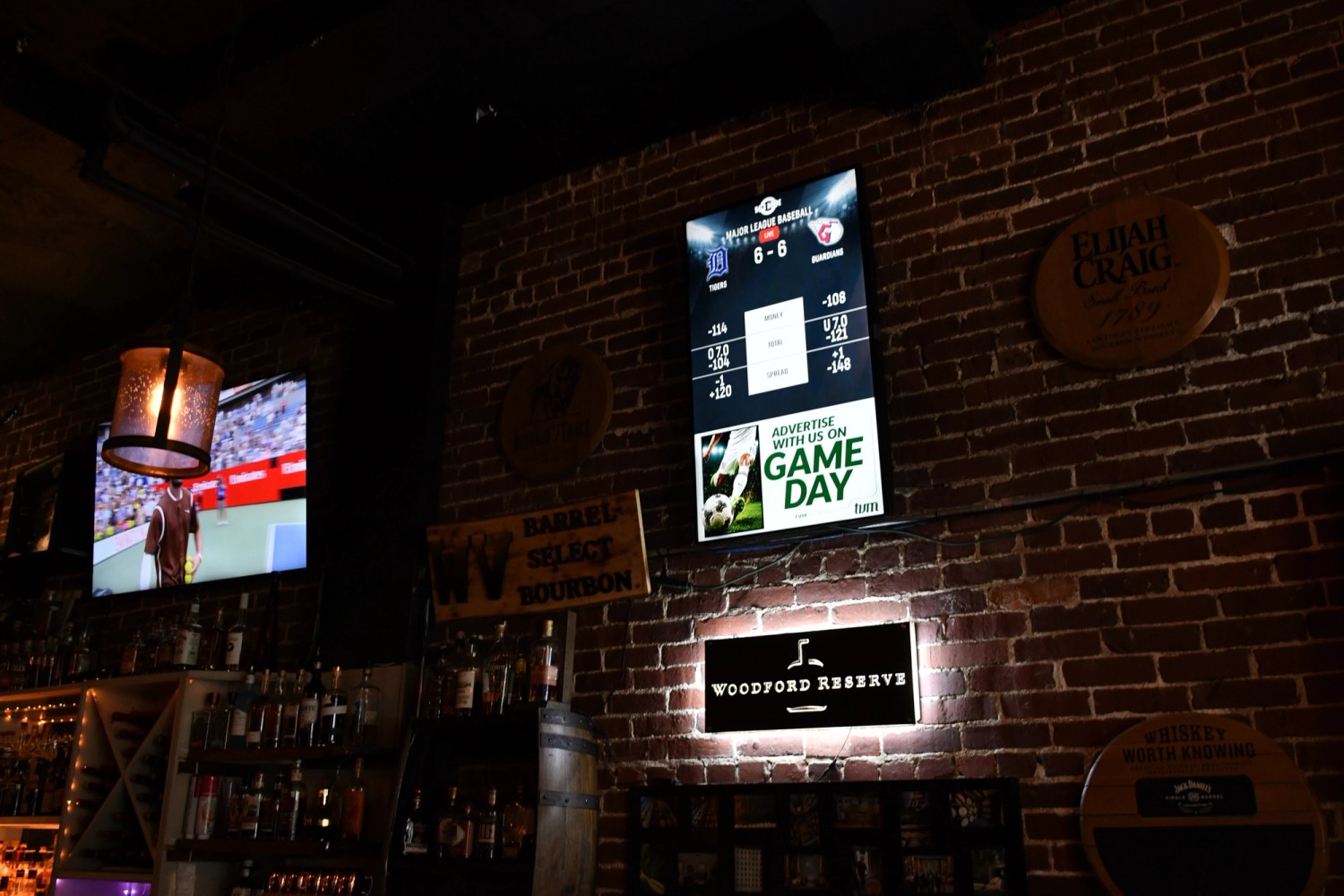
The Android TVM Showcase App offers a preview of the venue content experience. That is a telling product choice: the proposition is easier to understand when someone can see what the screen actually does. Software matters here because it keeps a physical object useful after the installation crew leaves.
The price of free is access
TVM’s venue page says the company handles hardware, installation, technology and ongoing support without charging the venue. The commercial exchange becomes clearer in its public U.S. terms: TVM keeps ownership of the equipment and reserves up to 20% of screen time, alongside branding rights on the mandatory sports feed.
Those terms specify a 24-month agreement, automatic extensions and a 60-day test period. They also require the system to operate during opening hours. For an operator considering the offer, the useful questions concern placement, programming control and the agreement’s duration as much as the initial bill.
Screens + software
Installation + support
Wall space + operation
Access for advertising
On the other side are brands and agencies buying media. TVM offers campaigns at market, regional and national levels. This makes the company a media owner with a venue product attached. The promotional software helps establish distribution; advertising turns that distribution into something buyers can purchase.
The customer who wanted people to stop drinking and driving
A revealing example comes from outside the beverage business. The National Highway Traffic Safety Administration’s 2022 Labor Day impaired-driving media plan included TVM as a new partner. It described almost 2,000 bars and restaurants and planned 12.5 million paid impressions through the network.
The plan explained its choice in unusually concrete terms. TVM’s vertical screens and their placement differed from Atmosphere’s, and its venue list had limited overlap. Buying both could add reach. For a campaign about impaired driving, appearing inside establishments serving alcohol also put the message close to the decision it hoped to influence.
That document establishes a planned buy, rather than a measured reduction in crashes or a completed impression total. Still, it shows what makes the inventory useful to a buyer: a particular setting, a particular format and people another network might miss. “Bars” is a much more specific distribution strategy than “consumers.”
From a wall to an auction
In December 2021, TVM selected Vistar Media’s ad server. The partnership connected directly sold campaigns and programmatic advertising, with buyers able to use private marketplace deals or an exchange. The unified auction was intended to improve how TVM sold its available advertising slots.
This is where its expertise extends beyond hanging displays. The business needs content management, functioning hardware, advertiser access and reliable descriptions of each location. Vistar later named TVM among participants in its Verify program, which evaluates inventory quality, including venue information and screen presentation. Such checks help make a scattered physical network legible to media buyers.
The room is harder than the pitch
Founded in 2017, TVM lists Michael Demir, Cihan Demir and Pedram Danesh as its founders in Crunchbase. Butterfly Ventures appears among its seed backers. Those beginnings place it at the meeting point of hospitality software and advertising: a company selling access to physical places while supplying the technology that makes those places usable as media.
The operational difficulty appeared early. In a St. Pete Catalyst interview, then-CFO Andreas Calabrese described recurring technical challenges and the problem of keeping different offices aligned. He had worked with TVM as a U.S. project manager for six months before joining full-time. His account makes expansion sound like a coordination job.
“There’s a lot of technical challenges that are small and recurring.”Andreas Calabrese · then CFO, speaking to St. Pete Catalyst
The company now presents a more explicit sports-fandom proposition. Its current materials report 7,000 screens in 3,000 U.S. sports bars, with operations also in Sweden. Henriette Zeuchner announced her appointment as group CEO in October 2025. In 2026, TVM promoted its presence around World Cup viewing and Cannes Lions.
The lesson another business can copy is the exchange: solve a recurring problem for the place that hosts your audience. The limits follow the same logic. A quiet venue offers fewer encounters; poor placement makes a screen easy to miss; irrelevant creative wastes proximity. Being in the room creates an opportunity. It does not establish attention or prove an extra sale. TVM’s wager is that a useful screen can earn enough of both to stay on the wall.