The largest in-store retail media network for grocery in America - putting brand advertising at the point of purchase, where the buying actually happens.
GROCERY TV // Digital screens at the front end of a partner store run brand campaigns beside retailer promotions - the moment a shopper is deciding what lands in the cart.
Retail media exploded online - sponsored listings, banner ads, the whole apparatus of digital shelves. But there was an inconvenient fact hiding in plain sight: more than 90% of grocery transactions still happen inside a physical store. Grocery TV was built for that gap. It equips grocery retailers with digital screens at the checkout, on end caps, in the center store and across service departments, then supplies the software and measurement to run them like a proper advertising business.
The pitch to a retailer is unusually simple. Grocery TV installs the hardware at no cost, hands over a content management system to push the store's own promotions - curbside pickup, loyalty programs, weekly deals - and sells advertising that runs alongside that content. The revenue is shared. A grocer that once gave away the most valuable real estate it owns, the moment a shopper is standing at the register deciding, now earns from it.
The pitch to a brand is just as direct. A campaign on Grocery TV reaches roughly one in four Americans in any given week, at the exact point where a purchase decision is made rather than three clicks and a day removed from it. And unlike a static end-cap poster, the exposure can be tied back to sales - a closed loop that in-store advertising historically never had.
That combination - free-to-install hardware, retailer revenue share, and measurable brand campaigns - is what turned a scattering of screens into the largest in-store retail media network for grocery in the United States.
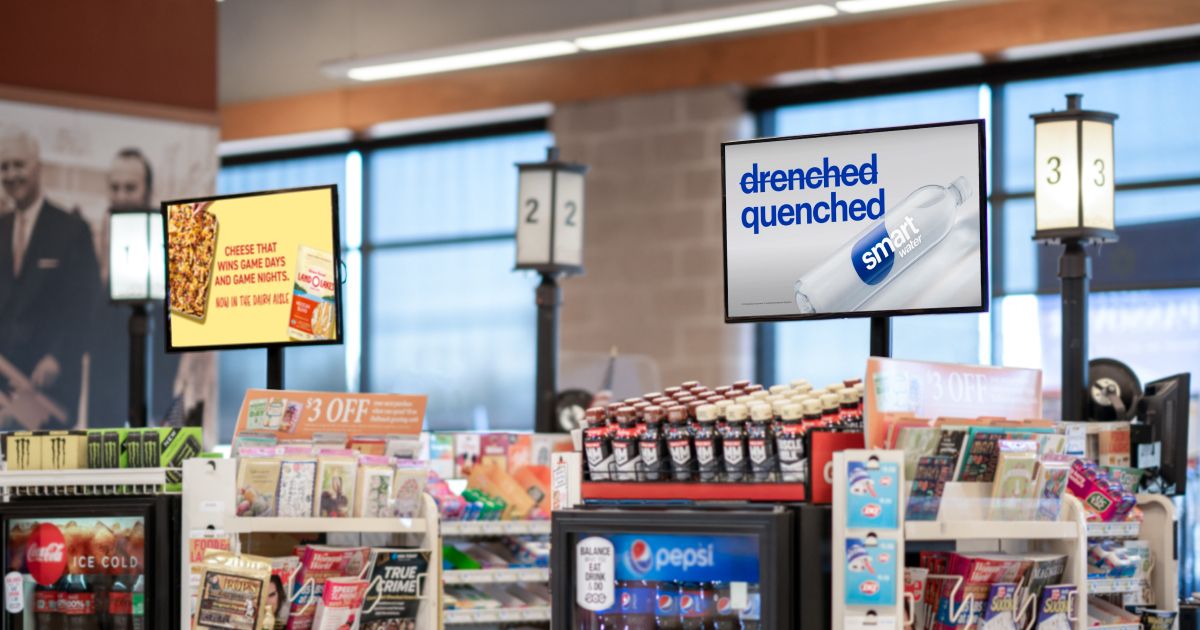
The connective tissue: brand campaigns delivered across 6,500+ stores and 120+ retail partners, sold and managed by Grocery TV so both endemic CPG and non-endemic brands can reach shoppers at the point of purchase.
Screens at the front end, end caps, center store and service departments - supplied and installed on Grocery TV's own technology stack at no cost to the retailer.
A CMS that lets each retailer deliver its own promotions and store content while brand advertising runs alongside it on the same screens, from one place.
Closed-loop measurement tying in-store exposure to sales lift, incremental reach and return on ad spend - the accountability layer online retail media set as the standard.
When you think about it, 90-plus percent of grocery transactions still happen in-store.
From Grocery TV's In-Store Retail Media Playbook - benchmarks the company reports for campaigns run across its network. Treat them as reported performance figures, not guarantees.
Grocery TV runs a two-sided business. On one side are grocery retailers - 120+ partners including Giant Eagle, Hy-Vee, Tops Friendly Markets, Price Chopper and Market 32, ShopRite, Winn-Dixie, Food City, Fareway, Cub, Brookshire's, Smart & Final and Redner's Markets - who want to modernize and monetize their stores. On the other are advertisers, both the CPG brands sitting on the shelf and non-endemic brands that don't, reaching about 95 million shoppers weekly.
Grocers historically had no clean way to run screens, sell ad space, and prove results across hundreds of locations. Brands had no measurable way to reach shoppers at the shelf. Grocery TV solves both: it takes on the hardware, software and operations grocers can't build alone, and gives brands a channel where a screen impression can be connected to an actual sale.
Rather than retrofitting generic digital-out-of-home tech, Grocery TV built a stack specifically for grocery layouts and operations, with an average six-week deployment to get a retailer live. The zero-cost install plus revenue share lowers the barrier for grocers, while the in-house measurement gives brands the accountability that pure signage vendors lack.
Retail media is one of advertising's fastest-growing categories, but most of the money and infrastructure went to online channels first. Grocery TV sits at the in-store frontier - competing with players like Cooler Screens and Vibenomics and complementing retailer-owned networks - and argues the physical aisle is the category's most underinvested opportunity.
We're building something bigger than ourselves - a platform that powers the growth of in-store media.
Over a phone call in a small Bakersfield apartment, Don Oelke and his family - 40+ years in grocery fixtures - see an opening to recapture shopper attention as magazine sales decline.
Oelke connects with Marlow Nickell and Edward Cates' boutique software firm; the company forms under the legal name Clerk Retail, Inc.
The first Grocery TV store launches in late 2017, with co-founders Cates and Oelke building the display units by hand.
A $5M Series A led by Silverton Partners funds the network's early expansion.
Sageview Capital leads a $30M round, with Silverton Partners, to scale in-store retail media nationally.
The Redner's Markets partnership pushes the network beyond 5,000 stores.
Grocery TV surpasses 6,500 stores across 120+ retailers and unveils a new brand identity.
The seed was a call between Don Oelke and his dad and uncle, who had 40+ years in grocery and made gum and candy fixtures - and saw new tech as the way to win back attention.
When the first store went live in late 2017, the co-founders assembled the display units themselves.
The legal entity is Clerk Retail, Inc. - "Grocery TV" is the flagship product that grew into the public brand.
Installation costs the retailer nothing; Grocery TV foots the hardware and shares ad revenue instead.
Watch & listen: Marlow Nickell on Beet.TV (2026), the CPG Guys podcast, and The Drum. Product demos and screen tours are featured on the Grocery TV website.