The view from TripleLift’s first office was the wrong side of a billboard. Times Square glittered somewhere beyond it. Inside, there was no heat. Eric Berry, Ari Lewine and Shaun Zacharia had a company to invent, and New York was contributing very little in the way of encouragement. Zacharia later remembered wondering whether they would make it through the first half of 2012. They were eventually kicked out of the office.
It is a useful place to begin a story that ends up involving a $1.4 billion valuation. The billboard gives the early business an appropriately awkward relationship with advertising: surrounded by the stuff, still trying to work out how to improve it. The founders had experience at AppNexus, technical ability, and each other. A settled product was another matter.
Berry’s career has repeatedly involved discovering that the next useful step requires leaving something behind. A legal career. A product into which effort has already gone. Eventually, the chief executive’s job itself. His particular skill was to give those changes an operating discipline. He could reconsider the answer without treating the accounts as optional reading.
An engineer takes the long way back
Before the advertising business, there was engineering at MIT, followed by NYU School of Law. Berry had grown up around lawyers and founded the MIT Law Club. Friends and family supplied a vocational diagnosis: “You’re very argumentative, you should go to law school.” It is career advice with an ingenious defensive mechanism. Disagreeing only strengthens the recommendation.
He graduated from NYU Law in 2008 and spent two years as a corporate associate at Simpson Thacher & Bartlett. The work involved private equity and transactions. By 2010, he had returned to technology, joining AppNexus in product architecture and client services. There he met Lewine and Zacharia, his future co-founders.
The route matters because an advertising exchange sits among several kinds of difficulty at once. Software has to run. Buyers and sellers have to agree on the transaction. A company has to turn all that activity into a business. Berry had approached those questions from more than one direction before he was responsible for the whole arrangement.
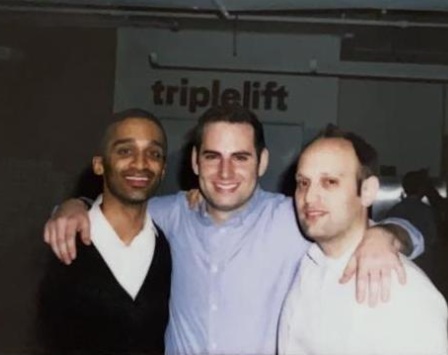
The idea survived. The products did not.
Berry’s later account of the accelerator period has very little of the immaculate origin myth. Other businesses already had customers. His team incorporated on the accelerator’s second day. A company sharing their office was working on wedding websites, and Pinterest kept coming up. Images were becoming a way people discovered things, expressed preferences and spent their time online.
The founders changed course repeatedly. Years later, Berry recalled taking six alternatives to the board after a seed round and pursuing the one the directors found least appealing. That anecdote contains a founder’s familiar confidence, but also something less frequently advertised: the willingness to tell investors that the previous idea needed replacing.
The stable part was a belief that advertising ought to work with a good user experience. Finding the right technology, format and commercial arrangement took repeated attempts. By 2019, Berry described TripleLift as organized around an idea rather than a particular product. The distinction gave the company room to move. An unsuccessful product could go without taking the entire purpose of the business with it.
There is an unromantic cost to that freedom. Abandoning a product means admitting that work already completed will not justify more work. The founder has to make the decision in front of colleagues who helped build it. Berry’s account makes that discomfort part of the job. Time spent is a fact about the past; customers still get a vote about the future.
An advertisement learns some manners
The commercial problem was easy to recognize. A large social platform could ask advertisers to make creative for its particular environment. Independent publishers, with their different page designs and buying relationships, faced a more complicated task. An advertiser wanted reusable assets. A publisher wanted something that belonged on its site. Neither side particularly wanted another bespoke production project.
TripleLift built an exchange, computer vision technology and a rendering engine. The system could identify elements within creative assets, including faces, text and logos, then assemble advertising to suit a publisher’s layout. Buying could happen through the automated systems advertisers already used. The visible result was an ad placement; much of the business was the machinery behind it.
A simplified explanation of TripleLift’s native advertising model.
That is why Berry’s engineering background is more than a biographical decoration. A promise about how an advertisement looks becomes a software problem when it has to work across many publishers. A pleasing example on one page is only the beginning. The repeatable process is what gives the example a business model.
The customer’s existing habits mattered too. Berry has described building around how customers understood the market and were accustomed to buying. A new advertising experience still needed a practical route into their spending. The company had to make its invention usable within the industry it hoped to change.
The pleasure of a smaller funding total
In 2019, TripleLift’s founders were asked what they would do differently. Berry’s answer was that he would have tried to raise less. The company had raised $16.5 million. For many founders, that number belongs in the paragraph explaining how much they have achieved. Berry was considering whether it could have been smaller.
“If anything, I would try to have raised less.”
Eric Berry, looking back on TripleLift’s financing in 2019
The attitude came from circumstances as well as preference. Advertising technology was not a sector every venture investor wanted to finance. Berry has said that the business therefore had to operate leanly. From 2015 through the 2021 sale, it was profitable. Annual planning aimed to find the most aggressive growth the company could support while still breaking even.
That put decisions about hiring, opportunities and organizational structure in the same conversation. A promising expansion had to fit the available resources. A budget became a way of choosing among ambitions, rather than merely documenting them after the choices were made. The freedom Berry valued came with a recurring obligation to decide what the business could afford.
Financing and company value are different measures. Neither is a statement of Berry’s personal wealth.
Vista Equity Partners announced its majority investment in March 2021; the transaction closed that spring. The company had grown from its native advertising proposition into a programmatic exchange and was developing connected television advertising. In his message to employees, Berry presented those as successive chapters that had helped create the value behind the deal.
The funding total and the sale valuation make an arresting pair, but they describe a collective outcome. True Ventures, an early investor, congratulated all three co-founders and the team. Berry’s own account of the transaction likewise addressed the people who had done the work. A founder can carry the headline while the company supplies the result.
Bring your homework
Inside the business, Berry’s strategy process involved something less photogenic than a deal announcement: written preparation. Leadership offsites examined threats, adjacent opportunities and the product mix. Participants prepared analyses ahead of time and shared them before the discussion. The meeting began with something people could examine, rather than relying entirely on whoever spoke most fluently.
He also described the value of having two co-founders with different perspectives. Trust in one another’s intentions allowed disagreements to become useful. That is a more demanding arrangement than simply getting along. It requires believing that a colleague can disagree with your preferred answer while still trying to do right by the same company.
The preparation had a practical counterpart in company communication. Berry wanted people to understand the reasoning behind decisions and to see what the technology actually produced. Company town halls included examples of advertising and publisher placements. An exchange can become abstract to the people building it. Showing the output made the work visible again.
A different seat at the table
In October 2022, Dave Clark succeeded Berry as TripleLift’s chief executive. The announcement said Berry would remain on the board. In his own public reflection, Berry called stepping down a difficult choice and emphasized the colleagues, publishers and marketers who had made the company part of his life. The handoff required another kind of judgment about what should happen next.
He went on to investment work. Bedford Bridge became Averin in May 2025, and Berry is now a co-founder and managing partner. In July 2026, he revisited TripleLift’s early changes of direction on the Founders Network podcast. The early uncertainty remains part of the story he tells, even with the outcome already known.
There are also details that resist the usual founder résumé. He previously did standup comedy. He has also been an extra in Fatal Attraction, a film he says he has never watched. He lives in New York with his wife and two daughters. At home, he has described a rule against phones at the dinner table. Attention has other claimants.
Recognition had arrived along the way. In June 2019, Berry won EY’s Entrepreneur Of The Year New York award in Marketing and Advertising. A decade after law school, the former associate was being recognized for a company he had helped create. The career change had acquired a rather public endorsement.
The office behind the billboard belongs to a much earlier version of his working life. The habit of reconsidering the plan has lasted. Berry’s story leaves a useful question for anyone building something: which part of the undertaking deserves your loyalty? He kept returning to the underlying problem, gave himself permission to change the product, and paid close attention to how long the company could keep going.