The Canadian in Manhattan who told American retailers something counterintuitive: help your customers save, and they will buy more.
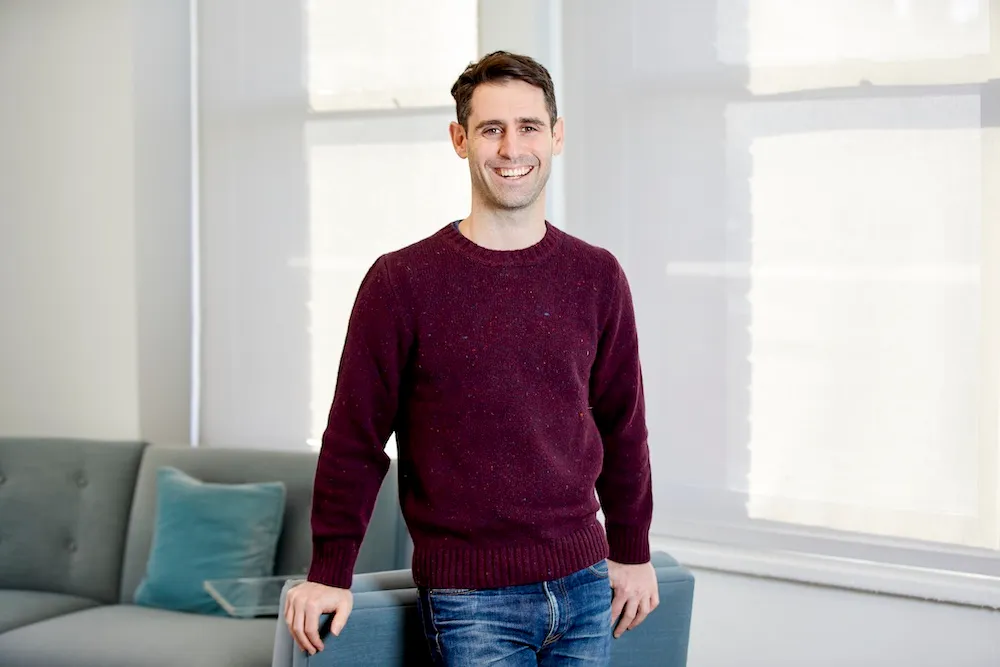
Hershfield, photographed in a well-lit room, looking like a person who has explained the concept of "Save Now, Buy Later" more times than he can count and has learned to enjoy it.
Michael Hershfield runs a New York fintech called Accrue, and Accrue does something that, said out loud, sounds either obvious or heretical depending on who is listening. It puts a savings account inside a retailer's checkout. You are shopping for a couch, or a vacation, or a pair of sneakers, and instead of a "buy now, pay later" button offering to slice the price into four installments, Accrue offers a wallet where you can put money aside, week by week, until the thing is paid for. The retailer often kicks in rewards for saving. When the balance hits the price, you buy. The category has a name now, coined in Hershfield's slide decks and podcast appearances: Save Now, Buy Later.
Accrue was founded in late 2021. Hershfield had watched, during the pandemic, credit offers arrive with a speed and enthusiasm that seemed slightly out of proportion to the goods being purchased. "I remember during the pandemic being overwhelmed with credit options," he told an interviewer. Buy now, pay later products were multiplying. Roughly forty-four percent of the people using them, he liked to point out, admitted to missing at least one payment. So he built the inverse.
The product itself is technically a co-branded, FDIC-insured wallet, a piece of financial plumbing that sits on the retailer's site and looks and feels like the retailer's brand. The customer signs up, sets a goal, contributes on a schedule, and often earns a reward from the merchant along the way. This last part is the interesting part. Retailers do not usually pay you to not buy their thing yet. Hershfield's pitch is that they should, because customers who save toward a specific product convert at higher rates, refund less, and come back more.
Accrue has raised roughly $54.7 million from a cap table that reads like a scavenger hunt of names people know. Tiger Global. Box Group. Aglae Ventures, the tech investment vehicle backed by the Arnault family. Twelve Below. Red Sea Ventures. UPS CEO Carol Tome. Fanatics CEO Michael Rubin. The Series B, twenty-five million dollars, closed in January 2023, in a fintech funding environment that was, to put it politely, no longer generous.
What Accrue sells is not really a savings account. It is a loyalty program that happens to hold money. The distinction matters because loyalty programs are a line item retailers already know how to budget for, whereas "help our customers open a bank account" is not, historically, a phrase that has appeared in retail CFO memos. Hershfield's job, in large part, has been to translate one into the other.
*Statistic Hershfield frequently cites in interviews.
"I remember during the pandemic being overwhelmed with credit options - buy now pay later being one of them."- Michael Hershfield, on why he founded Accrue
The biographical outline reads like a stack of unlikely adjacencies. Hershfield grew up in Canada, in a household where saving was described, without irony, as a normal way to live. He studied political science at McGill, then went to the University of British Columbia for a law degree. His first job on paper was as an in-house counsel at a corporate finance firm in Vancouver. Somewhere between the law and the operating world, he stopped calling himself a lawyer.
In 2007 he co-founded LiveStub, a ticketing startup, and ran it as CEO until 2010. What followed was a dense stretch of operating jobs at growing companies. Director of business development and legal at Howcast, the how-to video company. VP of business development and monetization at Sailthru, the email personalization business. COO of Kitchensurfing, the "have a chef cook dinner in your apartment" marketplace of blessed memory. COO at Nucleus. Each of these companies has a story of its own, some more graceful than others, and Hershfield's LinkedIn does not attempt to varnish the chronology.
Then WeWork. From roughly 2016 through 2019 he was Senior Vice President of Sales, a job he held for more than three years during the period when WeWork was, depending on your vantage, redefining commercial real estate or building an elaborate diorama of one. He left before the S-1. Whatever else you might say about WeWork, it was a place where you got very good at explaining a slightly unusual product to a slightly skeptical customer. Hershfield has been quietly using that skill ever since.
By late 2021 he had an idea and a hundred days. He describes the founding of Accrue as a sprint, an argument he made to himself first and then to a small circle of investors, that the entire architecture of consumer credit had been optimized to help people spend money they didn't have, and almost no one had bothered to make it easy to save money they did.
A customer picks a product or a category, sets a goal, and contributes to a wallet on their own schedule. The money is theirs, held with an FDIC-insured partner bank.
The retailer often adds contributions or bonuses as the saver progresses. It functions the way an airline miles program functions, except the currency is money and the reward is a purchase you actually wanted.
When the balance meets the goal, the purchase happens. The customer has been marketed to gently for weeks. The retailer has built a habit. Nobody has taken on debt.
"We want to give more Americans access to do the things they love."- On Accrue's mission
The financial architecture of American retail has, for the last decade, been designed around a small set of monetization primitives. Interchange fees. Points. Cashback. A steadily expanding menu of credit products, of which buy now, pay later is only the most recent and most photogenic. Each of these products is engineered to accelerate the transaction. Get the customer through checkout faster. Reduce cart abandonment by ten basis points. Let the customer pay in four.
Hershfield's argument is that this optimization has hit a limit. Consumers are, in aggregate, over-credited and under-saved. The gains from making it easier to buy have been substantially harvested. The next set of gains, he thinks, will come from making it more rewarding to wait. Waiting, in his framing, is not the enemy of retail. Waiting is a habit, and habits are worth building.
The regulatory backdrop is quietly on his side. Regulators around the world have become interested in whether buy now, pay later products should be treated more like credit than like invoicing. The Consumer Financial Protection Bureau in the United States has moved in that direction. If BNPL becomes more expensive to operate, the calculus for retailers rebalances. A savings wallet, by contrast, does not create a credit relationship, does not carry the same regulatory overhang, and does not, in the awkward phrase, put the customer in a hole.
Whether any of this ultimately produces a very large company is a separate question. There is a version of Accrue where it becomes the loyalty layer of choice for a generation of retailers. There is a version where it becomes a nice feature that a bigger platform quietly acquires. There is a version where Save Now, Buy Later turns out to be a category with a ceiling. Hershfield seems comfortable with the uncertainty, which is an underrated trait in a founder.
The founder and CEO of Accrue, a New York fintech that powers brand-embedded savings wallets for retailers.
SVP of Sales at WeWork, COO of Nucleus, co-founder and CEO of the ticketing startup LiveStub, and a series of operating roles at Howcast, Sailthru, and Kitchensurfing.
BA in Political Science from McGill University, JD from the University of British Columbia.
Roughly $54.7 million in total funding, including a $25 million Series B closed in January 2023.
Accrue's model. Customers save toward a specific purchase in an FDIC-insured, brand-customized wallet, often earning retailer rewards as they save.