The first interesting job title in Meredith Binder's public career is not Chief Marketing Officer. It is Documentation Manager. Long before she was shaping sustainability software at Novata, she was responsible for helping FactSet's U.S. sales organization understand and explain a complicated financial-data product. Documentation is where corporate romance goes to wear sensible shoes. It is also where a person learns a durable truth: information has no value merely because it exists. Someone has to find it, understand it, trust it, and use it.
That truth has followed Binder for 27 years. Her path runs through project management, sales marketing, global marketing, client operations, customer experience, merger integration, and now product leadership. Read as a list, it looks broad. Read as a story, it is unusually consistent. She has spent her career shortening the distance between complexity and action.
Chapter one / Learn the machinery
She grew because the firm grew
Binder joined FactSet in 1999 as a project manager, after studying industrial management at Carnegie Mellon. Over the next sixteen years, her responsibilities widened almost by accretion: documentation, U.S. sales marketing, international sales marketing, and eventually global marketing. She later described that chapter with admirable economy: “I started my career at a small firm, and as the firm grew - I grew.”
There is a hidden advantage in staying long enough to watch a company change scale. You learn which processes were clever at fifty people and comic at five thousand. You see the informal hallway answer turn into an onboarding problem. You discover that culture is partly a story people tell and partly the speed at which a colleague can locate the correct file.
At FactSet, rapid hiring had made knowledge-sharing harder. Binder was asked to find an internal social platform that could help new employees learn the product and the culture. Her rollout instinct was revealing. She began with few rules and modest predictions, letting people show how they wanted to use the tool. It was not laissez-faire for its own sake. It was product discovery before the phrase appeared in every planning meeting.
“Today, we have a social connection tool we can't function without.”Meredith Binder, then head of global marketing at FactSet
The network eventually connected 4,000 employees. Questions could produce answers that remained visible to everyone, turning one conversation into shared infrastructure. The episode sits neatly between her early documentation work and her present product role. In each case, the challenge is not simply storing knowledge. It is designing the conditions under which people will contribute to it.
Projects
Documentation
Marketing
Client & CX
Product
Chapter two / Survive the org chart
Then the company got much bigger
In 2015, Binder moved to SNL Financial as Senior Director of Marketing and Communications. S&P Global acquired SNL that year. A new brand is easy to announce and difficult to inhabit. Teams have histories, customers have habits, and every tidy box on the integration chart contains human beings wondering who decides what on Monday.
Binder helped bring marketing teams together after the acquisition and set strategic direction for the combined division. Her remit later expanded to global client operations, marketing, and customer experience, followed by the Chief Marketing Officer role at S&P Global Market Intelligence in 2022. The progression suggests that her value was not confined to campaigns. She was being asked to connect the promise made in the market with the experience delivered to a customer.
She did not turn this chapter into a victory parade. In a public reflection, Binder wrote that arriving at S&P Global meant learning to operate within a division and across the enterprise. “At times, it has been a learning curve for me,” she said. The candor makes the point more useful. Scale is not merely a larger version of the same job. It changes the number of people who can say no, the number who must say yes, and the amount of context that vanishes between them.
Former colleagues describe her as a flexible thinker with strong people skills, a manager who communicated across distance and accounted for local cultures. Another credited her with strategic shifts and cultural change at S&P Global Market Intelligence. Recommendations are inevitably generous, but a pattern across them is clear: Binder's leadership reputation rests on how she moves people through complexity, not only on what she announces at the end.
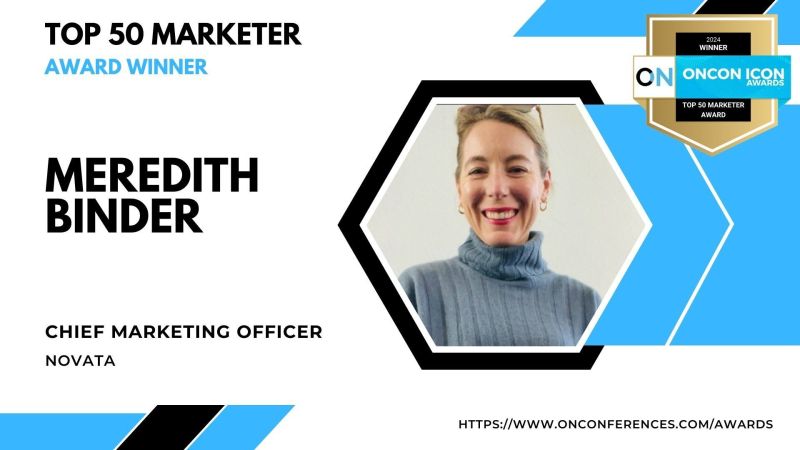
Recognition followed. DMN named her a Woman to Watch in 2017 for persona-driven work that built brand equity and sales pipeline. OnCon peers placed her among their Top 50 Marketers in 2022 and again in 2024. Binder's response to the second OnCon honor was less acceptance speech than team note. She wrote of her delight in marketing teams that create value and her gratitude for the marketers she had worked beside. The instinct to distribute credit is not decorative. It is how a leader signals what deserves repeating.
Chapter three / Make the metrics matter
Sustainability gave the old problem a new vocabulary
Binder joined Novata as Chief Marketing Officer in December 2022. The company builds software and services for collecting, reporting, and acting on sustainability data, particularly in private markets. Here, her career's two persistent subjects met: financial information and the organizational work required to make information useful.
Sustainability reporting is crowded with acronyms, frameworks, metric libraries, emissions scopes, stakeholder requests, and regulations that change by jurisdiction. Its public language can sound lofty. Its private reality often involves somebody chasing a spreadsheet attachment through an inbox.
Binder's way into the subject has been pointedly managerial. On Novata's Sustainable Intelligence audio series, she compared sustainability data with brand and marketing data. Both functions, she argued, have to demonstrate the impact of their investments if their information is to become a critical input for business decisions. It is an operator's definition of relevance. A metric earns attention when it helps someone choose.
She has also written about sustainability's changing label, arguing that a move from “ESG” toward “sustainability” changes the language more than the underlying purpose. Her older S&P Global reflections make that continuity visible. In 2019, she wrote that long-term sustainable growth required analysis of company performance and its effects on the wider world. The vocabulary has been contested since. The need to decide with better information has not.
Her article comparing ESG work with marathon training offers a more personal metaphor. A reporting program, like a training plan, depends on a defined goal, repeated measurement, patience, and the willingness to keep going after novelty has left the room. The analogy also punctures a common corporate fantasy: that declaring the target constitutes progress toward it.
“For both, it's crucial for functional leaders to be able to demonstrate the impact of their investments.”Binder on sustainability data and brand data
The combined brief / Product meets promise
Marketing moved closer to the thing being made
By 2026, Binder's Novata title had expanded to Chief Product Officer and Chief Marketing Officer. The pairing can look fashionable from a distance, but in her case it follows the grain of the career. Documentation taught her how users meet a product. Sales marketing taught her what buyers need to understand. Customer experience taught her what happens after the promise. Product leadership brings those encounters into the design of the promise itself.
That logic is visible in Novata for Supply Chains, introduced in July 2026. The software gives organizations a structured workflow for requesting and tracking sustainability information from suppliers. It also gives suppliers reusable responses and a guided process, replacing at least some of the email pursuit and spreadsheet improvisation that make reporting burdensome.
Binder framed the product around supplier fatigue. Organizations send multiple, inconsistent sustainability requests to companies with limited time and resources. Her prescription was simplicity and consistency: structured, repeatable workflows improve participation, and better participation improves data quality. The sentence is about software. It is also about respect. A system that acknowledges the other person's constraints is more likely to receive a useful answer.
This is where Binder's story becomes more interesting than a conventional rise through marketing. Her progression has not carried her away from the mechanics of information. It has carried her deeper into them. The documentation manager wanted the explanation to work. The global marketer wanted the organization to speak clearly. The customer-experience leader wanted the promise and the encounter to match. The product chief can now change the workflow that produces both.
There is no evidence that complexity is preparing to retire. Sustainability standards will evolve. Private-market firms will face new requests. Suppliers will remain busy. Artificial intelligence will fill some gaps and create fresh varieties of confusion. Binder's career offers a sturdy response: observe how people actually work, reduce needless friction, connect the data to a decision, and give the team credit when the system holds.
It is not glamorous advice. Neither was documentation. Both have aged rather well.