A clinical note can be an excellent account of what happened to a patient and a surprisingly poor guarantee that anybody will get paid. The encounter exists. The evidence exists. Somewhere between the ward and the billing office, however, a second record must be made: the charge. MediMobile has built its business around that second record, and the uncomfortable possibility that nobody remembered to create it.
- Mobile charge capture keeps encounters and patient lists moving.
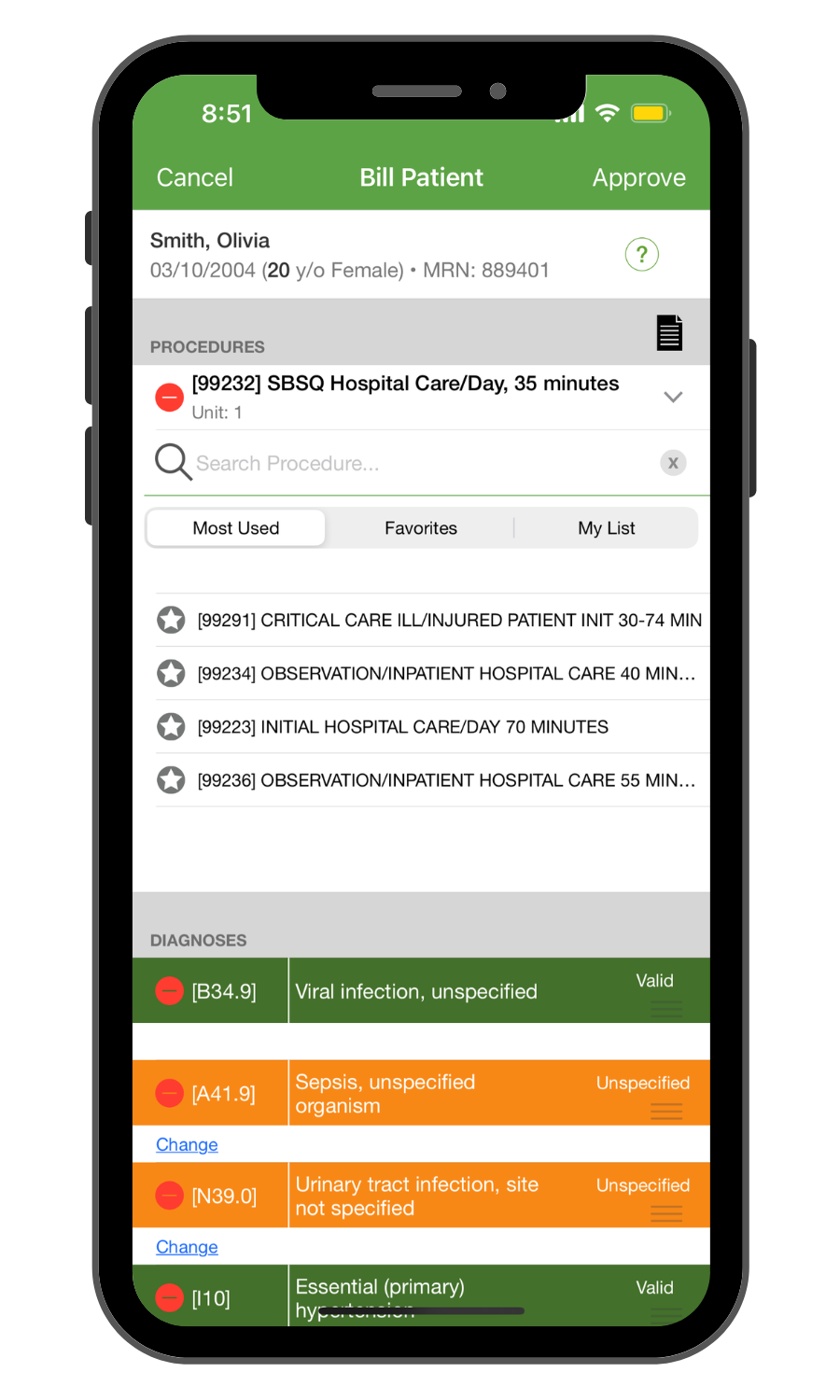
- Genesis reads clinical documentation to suggest codes and create charges.
- Snap & Bill starts with a photo or PDF when data feeds are unavailable.
The second record
The company occupies a particular stretch of healthcare administration. It connects clinicians, coders, billers, and revenue cycle managers around work already performed. Hospitalists, emergency medicine groups, specialists, health systems, and independent providers use its tools. A billing company can use the same platform from the other end of the process, checking what arrived and what needs attention before submission.
The attraction is easy to understand. A clinician wants to finish the encounter. A coder wants enough documentation to justify a code. A biller wants correct patient and insurance information. Each person can complete their own task while leaving the next person a small mystery. MediMobile tries to make those mysteries visible before they become an unpaid afternoon.
A long apprenticeship in missing charges
MediMobile dates its beginning to May 2000, when two employees tackled a hospitalist charge capture need. Its early proposition was to replace providers’ notecards with a mobile record. A 50-provider Austin group adopted it in 2003. Enterprise expansion followed in 2005; an iOS version arrived in 2010. Revenue reconciliation tools entered the story in 2020.
That progression matters. Capturing a charge answers one question: what did someone enter? Reconciliation asks another: what should have been there? The distinction gives the product its administrative logic. A tidy list of recorded charges can still conceal an encounter that never made the list. Completeness requires a comparison with the underlying activity.
- 01DocumentThe clinical record
- 02CodeCPT + ICD-10 suggestions
- 03ReviewCheck codes and gaps
- 04SendHandoff to billing
The note becomes the starting gun
Genesis, MediMobile’s AI coding platform, changes where the process begins. Instead of waiting for someone to select charges separately, it analyzes clinical documentation and recommends CPT procedure and ICD-10 diagnosis codes. It also supports MIPS quality-measure generation. The company publicly announced the Genesis name in October 2024, after introducing AI technology earlier.
The implementation starts with identifying documentation templates. Information can arrive through healthcare data feeds, APIs, file transfers, PDFs, or images. Clinicians continue documenting; coders or clinicians can accept or adjust the recommendations. MediMobile describes a feedback loop and logged changes. The review step gives the automation an accountable place in the workflow.
“Genesis bridges clinicians and revenue cycle with one continuous workflow”
Paul Valenzuela · Genesis anniversary page
There is more here than a code generator. Charge Review checks incomplete documentation, coding problems, and insurance mismatches before charges reach a billing system. Data Hub connects information across organizations. Analytics lets managers examine group performance and individual results. The company’s expertise lives partly in those connections: getting a useful record to the person who needs it.
Founder Paul Valenzuela was identified as CEO in the 2024 Genesis announcement. The engineering history is unusually long for a story involving AI: Chris Easter joined in 2007, after leading development work at Dell. Emil Indradjaja joined in 2006. Their biographies describe integration and mobile systems experience. That background helps explain why the product story spends so much time on information moving between organizations.

The photograph that skips the queue
A newer offering makes the company’s approach especially concrete. Snap & Bill combines MediCapture with Active List Lite for post-acute, home health, and telehealth work. Its premise is that documentation arrives in pieces. A face sheet here, a progress note there, an integration somebody hopes to arrange later.
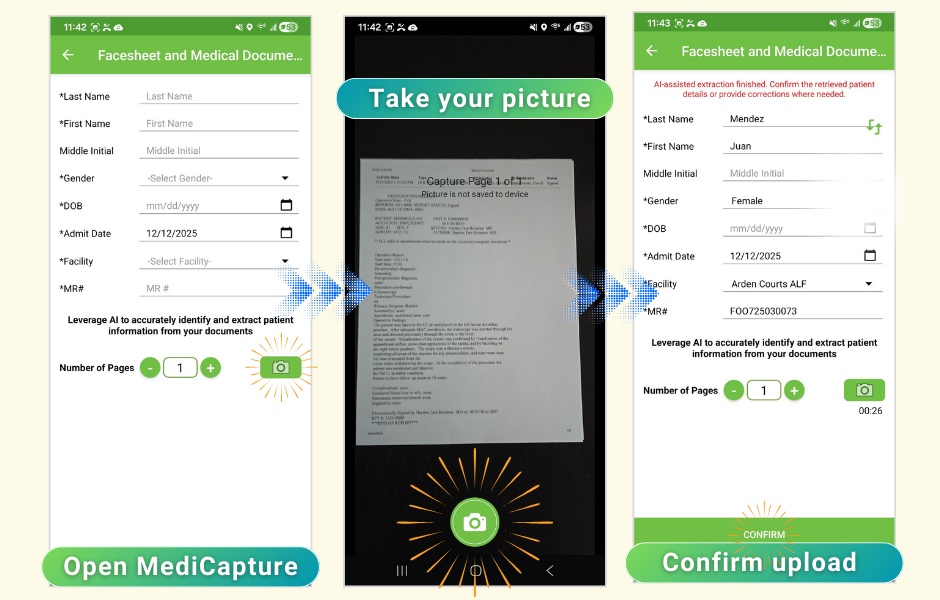
The provider photographs a face sheet or uploads a PDF to create or find the patient record, attaches supporting documentation, and completes coding or routes the work to billing staff. This is a practical concession to uneven infrastructure. A missing feed need not prevent encounter capture. It also preserves a familiar obligation: somebody still confirms the extracted details.
PointClickCare offers the other route. A February 2024 integration announcement describes moving post-acute patient demographics and insurance information directly into MediMobile. Photographs and live interfaces belong in the same story because facilities do not all supply information in the same way.
Three tiers, one awkward handoff
MediMobile sells software on a monthly per-provider model, with arrangements for larger practices. Essential supplies capture and processing. Advanced adds analytics and reconciliation. Genesis adds AI coding to both. A buyer should request a quote tied to providers, interfaces, and the chosen workflow; the subscription decision includes the work of making the connections useful.
The competitive field is real. Ingenious Med also offers AI charge capture, document viewing, and reconciliation. Existing EHR billing workflows are another option. MediMobile’s case therefore rests on whether its particular combination improves a team’s handoffs. “Uses AI” is a description, not a purchasing argument. Workflow fit, review quality, and usable information are more discriminating questions.
For a prospective customer, a sensible demonstration follows one encounter all the way through. Bring a representative note, an awkward exception, and the billing team that will inherit the output. Check the recommended codes against the documentation. Then ask who handles corrections, which interfaces are included, and how subscription and setup costs enter the calculation. Ask for a comparison with the existing process, including the time spent correcting mistakes.
Count what survives the journey
MediMobile advertises an annual revenue opportunity of $30,000 to $50,000 per physician and reports serving more than 50,000 clinicians in its 2024 Genesis announcement. These are company figures. For a buyer, the useful experiment is local: count encounters, identify missing charges, measure time to billing, and follow eventual collections.
1,000 encounters × 1% missed × $100
The same reasoning sets the limits. Software needs legible documents, sufficient clinical detail, workable connections, and people responsible for exceptions. A practice already capturing its payable encounters accurately may have less to recover. More generated charges are not automatically more collected cash.
The lesson others can copy is modest and useful: preserve the encounter early, compare it with what reaches billing, and make the next person’s task easier. MediMobile’s July 2026 message emphasizes small teams. The problem scales down rather well. One lost encounter can still matter to the person who did the work.