A medical appointment has a peculiar supporting character: the computer. It receives the doctor’s gaze, absorbs the patient’s story and demands that someone turn a conversation into fields. Nabla’s founders approached this arrangement with an unusual research method. They ran a digital clinic, hired 50 doctors and watched the work. The assistant they eventually sold grew out of that proximity. The computer had become rather good at asking for attention. Perhaps it could learn to give some back.
- Nabla turns clinical conversations into draft notes, then helps with dictation and coding.
- Its customers range from medical groups to health systems and software platforms.
- The useful test is time saved after review and filing, not the elegance of the first draft.
The clinic before the software
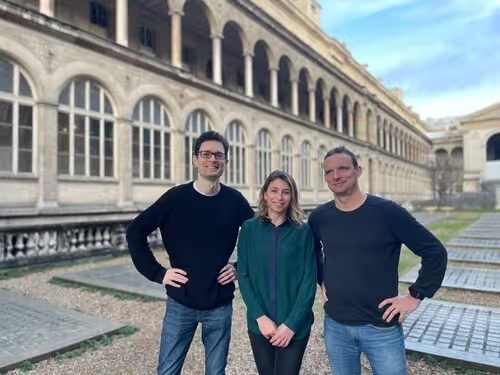
Founded in 2018 by Alexandre LeBrun, Delphine Groll and Martin Raison, Nabla began with considerable technical pedigree. LeBrun and Raison had worked on Wit.ai, acquired by Facebook; LeBrun had previously sold VirtuOz to Nuance. Healthcare offered a new setting for their expertise in language and machine learning. Yet knowing how computers interpret speech does not tell you what a physician needs at 6 p.m.
The early company operated a women’s virtual clinic. A 2021 partner account describes access to general practitioners, gynecologists, midwives, dieticians and mental health specialists. In 2022, Nabla opened its technology to other healthcare businesses. Then came a telling signal: outside doctors asked for the assistant being developed inside the clinic. Nabla Copilot launched in March 2023. Running the service had helped reveal a product other clinicians wanted.

The note has somewhere to go
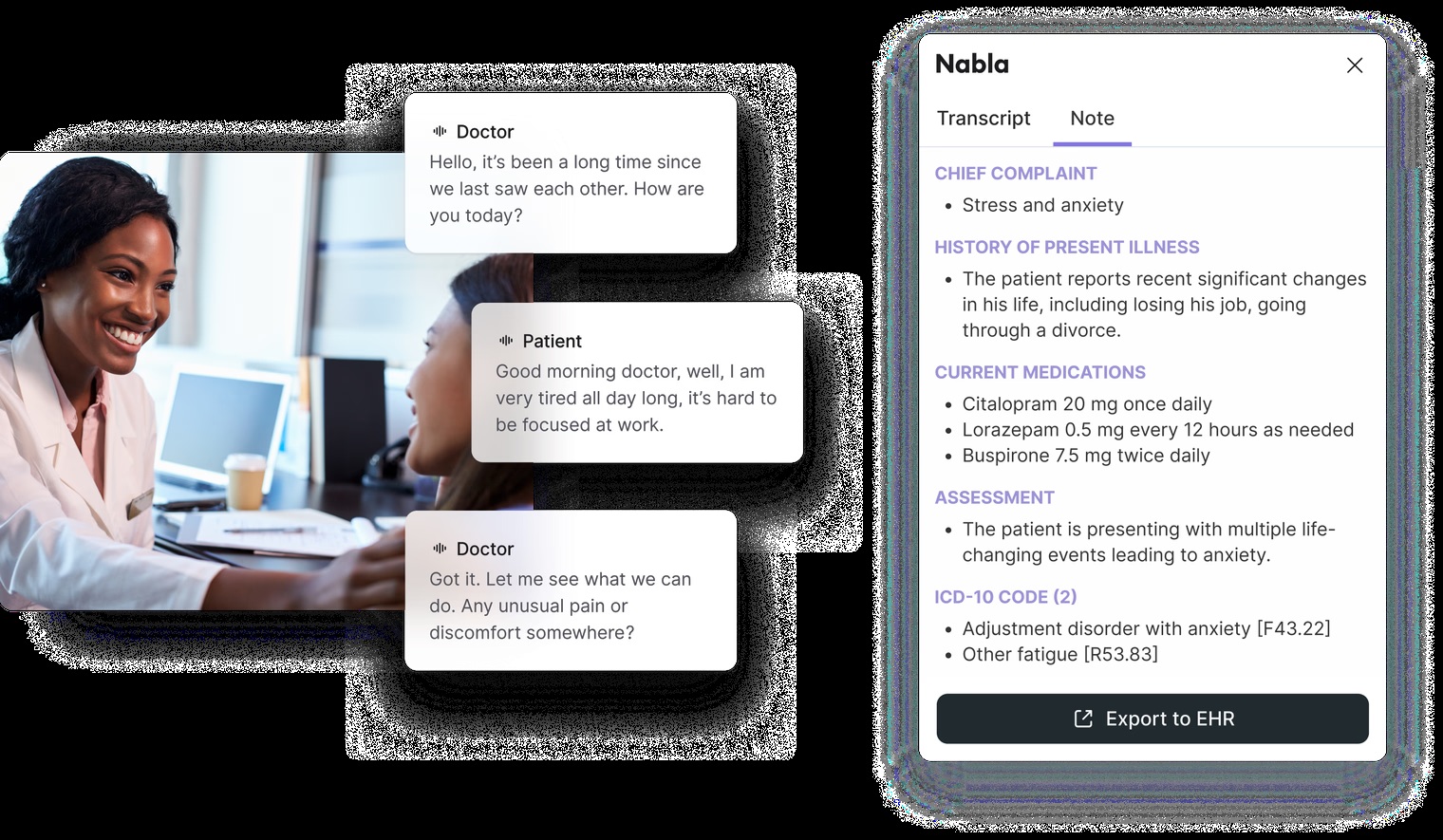
Nabla’s ambient assistant captures a patient-clinician conversation and drafts a structured clinical note. The clinician reviews it, makes corrections and moves it into the electronic health record, or EHR. Templates and preferences can be tailored to different specialties. Web, mobile and extension access give clinicians several ways to use it. Nabla’s help center says it supports more than 30 languages.
The less photogenic part is integration. Nabla’s Epic offering uses chart context, supports schedule synchronization and enables note export. Its current product page explicitly describes resolving earlier export limitations for group workflows. That is a useful clue about where polished demonstrations meet hospital life: multiple people may touch the same record. An assistant that writes beautifully but complicates filing simply relocates the nuisance.
- 01ListenPatient + clinician
- 02DraftStructured note
- 03ReviewClinician edits
- 04FileEHR workflow
Eight weeks in Denver
Denver Health provides a more grounded test than a product slogan. In Nabla’s account, the safety-net system began with an eight-week pilot: 50 clinicians, 12 specialties and more than 6,000 visits. The deployment needed to fit Epic, serve a multilingual population and accommodate sensitive care. These requirements concerned the organization around the encounter as much as the encounter itself.
The case study reports a 40% reduction in post-visit documentation time and a 30% reduction in overall burnout scores, measured through clinician surveys. Following the pilot, 400 clinicians adopted Nabla within a week. Those are vendor-published results from one deployment, not promises for every hospital. Their value lies partly in the bounded experiment: a defined group, a defined period and work that could be measured.
The paperwork after the paperwork
The visit is only one part of a clinical day. Messages, referrals and follow-up tasks persist after the patient leaves. Nabla now sells clinical dictation alongside ambient documentation, plus E/M and ICD-10 coding suggestions. Its coding product explains suggestions against the clinical record and leaves the final decision with the clinician. The company is moving toward a larger share of the administrative sequence.
In February 2026, M Health Fairview selected Nabla’s combined ambient and dictation platform for systemwide deployment. In July, Nabla announced Dictation for Mac, processing speech on the device through a native Apple stack. That claim applies to the Mac dictation product; it should not be casually extended to every Nabla workflow. Existing PowerMic and SpeechMike hardware can remain in use. Familiar equipment has its own persuasive powers.
“We believe it’s time for software to adapt to clinicians.”
Laurent Landowski, chief product officer / July 2026
The commercial arrangement is subscription software, with enterprise fees set in order forms. Platform partners can embed a hosted interface or use Nabla’s Core API. For a buyer, the relevant cost includes implementation, training and review time alongside the subscription. The $70 million Series C announced in June 2025 brought company-reported funding to $120 million. Investor capital funds the supplier’s expansion; it does not establish a customer’s return.
What a hospital is actually buying
Nabla competes with Abridge, Suki, Ambience and Microsoft’s Nuance offerings. Its pitch emphasizes customization, EHR embedding and the combination of ambient notes, dictation and coding. These are reasons to evaluate it, rather than proof that it wins every comparison. A health system buys an everyday working relationship: reliable software, usable notes, responsive implementation and enough clinician trust to sustain adoption.
The conditions matter. An organization needs a workable audio-capture process, documentation preferences that fit its clinicians and an agreed review routine. Savings can shrink when drafts require extensive correction or exports add friction. Nabla’s Epic page says audio is not stored by default and retention is configurable. Governance belongs in deployment planning. A tidy privacy slogan cannot substitute for understanding the organization’s actual settings.
A practical way to copy the Denver approach is to choose a small group of willing clinicians, record a baseline and compare time spent documenting after review. Include difficult encounters and different specialties. Count corrections and abandoned uses as well as completed notes. Expanding only after those checks gives the organization a chance to discover whether the assistant saves work or merely makes the first part look faster.
The doctor looks up
Brian Manning became CEO in July 2026, while LeBrun remained executive chairman and AI leader. The broader ambition is clinical intelligence across more of the care journey. The transferable lesson is smaller and more useful: observe a job closely, solve a recurring irritation and measure the whole workflow. Nabla’s clinic made that possible. The ultimate verdict still arrives in the consulting room, when the doctor can finish the record and attend to the person.