Consider the pepper at the back of the cupboard. It occupies little space, survives several kitchen reorganizations and attracts attention chiefly when it runs out. Yet the company behind that familiar red cap has built a substantial business around an easily overlooked proposition: a small ingredient can change your opinion of everything else on the plate.
The story in three bites
- McCormick sells familiar pantry brands and custom flavors for other businesses.
- Its two divisions generated $6.84 billion in fiscal 2025 sales.
- A proposed Unilever Foods combination would add Hellmann’s and Knorr, subject to closing.
McCormick & Company manufactures spices, herbs, seasoning mixes, extracts, condiments and flavors. Its customers range from someone rescuing a Tuesday chicken dinner to a manufacturer developing a snack for millions of people. That range is the interesting part. A shopper sees a jar. A food company sees a supplier, a development partner and a way to make a product taste the same next month.
Two doors into the same kitchen
In fiscal 2025, Consumer brought in roughly $3.95 billion; Flavor Solutions contributed $2.89 billion. The first sells through grocery stores, warehouse clubs, discounters and ecommerce. The second supplies manufacturers and foodservice operators with flavorings, blends, coatings and ingredients. Both depend on understanding what people want to eat, then delivering it reliably.
One company / two routes to dinner
Consumer
$3.95bn
Flavor Solutions
$2.89bn
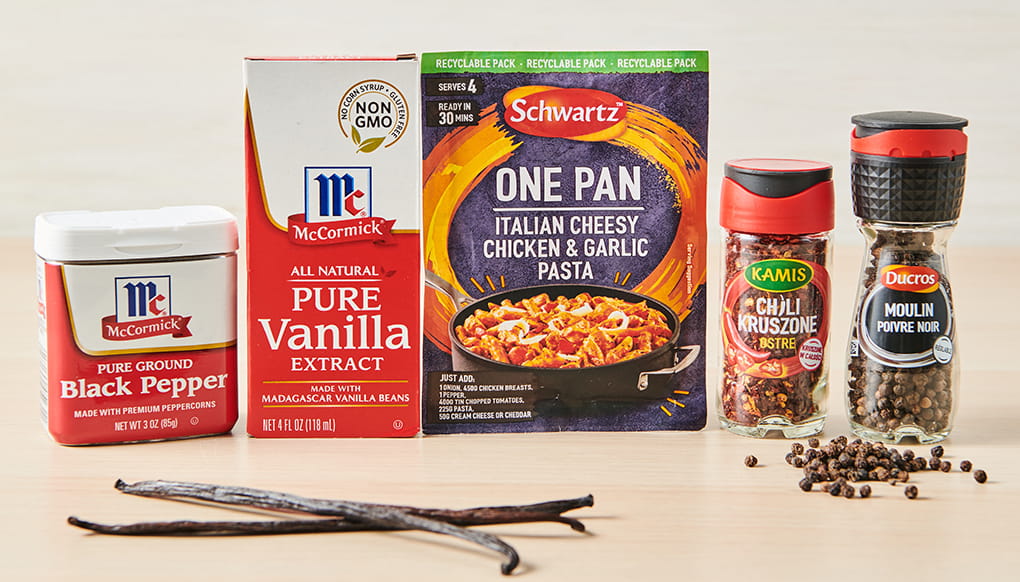
The portfolio includes OLD BAY, Lawry’s, French’s, Frank’s RedHot, Cholula, Schwartz and Ducros. This is broader than a collection of spice jars. It includes the mustard on the sandwich and the sauce beside the wings. For cooks, the attraction is practical: recognizable flavors, recipe ideas and less work assembling a blend from scratch.
For manufacturers, the task can be more demanding. A beverage, dairy alternative or protein product needs a flavor that suits its ingredients and survives its production process. McCormick’s Create IT co-creation process takes customer projects from concept through formulation to commercialization. Here, taste has to function inside a business brief.
The archive behind the experiment
A company that has spent decades formulating food accumulates something more useful than nostalgia: records of experiments. In 2019, McCormick publicly announced its collaboration with IBM Research on artificial intelligence for flavor development. The work drew on more than 40 years of proprietary sensory and taste data, including past formulas and consumer preferences.
IBM described a system that helped developers explore combinations they might otherwise miss. The collaboration informed the ONE seasoning range. McCormick now describes its proprietary SAGE technology as another tool for extracting insights from formulation, sensory and flavor-chemistry data. Human expertise remains conspicuous: the company reports more than 400 food scientists across 20 Technical Innovation Centers.

The useful lesson for a smaller business is to keep its experiments. Record the formula, the audience and the response. An archive becomes valuable when the next developer can learn from it. McCormick’s experience suggests the usefulness of that discipline; it does not establish that software can make an untested flavor commercially successful.
Buying a place at the table
Acquisitions have shaped the company since it bought Philadelphia’s F. G. Emmett Spice Company in 1896. The original Baltimore business, founded by Willoughby M. McCormick in 1889, had sold extracts and other goods. Even the spice identity was partly purchased.
More recent checks have been larger: approximately $4.2 billion for RB Foods in 2017, bringing French’s and Frank’s RedHot; $800 million for Cholula in November 2020; $710 million in cash for FONA, expanding flavor capabilities, that December. These purchases added different ways to season a meal, supported by a shared distribution and development business.
That logic reached a different scale on March 31, 2026, when McCormick announced an agreement to combine with most of Unilever Foods. The proposed transaction values that business at approximately $44.8 billion, including a $15.7 billion cash payment plus equity. Unilever and its shareholders would collectively own 65% of the combined company. Closing was expected by mid-2027, subject to approvals and other conditions.
“flavoring calories while others compete for them”
Brendan Foley / March 2026
Foley’s phrase explains the strategic appeal. Knorr and Hellmann’s would extend the company’s reach in cooking aids and condiments. But projected savings are still projections. Combining operations, keeping customers and securing approvals are separate jobs from announcing an agreement. October’s update described integration planning, not a finished combination.
The number under the number
There is a useful warning against easy conclusions in the latest quarter. On October 1, McCormick reported third-quarter sales growth of 17.4%, alongside organic growth of 1.9%. Acquisitions contributed 14.6 percentage points and currency 0.9; rounding explains the small difference in the sum.
Q3 2026 / sales growth, unpacked
Much of the jump followed January’s $750 million purchase of an additional 25% of McCormick de Mexico, taking ownership to 75% and bringing its sales into consolidation. This matters when judging the business: expanding the accounting perimeter and selling more through the existing operation tell different stories.
What survives the next dinner?
The business has encountered less abstract trouble. The Great Baltimore Fire destroyed its premises in 1904; a replacement factory followed that year. During the Depression, austerity preceded a management change. Under Charles P. McCormick, the company moved toward higher wages, shorter hours, profit sharing and employee participation. Its history contains revisions as well as continuity.
Today, alternatives include store brands and regional seasonings; industrial customers can choose flavor specialists such as Givaudan or IFF. McCormick’s breadth helps, but cannot make every purchase sensible. If customers reject a flavor, trade down or face rising ingredient costs, distribution alone cannot settle the problem.
For a cook, start with a recipe or a blend that solves tonight’s problem. For a food business, start with the intended eater and a precise development brief. McCormick’s enduring insight is modest enough to copy: pay close attention to the part of the meal people barely notice until it is wrong.