The Brooklyn brand that turned two ingredients - honey and chili peppers - into an American condiment category all its own.
MIKE'S HOT HONEY - the squeeze bottle that started a category. Photographed for the brand; sweet up front, chili on the finish.
In 2004, on a study-abroad trip to Brazil, a college student named Mike Kurtz walked into a pizzeria and noticed jars of honey infused with chili peppers sitting on the counter. He drizzled some on a slice. The idea followed him home.
Back at the University of Massachusetts-Amherst, Kurtz started making his own version in his apartment, testing peppers and honey until he landed on a recipe that was, in his words, hotter and more chili-forward than anything he'd tasted abroad. In 2010 he moved to Brooklyn, took a job at Paulie Gee's pizzeria in Greenpoint, and introduced the owner to his hot honey. It went straight onto a soppressata pizza called "The Hellboy," which has stayed on the menu ever since. That single dish did the work of a marketing department: customers wanted the honey by the bottle.
From there the growth was steady rather than sudden. Kurtz set up a distribution operation in 2011. Whole Foods became the first grocery chain to stock the product in 2014. A year later, Kurtz did something many founders resist - he hired Matt Beaton as CEO and stepped back to focus on the product and recipe. The company raised outside capital, expanded its retail footprint, and, by 2024, was reportedly generating around $40 million a year with a lineup built almost entirely around a single squeeze bottle.
"It's a lot hotter, more chili forward and has a much stronger kick than what I tasted in Brazil."
Mike's Hot Honey is exactly what the name says: 100% pure honey infused with real chili peppers and a touch of vinegar. The result is a sweet-then-spicy condiment designed to be drizzled - on pizza, fried chicken, cheese boards, roasted vegetables, biscuits, cocktails, and whatever else a cook wants to wake up.
The problem it solves is deceptively simple. Home cooks and restaurants both want an easy way to add complexity to a dish - sweetness and heat in the same pour - without mixing it themselves. Mike's packaged that balance into a shelf-stable bottle that behaves the same every time.
For restaurants, it's a menu ingredient that signals a little culinary flair; for retailers, it's a fast-moving specialty item; for home cooks, it's a one-bottle upgrade. The brand is certified Kosher, gluten-free and paleo-friendly, which widens the shelf it can sit on.
Where many food startups sprawl into dozens of SKUs, Mike's Hot Honey stayed narrow on purpose. That focus is the strategy: own the original, and let the category grow around it.
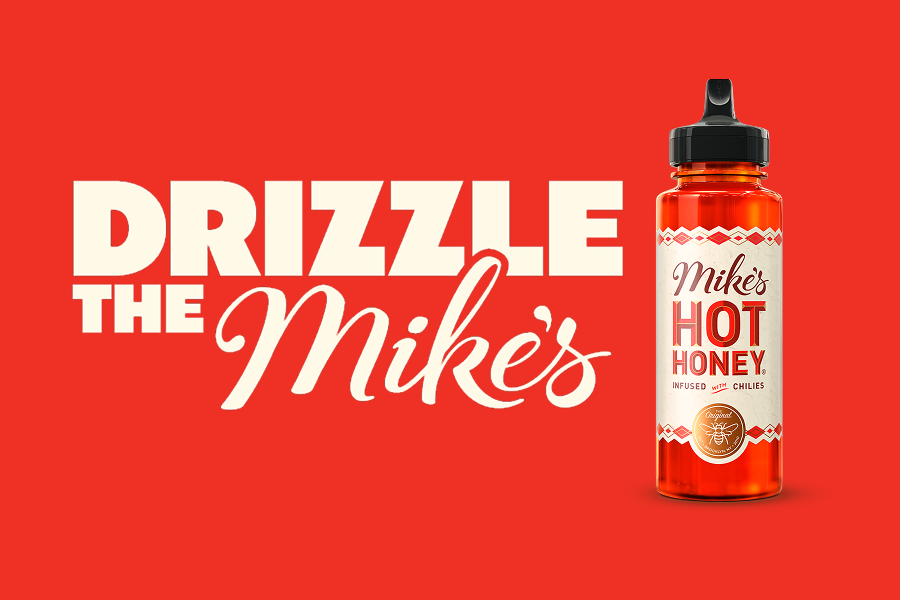
Pure honey infused with chili peppers and a hint of vinegar. The squeeze bottle that defined the category.
A spicier build for heat-seekers who want more chili kick without losing the honey sweetness.
Larger formats for pizzerias, kitchens and distributors that serve it by the menu, not the jar.
A honey-and-chili syrup built for beverages and cocktails - the brand's first step beyond the bottle.
Hot honey gift boxes, pins, hats and apparel sold direct through the brand's online store.
Licensed products from Tillamook beef jerky to Ewing Athletics sneakers carry the Mike's flavor.
A hybrid consumer-goods play. Revenue flows from retail grocery, direct-to-consumer e-commerce on a Shopify storefront, foodservice sales to restaurants, and licensed co-branded products. One recipe, multiple channels.
Home cooks and food lovers at retail and online; pizzerias and restaurants using it as a menu ingredient; and foodservice distributors moving it in bulk. Distribution spans 30,000+ stores and 3,000+ restaurants.
Hot honey was not a supermarket category before Mike's. Now the shelf is crowded with rivals and private-label imitations. The brand's defense isn't a secret formula - it's being first, owning the story, and holding the restaurant relationships that put the flavor in front of eaters in the first place.
Competitors range from other infused-honey makers such as Bushwick Kitchen and Savannah Bee Company to store-brand hot honeys and traditional hot-sauce companies moving into the space. What's harder to copy is the fifteen years of farmers markets, pizzeria drizzles and hand-sold jars that built trust before the trend arrived. In a category built on a single idea, credibility is the moat.
Mike Kurtz discovers chili-infused honey at a pizzeria while studying abroad.
Kurtz starts the company and joins Paulie Gee's, where "The Hellboy" pizza debuts.
A distribution operation begins supplying restaurants and early retail.
The first grocery chain to stock the product on shelves.
Kurtz hands over the wheel to scale the company; funding rounds follow.
The WNBA legend is appointed as revenue reaches an estimated $40M.
Hot Honey Syrup launches for cocktails; a Tillamook jerky collaboration debuts.
Widely credited with popularizing the hot honey category in the United States.
WNBA legend Candace Parker joins the board of directors.
Tillamook Country Smoker releases a beef jerky made with Mike's Hot Honey.
The brand expands into beverage innovation with a cocktail-ready syrup.
Recognized among best creative ads for its brand campaigns.
Positioned as America's leading hot honey brand by reach and recognition.