Max Mikheev has a fairly modest ambition for a chief executive: he would like to spend more time doing science. In 2021, while holding both the executive and scientific jobs at BIOMEDICAN, he said he would happily pass the business and finance duties to the right candidate. Raising money and working with investors occupied time he wanted to spend elsewhere. A founder is supposed to love the whole adventure. Mikheev was refreshingly specific about which part he liked.
“I prefer to concentrate on the scientific side,” he said. There is a person inside that sentence, easier to recognize than the collection of titles. A company needs capital. An experiment needs attention. The founder who carries responsibility for both cannot always give each what it wants. Even an organism engineered to produce a valuable compound has one advantage over its chief executive: nobody asks it to join an investor call.
That preference gives shape to Mikheev’s career. He has worked on genomic software, computational models and engineered yeast. These can sound like separate occupations until you notice their shared practical concern: turning biological complexity into a system someone can actually work with. His route to the fermentation vessel began with information on a screen.
A scientist meets the software problem
In 2002, Mikheev and collaborators began developing BioUML in Russia, initially addressing microarray analysis, genetic pathways and gene networks. He moved to the United States in 2006 for research involving the National Institute on Aging and the University of Pittsburgh. By 2011, he had formed BioDatomics to address the analysis demands of next-generation sequencing.
The observation behind the company was unglamorous and useful. Researchers had data and struggled with the tools needed to interpret it. BioDatomics brought existing open-source programs into a shared environment. Its BioDT platform, introduced in 2013, included roughly 400 tools and let people arrange analysis workflows visually. As Mikheev put it, “end users don’t need to know programming languages.”
There was commercial reasoning alongside that accessibility. A free community edition could coexist with paid support and enterprise capabilities. Making a tool available and making it usable inside an organization are different jobs. The company tried to do both. For Mikheev, it was an early example of building a business around the work between a scientific capability and its practical use.
Before the tank, a world made of agents
A 2010 paper adds another piece to that picture. Mikheev was among the authors of SPARK, short for Simple Platform for Agent-based Representation of Knowledge. The framework was designed to model biological systems through interactions among individual components. It provided a Java application, a graphical interface and a language for constructing models.
Its design addressed questions of scale. Components could have different sizes and shapes. Multiple spaces could represent different levels of a system at once. The point was to let researchers connect local events with behavior that emerged across a larger whole. Mikheev’s collaborators included Alexey Solovyev, Leming Zhou, Yoram Vodovotz and Qi Mi.
The connection with his later work is a way of reading the career, rather than a claim that a simulation became a fermenter. Both ask the designer to pay attention to interactions. A useful part does not automatically make a useful system. The relationship between parts has to work too. That is a demanding idea to carry from a computer into a living cell.
The yeast has relevant experience
BIOMEDICAN, founded in 2017, puts a particular organism at the center of its manufacturing approach: Yarrowia lipolytica, an oil-producing yeast. The company engineers it to produce compounds that would otherwise be obtained through other routes, including extraction from plants. Its product list includes CBG, CBGA, CBN, CBNA, THCA, THCV and THCVA.
Mikheev’s explanation of the choice is unusually concrete. The organism produces oils, and the compounds his team wants to make are associated with oil droplets in the plant. He is interested in reproducing aspects of that arrangement within yeast. The host’s existing characteristics are part of the engineering decision. The organism arrives with something relevant on its résumé.
In a 2021 essay, he compared cultivation, chemical synthesis and biosynthesis as production routes. The last uses an organism’s biological processes to make a desired compound. His account emphasized the importance of engineered enzymes and the difference between producing a target molecule efficiently and producing unwanted material alongside it.
That gives the manufacturing argument its precision. Simply asking whether yeast can make something leaves out much of the work. Which yeast? Which modifications? Which intermediate steps? How much of the desired output, and how much of everything else? A convincing answer has to survive those smaller questions.
Two names on the patent
The technical work has a dated record. U.S. Patent 11,149,291, titled Production of cannabinoids in yeast, was granted on October 19, 2021. It names Maxim Mikheev and Difeng Gao as inventors and BIOMEDICAN as assignee. Its application was filed in July 2018, with a priority date in July 2017.
The document describes genetically modified yeast with sets of genes serving different parts of a production pathway. These include steps involving GPP, olivetolic acid and Hexanoyl-CoA, along with steps toward the cannabinoid or its precursor. The vocabulary is dense because the problem is specific. A pathway must account for the operations required to reach the product.
A continuation, U.S. Patent 11,939,613, was granted on March 26, 2024, again naming Mikheev and Gao. Together the grants mark sustained work on the same technical family across several years. They are milestones in invention and ownership. Commercial manufacturing adds further questions about operating a process repeatedly, recovering the output and supplying a buyer.
Gao also appears on BIOMEDICAN’s team as lead scientist. That overlap is useful to remember when reading a founder’s profile. The executive’s name is convenient shorthand for a company; the invention itself has collaborators. Here, the second name is printed on the document.
“I prefer to concentrate on the scientific side.”
Max Mikheev, 2021
A red pigment broadens the picture
Mikheev’s work with yeast extends beyond the compounds most closely associated with BIOMEDICAN. He co-authored Large-scale bioproduction of natural astaxanthin in Yarrowia lipolytica, published in Bioresource Technology Reports. Astaxanthin is a red pigment, and the paper concerns its production through engineered yeast.
The research describes genetic engineering and fermentation experiments at several volumes, including three-liter and 100-liter bioreactors. Fourteen genes were inserted into the host genome and overexpressed. The experiments used glucose or glycerol as carbon sources and explored ways of improving production and recovery.
Those details widen the portrait from a founder associated with one product category to a scientist working on a manufacturing organism. The research discloses Mikheev’s financial relationship with BioKai, which supported the larger fermentation work. It is a distinct project, with its own collaborators and conditions; its results should be read in that setting.
For the career story, the interest is continuity. A new output requires new work, while the familiar yeast remains in view. The same organism can open another line of inquiry. It does not remove the need to do the experiment.
The colleagues between the titles
BIOMEDICAN’s team brings together molecular biology, strain engineering and equipment development. Its published roster includes Gao, senior scientist Evgeniya Yuzbasheva and lead engineer Andrey Romanenko. Dennis O’Neill appears as president; Eugene Fooksman as a board member and adviser. Mikheev appears in both the science and management groups.
That repetition neatly illustrates the job he described. He participates in the technical enterprise and carries responsibility for the organization around it. His preference for concentrating on science makes the arrangement more interesting, because it places a practical desire beside an expansive title.
There is also an unexpected mechanical footnote. A U.S. patent application assigned to BIOMEDICAN names Mikheev as inventor of a 3D printer. Published in January 2022, it addresses printer hardware, including the extruder and heating arrangement. The application is listed as abandoned. It remains a documented detour into a different kind of machine.
The detour sits comfortably beside the rest of his record. Software, cells and printer hardware offer very different working materials. Each nevertheless requires an arrangement of parts that can carry out a sequence reliably. The patent application does not establish a product launch, but it adds a tangible example of Mikheev working beyond the boundary suggested by a molecular biology degree.
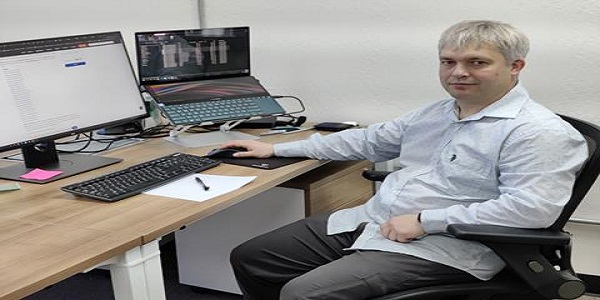
It also makes the workstation photograph feel apt. The desk holds the familiar equipment of someone whose work crosses between digital instructions and physical results. A monitor and a laboratory bench belong to the same working landscape. Much of the activity happens before there is an object worth photographing: choosing a design, arranging a workflow, inspecting a result and deciding which step to try again.
The work he would keep
The appealing thing about Mikheev’s admission is its lack of ceremony. He identified the part of his job he wanted to keep. Across software, modeling and fermentation, he has repeatedly worked on tools and systems that make biological questions tractable. Companies have been among the structures he has used to pursue that work.
From a distance, the titles look settled: founder, chief executive, chief science officer. Close up, they compete for a finite working day. Mikheev has said where he would put more of it. Somewhere between the genomic workflow and the engineered yeast, the preference has remained wonderfully easy to understand: give him the scientific problem, and enough time to work on it.