The useful thing about a tube of stacked crisps is that nobody needs instructions. The hand knows where to go. The lid pops, the stack appears, and a familiar little ritual begins. Matthew Parry saw that familiarity as an opening. He had spent years in Australia importing food products, presenting brands to grocery buyers and learning how packaged goods make the long trip from an idea to a shelf. When it was time to build his own company, he did not ask shoppers to adopt a new behavior. He asked what might make an old behavior easier to choose.
The answer became The Good Crisp Company, founded in Australia in 2015. Its proposition could be read from several feet away: the fun and convenience of a canister crisp, remade with a shorter, more legible ingredient story. The package was a bridge between nostalgia and a changed grocery aisle. Parry was not selling novelty for novelty’s sake. He was selling recognition with fewer reservations.
That distinction sounds small. In consumer goods, small distinctions can support very large businesses. Every supermarket shelf is a compressed argument. Color, format, price, placement and promise have seconds to work. Parry entered that argument with an object customers already understood and a message they could repeat.
The apprenticeship before the idea
Before he was a founder, Parry was an operator in the less cinematic corners of food. His Australian business imported international products and sold them into local grocery channels. Over roughly a decade or more, he launched brands that belonged to other people. That meant learning distribution, retailer expectations, packaging, margins and the awkward translation between what a brand wants to say and what a buyer needs to hear.
The experience gave him a category map. He had helped introduce canister chips to the Australian market, studied the incumbent products and noticed room for a clean-label alternative. His marketing education mattered here. Parry earned a Bachelor of Management in marketing from the University of South Australia and later completed an MBA at the University of Adelaide with a distinction average. The academic language was useful; the years of purchase orders and buyer meetings made it practical.
A California trade show widened the plan. Parry had originally expected to launch in Australia. The response in the United States suggested a much larger route. In 2017, The Good Crisp made its American debut at Whole Foods stores in Northern California. This was a useful beachhead: an audience already comfortable reading labels, inside a retailer where emerging products could win attention.
Moving toward the shelf
Founders often describe international expansion as a line on a chart. For Parry, it involved moving a household. In 2019 he relocated with his wife and three daughters to Colorado. He had decided the U.S. was the company’s largest opportunity and that pursuing it seriously required being present. Boulder’s dense network of natural-products founders, service providers and retailers offered something a video call could not: repeated proximity to people who knew the aisle.
Soon after the family arrived in Los Angeles, one of their first stops was a Whole Foods to look at Good Crisp products on an American shelf. It is a wonderfully literal founder moment. Years of distribution knowledge, product work and travel had been compressed into a can sitting under fluorescent lights. The ambition was national. The proof was local and physical.
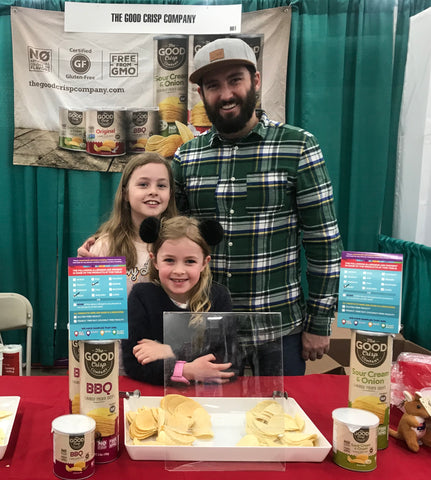
Parry’s daughters were not decorative characters in the origin story. He brought them into product development, asking for opinions on samples and ideas. When possible, he took them to trade shows so they could see how he explained the products to customers. The arrangement offered the company a tiny, candid focus group and gave the children a view of what their father’s work actually involved.
At home, he calls himself the “fun maker.” A request for a fort, a Lego concept or a cardboard-box car tends to find him. His favorite low-cost trick is to turn pancakes into faces by adding ears or arranging toppings. The effect, he says, is ten times the effort. That instinct travels neatly into consumer products: a small, visible choice can make an ordinary object feel considered.
The comparison problem
The canister was an advantage, but it also created a positioning trap. Reviewers and retailers naturally compared Good Crisp with the category leader. The comparison made the product easy to explain, while threatening to reduce it to a copy. Parry’s task was to preserve the instant recognition and build a distinct reason to return.
A 2019 rebrand helped articulate the company for a broader audience. The messaging grew less dependent on a narrow natural-food identity and more focused on a family proposition: familiar snacks, good ingredients, flavors people wanted. The company also worked across retail channels instead of treating specialty and conventional grocery as separate worlds. Merchandising followed the shopper.
Product expansion followed the same logic. The company moved beyond stacked crisps into cheese balls and crinkle-cut chips. These were not strange inventions in need of a tutorial. They were established pleasures reconstructed around the same brand promise. The portfolio could grow while the idea remained compact.
Reported retail reach
The 2017 marker indicates the U.S. debut, not a comparable door count. Later figures reflect publicly reported distribution at those dates.
By 2021, The Good Crisp was reported in more than 11,000 U.S. stores. Five years later, the figure had passed 20,000 retail doors across the United States, Canada, Australia and the United Kingdom. The numbers tell a growth story, but they also reveal the accumulation underneath: retailer presentations, production runs, forecasting, freight, resets and the daily prevention of small errors.
Parry has spoken about balancing rapid growth with conservative hiring. It is an operator’s tension. Shelf count can rise faster than an organization’s ability to absorb complexity. Hiring too early burns cash; hiring too late concentrates risk in exhausted people. The founder’s role shifts from personally solving problems to deciding which problems deserve a permanent owner.
Choosing the next constraint
In January 2026, MPearlRock acquired a majority position in The Good Crisp Company. The terms were not disclosed. The buyer brought a partnership connected to MidOcean Partners, Kroger and the retailer’s data business, 84.51°. For Parry, the rationale was specific: expand household penetration, accelerate awareness, deepen distribution and improve the manufacturing footprint.
The transaction did not close the founder story. It changed its scale. A company that began by finding a narrow opening in canister snacks now had a partner designed to help emerging consumer brands handle data, merchandising, sales, operations and supply chain. Parry remained founder and chief executive, now operating with a different set of resources and expectations.
There is a temptation to read the acquisition as the inevitable final panel of a neat founder comic: idea, launch, growth, deal. The real shape is messier. Parry had to decide when an Australian product should become an American priority, when a comparison was useful, when a brand needed to broaden, when a product line could stretch, and when more capital and operating support were worth sharing control.
His story offers a practical lesson for builders. Innovation does not always require asking people to become someone new. Sometimes it begins by noticing the object they already reach for, understanding the small compromise embedded in that choice, and rebuilding it without removing the joy. The can stays familiar. The reasons inside it change.
That is also why Parry’s pancake faces belong in the business story. A pair of ears made from batter does not reinvent breakfast. It signals attention. Good consumer products often work the same way. Their best ideas are legible, human and almost obvious after someone has made them. The difficult part is turning that observation into thousands of reliable repetitions, then millions.
Parry spent his apprenticeship moving other people’s products. He built his company by understanding what should remain in place and what could be reconsidered. After a decade, the ambition he stated at the beginning remains unfinished by design: a brand trusted enough to earn a permanent spot in the pantry. Not a new ritual. A better reason to keep the old one.