The first data center had a small logistical difficulty: it was still in Brent Whitehead’s parents’ backyard. Matt Lohstroh and Whitehead had spent late nights welding and assembling it in Buna, Texas. When the time came to lift their creation onto transport, the crane truck broke. Another crane had to come. Before their business could tackle wasted energy, somebody had to get the machinery out of the garden.
It is a useful place to begin with Lohstroh, co-founder and CEO of Giga Energy. His career runs through bitcoin, natural gas and, increasingly, AI infrastructure. Those are large subjects with an ample supply of grand language. A stranded container is easier to picture. The gap between having something built and having it working would become central to the business he and Whitehead developed.
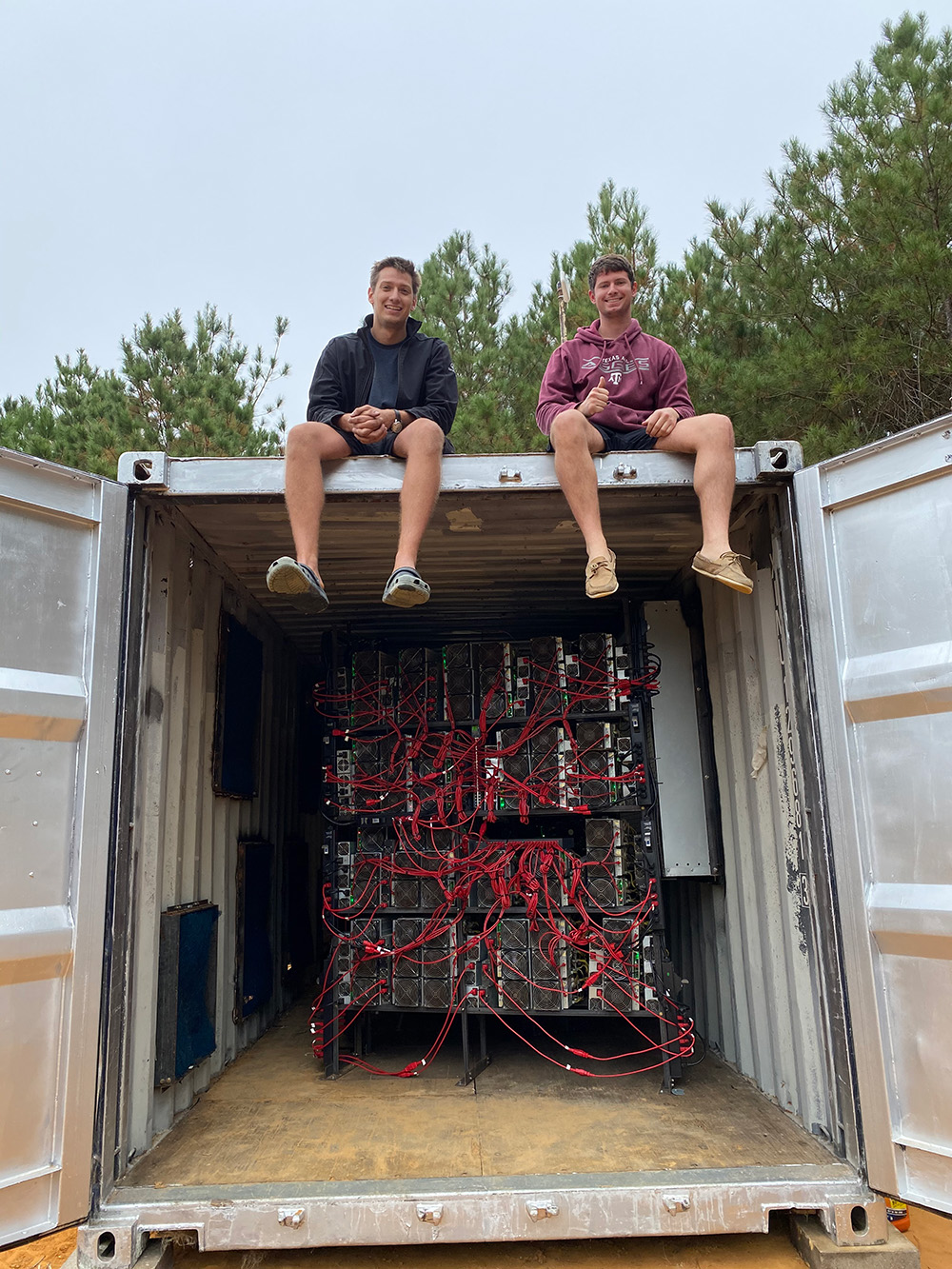
A backyard with a shipping problem
In 2019, both founders were students at Texas A&M. Lohstroh studied finance; Whitehead studied industrial distribution and brought an oilfield background. They had seen a Canadian operation using natural gas to power bitcoin mining through Twitter. A trip to Canada followed. The attraction was practical: oilfields could have gas without an economical route to a buyer, while mining computers needed electricity wherever it could be produced.
The early setup put computing near the energy supply. Gas went into a generator. Electricity powered miners housed in a modified shipping container. Instead of trying to transport the fuel to distant customers, the computers could do their work beside it. A well site became a place where energy and a digital payment network met, with considerably more cables than the phrase suggests.
Lohstroh later discussed that model at an energy-industry conference in Dallas. His audience included people accustomed to wells and generators, meeting a customer whose demand could arrive inside a container. Explaining that combination was part of the job. Bitcoin supplied the reason to consume the power; the oilfield supplied the conditions under which the business had to function.
The lawn money goes underground
The starting capital had a familiar suburban origin. Both founders had run lawn care and landscaping businesses in high school. They pooled those savings to get Giga going. There is a pleasing continuity between the two enterprises: equipment, outdoor work and customers who expect something to happen on an agreed day. The new business simply involved a more complicated relationship with the electricity bill.
College also gave them people to call. They credited Startup Aggieland co-founder Shelly Brenkman and Mays Business School professor Detlef Hallermann with helping them build the business and connect with investors. Lohstroh’s university activities included founding the A&M Bitcoin Club. His interest had acquired an address, a network and, eventually, machinery that had to be maintained.
Even the name carried a campus reference. Giga joined the numerical prefix with the Aggie expression “Gig ’Em.” For a company working in energy, it was a serviceable unit of ambition with a college joke tucked inside. Both men belonged to the university’s class of 2021. The business they started as students continued beyond graduation.
- 01Stranded gasEnergy at the well site
- 02GeneratorGas becomes electricity
- 03Bitcoin minersComputing moves to the fuel
A simplified view of Giga’s early operating model.
The model could travel. In 2024, Giga’s expansion into Argentina involved Phoenix Global Resources and Exa Tech, with a pilot in Mendoza drawing on gas associated with the Vaca Muerta formation. That extended the founders’ original proposition beyond Texas. It also put a limit on the idea that this was only a local curiosity. The location could change while the basic arrangement remained recognizable.
A customer becomes a manufacturer
Operating the sites exposed another problem. Equipment took time to arrive, suppliers had separate responsibilities, and a delayed component could hold up the whole job. Lohstroh has described Giga’s development as a response to its own operating difficulties. A business originally buying infrastructure gradually acquired reasons to manufacture it.
“We started by solving our own operational problems.”
Matt Lohstroh
By March 2025, his account of the company described control extending from engineering drawings through delivery, with staff present in factories and a supply chain spanning countries. He also emphasized that Giga used the equipment at its own sites. That gives a manufacturer a fairly direct form of feedback. A problem in the product can turn up in the seller’s own operations before the next sales conversation.
The product range grew to include transformers, switchboards and modular data centers. Houston and Long Beach became important parts of its manufacturing footprint. This expansion placed Lohstroh in a business where a buyer’s interest in delivery dates could rival interest in technical specifications. A component can meet its specification perfectly and still arrive too late to rescue a schedule.

Eight weeks, and a change of plan
A project with electrical contractor RC Power gives the delivery argument some texture. The customer needed a transformer and main switchboard package for AI and GPU laboratory capacity. Space was tight. Timing was tight. Then breaker requirements changed after production had been authorized. The paperwork had moved; the job kept moving too.
Giga’s published account records switchboard delivery eight weeks after signed drawings. RC Power’s project manager described daily coordination and involvement continuing through installation, including changes to breakers on site. The useful detail is the span of responsibility. Manufacturing an object was one part of the assignment. Keeping it useful as the customer’s requirements evolved was another.
For Lohstroh, these are the circumstances in which the company’s operating choices have to earn their keep. A factory, an engineering team and site experience cost something to maintain. Their value becomes visible when a project needs several of them at once. The customer’s clock keeps running while everyone decides whose problem a changed requirement has become.
There is also a distinction between selling equipment and selling computing. Giga’s expansion gives Lohstroh a place in the AI buildout through the physical systems around it. The transformer does its work regardless of the software running downstream. That helps explain why a company with bitcoin roots can find customers in a different computing market. The buyer changes, and the demands on the facility change, while much of the electrical work remains part of the same profession.
The people who recognized the box
Giga’s work began attracting people who had encountered similar difficulties elsewhere. Angad Sandhu, whose career included Tesla and Google, became interested after seeing its Hydrobox bitcoin mining container. He recognized a compact integration of computing, cooling and power distribution. Visits to the Houston and Long Beach factories followed.
His account of joining in 2026 focused on what happened after equipment shipped: installation, commissioning and the connections between systems. He wanted more of that work completed in factories, with defined interfaces between modules. For a founder, that is a consequential kind of recruit. Sandhu saw a way to apply experience from much larger organizations to the hardware Giga had already been building.
Matt Prusak arrived with a different set of responsibilities. Announcing his move as Chief Business Officer and interim CFO in August 2026, he recalled sitting down with Lohstroh carrying five pages of questions. Partway through, his attention shifted toward whether he wanted to help build the company. His assignment would include capital, people and the operating systems needed for expansion.
The two arrivals make the next stage more concrete. Engineering has to repeat successfully across projects. Financing and organizational decisions have to support those projects. The early founders could solve a backyard problem with another crane; a larger operation needs a dependable way to solve many problems at once. Lohstroh now has colleagues whose careers have been spent inside those complications.
Nine months is a promise to keep
In July 2026, Giga introduced GigaBase, its modular AI data center system. The proposition is nine months from shovel-ready to rack-ready. Its approach combines factory-built modules for computing, power and cooling, with connections designed before the equipment reaches the site. Manufacturing and site work can proceed in parallel. The company is selling a method of organizing a build alongside the equipment itself.
Giga’s reported data center footprint in its July 2026 GigaBase announcement. Development capacity is a pipeline, not completed operating capacity.
Those ambitions have a physical base. Giga reported 175 megawatts of sites online and more than 500 megawatts in active development in its launch announcement. The distinction matters: operating sites and future projects occupy different places on a calendar. The next test is carrying the manufacturing approach through that pipeline without making the customer absorb a fresh collection of coordination problems.
When asked about a favorite company memory, Lohstroh chose the first energization of a data center built with Giga’s own manufactured equipment. It is a revealing milestone to keep. A drawing had become equipment; equipment had become a site; the site had switched on. Years after the backyard build, the satisfying part was still reaching the point where the thing worked.
The phrase shovel-ready matters here, too. A nine-month proposition begins at a particular stage of a project, after the site has reached that point. Land, utility arrangements and permissions still belong in the larger picture. Lohstroh’s company is concentrating on the work it can bring together and repeat. Its proposition gives customers a schedule to examine, with a defined starting line. As the business grows, those details will tell us more than any comparison between its earliest container and its newest product.
His longer-term ambitions include building the processes and scale for a possible public listing. For now, the more immediate deadlines belong to customers waiting for power. There is something wonderfully unforgiving about that business. The presentation can end on time and the meeting can go well. Eventually, somebody has to turn on the equipment.
Follow the current
Explore Giga’s work, hear Lohstroh explain the early business, and follow his updates.
- Giga Energy - equipment and data center development ↗
- Matt Lohstroh on LinkedIn ↗ · On X ↗
- Watch: building a mining infrastructure company, at Bitcoin Commons ↗
- Listen: Bitcoin Gas Flare Mining, with Matt Lohstroh ↗
- Read Lohstroh’s essay on Giga’s manufacturing model ↗
- Read his conversation about Giga’s development and ambitions ↗