Before Matt Koscal had an airline to run, he had aircraft to watch. As a child, he watched planes descend into Chicago’s O’Hare, fascinated by flight. When he became chief executive of Republic Airways on June 15, 2026, he returned to that memory. The distance between those two moments contains a less obvious aviation story: years spent working on the arrangements that allow other people to fly.
He joined Republic in April 2014 as vice president of human resources. Recruitment, retention, management development, communications and compensation were on his desk. The aircraft already existed. His assignment concerned the people who would keep the operation moving. By the time he reached the chief executive’s office twelve years later, that assignment had expanded into training schools, commercial relationships and a merger.
There is a pleasing lack of glamour in that route to airline leadership. A jet makes an excellent photograph. A better way for a flight attendant to retrieve a schedule rarely does. Koscal’s career at Republic offers a reason to pay attention to both.
The schedule on the other end of the telephone
One early project involved an inconvenience familiar to anyone who has waited for a person to retrieve information that ought to be on a screen. Republic’s flight crews called a corporate hotline to get itinerary details, including assignments and lodging. During bad weather, the queue could grow just as the need for information became more urgent.
In late 2014, the airline engaged Indianapolis software firm DeveloperTown to build a mobile application for its roughly 4,200 crew members. Koscal wanted a product built around Republic’s needs. The decision carried ordinary but consequential questions: would people use it, and could a developer without aviation experience deliver it?
The design work included more than 200 hours of employee interviews. The resulting tools let crews find schedules, submit forms and retrieve information away from a crew room. DeveloperTown later reported 91 percent voluntary usage among 4,000 crew members. That is a useful measure of whether a workplace tool has earned its place on someone’s phone.
The episode puts some detail behind Koscal’s interest in employee experience. A crew member trying to locate a hotel reservation has little use for a speech about belonging. Giving that person the answer is a more persuasive introduction. It also reveals how readily the supposedly administrative side of an airline reaches into the working day of its operation.
Voluntary usage among 4,000 crew members in the published Crew Life app case study.
Build a school, then build a route into the job
Koscal’s responsibilities widened to labor relations and government affairs in 2015. From 2016 he served as senior vice president and chief administrative officer, becoming executive vice president in 2022. The progression placed workforce questions alongside negotiations and institutional partnerships. His bachelor’s degree was in management at Purdue; he also completed executive training at Wharton and the Center for Creative Leadership.
In 2018, Republic announced Leadership In Flight Training Academy, better known as LIFT. The premise was practical: an airline that needs pilots can participate in creating a route into the profession. The academy opened a way to connect training directly with future airline employment, while seeking to lower financial barriers and attract a wider range of candidates.
Its Indianapolis location, at the international airport, gave the idea a physical home. The launch plan paired Diamond training aircraft with simulators and a curriculum shaped around commercial flying. Students could see an employer at the far end of the process, rather than assemble a career one disconnected qualification at a time.
That distinction matters. Wanting to fly is a beginning. Finding training, paying for it, developing experience and understanding where employment might follow are separate problems. A school attached to an airline can organize those steps into a more legible sequence. It still leaves the student with plenty of work.
The educational partnerships added further routes. In 2020, LIFT and Vincennes University welcomed the first students in a joint professional pilot program, offering a degree option alongside flight training. Koscal’s work also included structuring Republic’s strategic relationship with Cape Air, another connection between developing experience and building an aviation career.
- 01Flight training
- 02Build experience
- 03Airline qualification
- 04First officer
A simplified training pathway. Each stage has its own requirements.
A headquarters with room for the people passing through
The next version of the same idea appeared in Carmel, Indiana, where Koscal lives. In 2021, Republic announced a new aviation campus and headquarters. Koscal described a project intended to attract and retain employees while reducing inefficiencies. Putting training and corporate functions together would give the airline a place built around its particular rhythms.
An airline headquarters has an unusual population. Alongside the people who work there regularly are crews arriving for training, instructors and colleagues passing through between other assignments. A campus has to accommodate that movement. The design question extends beyond where executives put their desks.
Discussing the project that year, Koscal also connected the campus with aviation outreach. He wanted a more inviting introduction for women, people of color and people from economically disadvantaged backgrounds. His point was specific: the industry needed to introduce itself to people it had not reached well enough.
By December 2025, he described a training center with eight full-motion simulators and ten other complex stationary simulator units. Bringing operational employees, administrative teams and people in training onto one site was part of his explanation for the campus. It would let groups with different daily routines encounter the same organization in person.
The training story had also acquired graduates. More than 200 LIFT alumni were working at Republic by that December. One, Abe Ford, had finished the academy in 2021 and become a captain. The academy was producing colleagues, with careers that continued beyond the classroom door.
Forty-five minutes in a different kind of aircraft
There is another photograph of Koscal that belongs in this story. In June 2025, he was one of four passengers aboard BETA Technologies’ electric ALIA aircraft on a demonstration flight to John F. Kennedy International Airport. The journey from East Hampton took 45 minutes. Blade Air Mobility chief executive Rob Wiesenthal was also aboard.
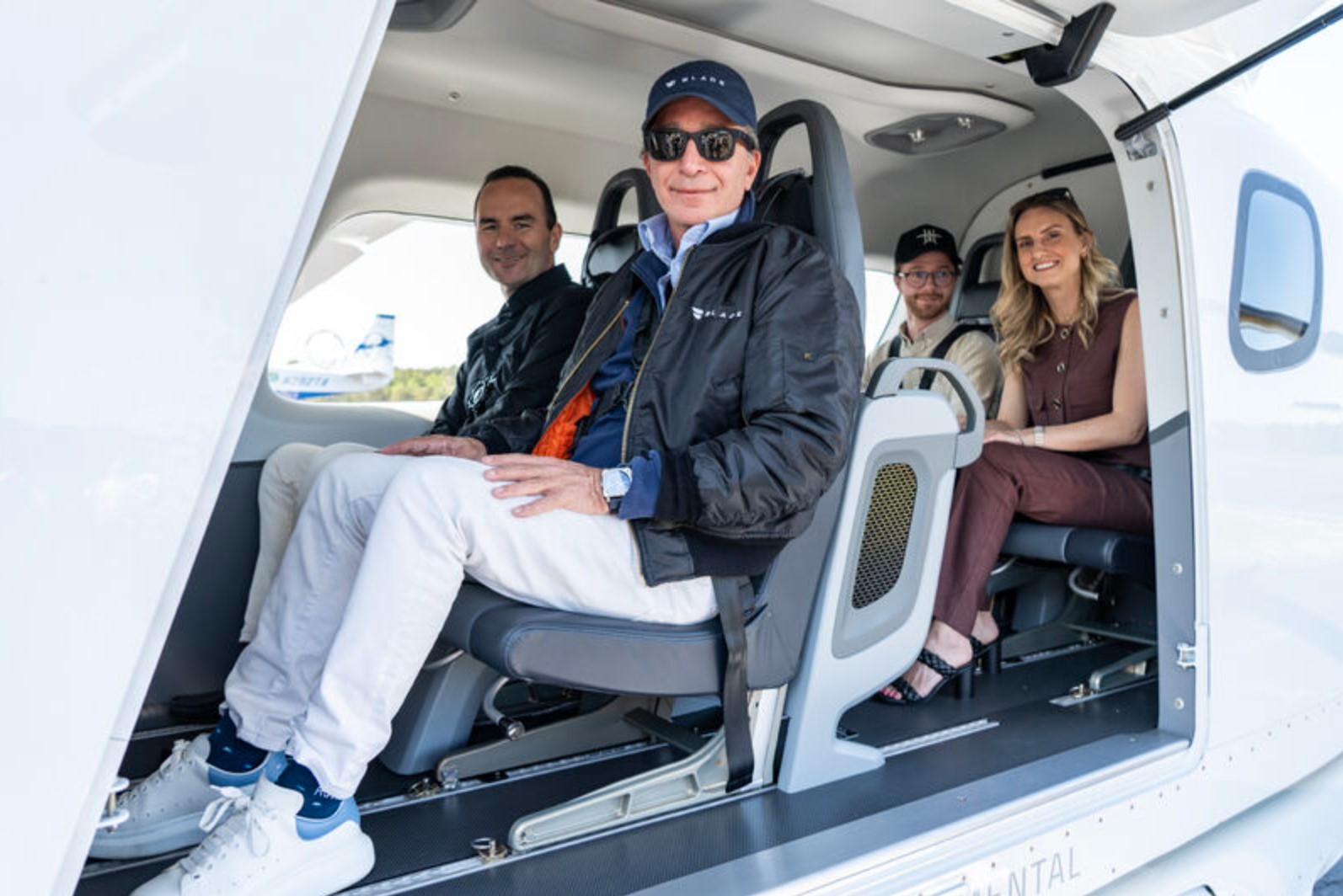
Later that month, at the Paris Air Show, BETA and Republic announced a memorandum of understanding to evaluate the aircraft for regional passenger and cargo applications. Their proposed work covered operating economics, infrastructure and aircraft performance. For an airline executive, the interesting question went beyond whether an electric airplane could leave the ground.
In a BETA video, Koscal set out the standard: “The expectations are really high when it comes to operational reliability.” It is a sentence with very little air-show sparkle and considerable airline relevance. A demonstration offers an occasion to look at possibilities. An operation requires those possibilities to withstand repetition.
“The expectations are really high when it comes to operational reliability.”
Matt Koscal, in BETA’s Republic video
That makes the electric-aircraft work a revealing companion to LIFT and the crew application. Each addresses a different stage of the same undertaking: preparing people, equipping them and asking what the next form of the operation might require. The aircraft changes; the demand for dependable service follows it.
The larger airline he now has to bring together
During 2025, Koscal became Republic’s president and chief commercial officer. Bryan Bedford retired as chief executive, and board chair David Grizzle took the CEO role. Koscal publicly thanked Bedford for more than a decade of mentorship. He and Grizzle then worked together through Republic’s combination with Mesa Air Group.
The merger closed on November 25, 2025, returning Republic to the public markets. Koscal’s company biography credits him with leading its negotiation, closing and integration. Those are three distinct jobs. Agreeing on a transaction provides the terms; closing completes the deal; integration asks thousands of people to make the combined business work.
On April 28, 2026, the board announced its unanimous choice of Koscal as the next president and CEO, effective June 15. Grizzle returned to non-executive chair. Koscal also joined the board. The succession put an executive who had worked across several of Republic’s internal functions in charge of combining a larger operation.
- 275 operating for airline partners
- 31 leased to American Airlines
- 8 unallocated spares
Total fleet and operating fleet describe different things.
Republic’s work is often encountered under another airline’s name: American Eagle, Delta Connection or United Express. Its partners control routes, fares and schedules; Republic concentrates on supplying the regional operation under its agreements. For Koscal, commercial relationships and the daily delivery of service are closely joined responsibilities.
There is a familiar thread here for an executive who arrived through human resources. Combining two workforces requires attention to how people receive information, learn procedures and understand their responsibilities. Those concerns once appeared at the scale of a crew member seeking an itinerary. They now extend across a combined airline. The scale has changed considerably; the need to make complicated arrangements usable by the people carrying them out remains easy to recognize.
The first quarterly results released after he became CEO showed a 98.21 percent completion factor for the second quarter of 2026. By July, core support integration was substantially complete, while operational policy and procedure harmonization with the FAA continued. A completed merger and a fully integrated airline have different calendars.
His stated priorities as CEO include transparency, a stronger culture and investment in employees. Those intentions now face the ordinary tests of a larger business: whether training feeds the operation, whether colleagues can work together, and whether the service promised to airline partners arrives consistently.
The boy watching arrivals at O’Hare could enjoy a plane coming into view without considering any of this. The chief executive has to think about what happened before it appeared: a person trained, an assignment understood, an aircraft ready, a relationship honored. Koscal’s route to the job has given him years in that less visible part of the journey.