In December 2012, Aaron Todd's company agreed to buy a helicopter tour operator in Las Vegas. The proposed price was $44 million. The scenery was the Grand Canyon. For an executive who had arrived in aviation through accounting, the attraction included something rather less photogenic: a place for pilots to build experience.
Sundance Helicopters had 22 aircraft and 150 employees. It also flew the AS350 and EC130, types Air Methods already knew how to operate. Todd saw a connection between two businesses whose customers boarded helicopters for very different reasons. A tour operator could broaden the company’s income while offering pilots a route into its other operations. The tourist saw a canyon. The chief executive saw a career path.
That December announcement offers a useful introduction to Todd. His working life at Air Methods stretched from the finance office to the chief executive’s desk, from acquisitions to pilot contracts. The interesting parts happen where those responsibilities meet: an aircraft purchase becomes a maintenance decision; a new subsidiary becomes a recruiting opportunity; growth becomes a question of whether thousands of people can work together.
Before the helicopters, the account
Todd earned a Bachelor of Science in accounting at Brigham Young University. He spent nine years in public accounting with KPMG Peat Marwick, including six working on the Air Methods account. By the time his appointment as chief financial officer was announced in June 1995, the company was already familiar territory.
There is a pleasing reversal in that beginning. Auditors generally examine what management has done. Todd would eventually become the manager whose decisions others examined. His entry was through sustained exposure to one business, rather than a sudden introduction to a glamorous industry. Six years on an account is ample time for the novelty of rotor blades to give way to the less decorative business of keeping the enterprise running.
He joined Air Methods as CFO in July 1995 and became secretary and treasurer that year. A board seat followed in June 2002. His appointment as CEO took effect on July 1, 2003, succeeding George Belsey. Those dates describe a gradual increase in responsibility: eight years inside the company before taking its top operating job.
The price of keeping something airborne
By early 2010, Todd was describing a company recovering from a decline in flight activity. His explanation moved between demand, fuel, maintenance and the age of aircraft. Air Methods had taken delivery of 46 new helicopters over the preceding two years and had seen maintenance costs fall by more than 20 percent. New machinery could be expensive to buy and cheaper to keep working.
He also discussed why the company used both single-engine and twin-engine helicopters. Conditions mattered, including flights over water and operations under instrument flight rules. The choice belonged to the job the aircraft had to perform, as well as the cost of owning and operating it. This was the sort of calculation in which the finance office and the hangar had plenty to discuss.
Todd’s account of that period resisted an easy equation between expansion and success. He described consolidation as a way to address excess capacity in particular markets. More aircraft in a region did not automatically make the operation more durable. Where an aircraft was stationed could matter as much as whether another one had been purchased.
A handshake, after two and a half years
One photograph from Todd’s tenure contains no aircraft at all. Seven people sit around a conference table. Papers lie in front of them. Todd, fourth from the left, shakes hands with union president Michael Goodwin. The occasion was the signing of a collective bargaining agreement on February 10, 2012.
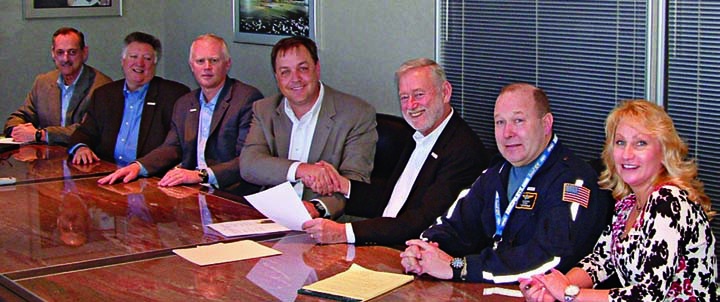
The agreement covered more than 1,000 pilots. Negotiations had lasted two and a half years, with a mediator from the Federal Mediation and Conciliation Service. Pilots ratified the contract by a wide margin. It included wage progression tied to length of service and adjustments reflecting work location.
Air Methods had recently acquired Omniflight, which employed more than 300 helicopter pilots. Discussions about bringing those pilots into the bargaining unit were still underway. A corporate purchase could be signed on one timetable; the work of joining its people to an existing organization followed another. The conference-table photograph catches that less spectacular side of running an aviation business. Nobody in it needs a windsock.
Las Vegas had something Colorado needed
The Sundance transaction brought Todd into tourism at the end of 2012. Blue Hawaiian Helicopters followed in late 2013. Together, the two businesses gave Air Methods operations around Las Vegas and the Grand Canyon, and in Hawaii. By February 2014, its tourism division had 46 Airbus EC130 and AS350 helicopters.
Todd’s reasoning went beyond a second source of revenue. Tour pilots could accumulate turbine time quickly. He described new-hire classes that already included pilots arriving from the tour business, and wanted the transition to become smoother. Geography supplied the brochure photographs; repeated flying supplied professional experience.
He also described a relationship attractive to the businesses joining Air Methods: access to capital and the stability of a larger organization. For the parent company, the acquired operators offered aviation knowledge and a different operating rhythm. His 2014 discussion of the tourism division was about connecting those advantages. The route from a sightseeing flight to another cockpit was an explicit part of his plan, rather than a cheerful coincidence discovered afterward.
Rehearsal gets its own address
Recruiting experienced pilots was one concern. Giving them places to practise was another. On December 5, 2014, FlightSafety International announced a long-term agreement with Air Methods for a Colorado learning center equipped with four Level D full-flight simulators.
The planned machines represented the Bell 407GX, Airbus AS350 B3, EC130T2 and EC135. The EC135 simulator was already being used in Dallas and was to be installed first. The other three were to follow after design, development and manufacture. The facility was scheduled to open in 2016, with classrooms and room for further expansion.
Todd welcomed the move toward training closer to the company’s Colorado base. His stated commitment was to “the safe return of each member of our team.” The training agreement put specific equipment behind that objective. Four named aircraft types made the announcement more concrete than an open-ended promise to spend more time practising.
“The safe return of each member of our team.”
Aaron Todd, December 2014
A decade on the order book
In March 2015, Bell announced an agreement to sell Air Methods 200 Bell 407GXP helicopters under a ten-year contract. Deliveries were scheduled to begin in 2016. An order of that duration connected the fleet’s future to a manufacturer’s production schedule, well beyond the next earnings announcement.
The aircraft had an upgraded Rolls-Royce engine, an additional 50 pounds of payload capability compared with the 407GX platform, and avionics changes. Bell also described a longer transmission overhaul interval. For an operator, a specification sheet contains several kinds of promise: what can be carried, how the aircraft performs, and how frequently a component needs attention.
Todd attended a ceremony marking the first delivery at the company’s Englewood headquarters in January 2016. Air Methods founder Roy Morgan was there too. The photograph from that event places the founder and a later chief executive in the same group, beside the tangible result of a purchasing decision. The contract had become a helicopter.
Bell 407GXP aircraft under a ten-year contract. This is the announced agreement, not a count of completed deliveries.
Read the Bell announcement ↗When the company itself changes hands
Acquisitions had been a recurring part of Todd’s work. In April 2017, Air Methods became the acquired company. American Securities completed its purchase on April 21, paying $43 per share in cash. Air Methods shares ceased trading on Nasdaq.
The operation changing hands employed more than 5,000 people and served 48 states from over 300 bases. More than 1,000 of its employees were retired or active-duty military veterans. Those figures give some sense of the organization behind the transactions: a widely distributed workforce, with many different professional backgrounds.
Todd presented private ownership as an opportunity for greater operating flexibility and long-term investment. It was an ambition expressed at the transaction’s closing, not a verdict on everything that followed. The change in ownership marked a new chapter for a business he had first encountered as an outside accountant.
People had also figured in Todd’s description of the difficulty of the job. In a Forbes gallery, he identified getting 4,000 employees committed to a shared vision and culture as a central struggle. That observation belongs beside the fleet figures. A larger organization brings more colleagues whose work happens far from the executive office. A signed acquisition agreement provides ownership; a common way of working takes attention after the signing. Todd’s answer placed that problem among the obligations of the chief executive, alongside the more easily counted aircraft and transactions.
Twenty-three years, seen from the ground
Todd left the chief executive role in 2018. Steve Gorman succeeded him, joining Air Methods that August. The succession ended roughly 15 years as CEO and 23 years inside the company, following the earlier years spent on its audit account.
His career leaves a series of unusually concrete scenes: a long negotiation ending in a handshake, a tour operator becoming a proposed route for pilot development, simulators assigned to a Colorado address, a ten-year order beginning with one delivered aircraft. None requires a theory about his private life to be interesting.
The accountant’s route into aviation gives those scenes their connection. Across Todd’s tenure, decisions about capital kept returning to decisions about people and equipment. Even a flight over the Grand Canyon could have another destination in mind.