A prospective student arrives at a college website with a question. The website answers with an organization chart: admissions over here, academic departments over there, continuing education somewhere else. Everyone has published something. Finding the next useful thing becomes the visitor’s job. Modern Campus has built its business around that small, expensive transfer of responsibility.
- The buyer: colleges and universities, from marketing teams to registrars and continuing education offices.
- The work: websites, course information, approvals, registration and student conversations.
- The idea: make the next action easier for students and the underlying work simpler for staff.
Its software sits at the points where interest can become action: a program page, a course catalog, a registration screen, a text reminder. The company reports more than 1,700 institutional customers. But the useful way to understand it is to look at what happens when one student meets one screen.
A homepage with somewhere to go
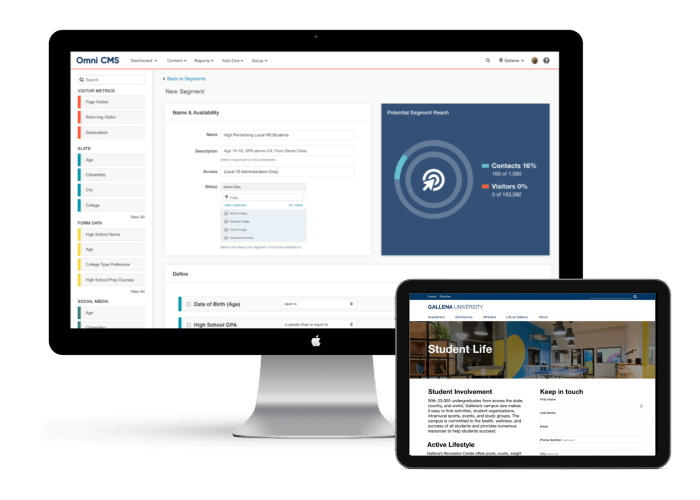
At Ferris State University, digital marketing director Eric Hazen’s three-person team faced a 12,000-page website. With Modern Campus CMS, it introduced content blocks tailored to visitors’ behavior, location and information supplied through forms. An applicant could see an application prompt; someone further along could see an orientation step.

The vendor’s case study reports inquiry-stage clickthrough rising from 2.3% to 66.66%. That measures clicks, rather than enrolled students. Another comparison is less triumphant: out-of-state visit clickthrough was 1.45%, against a previous overall homepage rate of 1.6%. Different audiences complicate the comparison. They also make the point: personalization needs checking, segment by segment.
“Prospects don’t have to search for their next step, it’s presented to them.”Eric Hazen / Ferris State University
The company inside the product names
Modern Campus emerged as a shared brand in March 2021, combining Destiny Solutions and OmniUpdate. One business understood continuing education administration. The other understood college websites. Putting them together expressed a particular view of the market: the institution’s public face and its administrative machinery belong in the same conversation.
Acquisitions widened that conversation. DIGARC brought catalog, curriculum and scheduling tools in June 2021. Presence added campus engagement. Signal Vine and Augusoft followed in January 2022, adding conversational texting and another continuing education business. Familiar product names still reveal the family tree: Acalog became Catalog; Curriculog became Curriculum; Presence became Involve.
This is a portfolio assembled around a sector’s recurring problems. The interesting question is how well the pieces connect in an actual institution. Buying related tools from one company can simplify vendor relationships; it still leaves the institution with decisions about data, permissions and ownership.
Different desks. The same student.
For a web team, CMS offers publishing workflows and personalized content. For a registrar, Catalog organizes published course information while Curriculum manages proposals and approvals. Schedule helps staff coordinate classes; Navigate helps students assemble timetables around their availability. These are different jobs, with different definitions of a successful afternoon.
Involve handles organizations, events and co-curricular participation. Message combines automated texting with staff conversations. Career Pathways puts employment and salary information alongside educational options. Lifelong Learning manages continuing education registration, payments and programs. A working adult buying a short course needs that practical route through enrollment, even when the university’s main systems revolve around semesters and degrees.
The savings were hiding in the accounts
At the University of Minnesota, departments had accumulated separate registration systems. The result, in its published customer account, was redundant administration and inconsistent experiences. Consolidating non-credit activity into Destiny One, now part of Lifelong Learning, brought registrations and financial processes into a common framework.
Two units estimated annual savings of $33,000 and $15,000 respectively, including administration and merchant-account costs. Those are local estimates, not a university-wide return calculation. The operational change is easier to picture: fewer separate payment accounts, centralized reconciliation and less manual financial work. A learner sees a simpler purchase. An accountant gets some time back.
What an institution is actually buying
Modern Campus sells software to institutions, with optional modules and services around implementation, design and ongoing operations. The buying exercise needs a defined scope: which programs, which systems, which staff workflows. A useful budget comparison includes migration, integration and the time employees will spend changing routines, alongside the subscription.
Its distinction is the breadth of higher education work represented in that portfolio. Specialist competitors remain: Hannon Hill’s Cascade CMS, for example, also serves college web teams. Modern Campus can sit beside existing enterprise systems, too. Its partner directory lists Ellucian and describes a Lifelong Learning integration with Anthology Student that keeps Anthology as the system of record.
That places Modern Campus between the public website and the systems people use to run a university. Its expertise is the detail of institutional work: a proposal needs approval before publication; a course purchase needs a financial record; a student reply needs a human response. Those details explain why a general-purpose website tool is only one part of the comparison.
The organization presents a similar emphasis internally. Its stated mission is to unlock the value of lifelong learning for students and institutions. Its careers page advertises flexible work, training and unlimited paid time off. Those are the employer’s commitments on paper; the more revealing promise for customers is sustained help with systems that staff must use every day.
Start with the handoff
The transferable lesson is pleasantly small. Pick a moment when a learner stalls. Identify the next action. Give someone responsibility for the content and the underlying process. Then measure completion by audience. A new interface cannot rescue a course that students do not want, and an automated reminder cannot resolve a question nobody is assigned to answer.
The company’s next chapter extends that logic. Providence Equity Partners’ majority investment was announced in August 2025, alongside Craig Chanoff’s appointment as CEO. In June 2026, Modern Campus and Future Ready Consulting launched Growth Advisory Services to help continuing education leaders evaluate program portfolios and demand. The question now reaches upstream: before making enrollment easier, is the institution offering something people want to enroll in?