In July 2009, Mats Johansson gave up a job he had held since ZetaDisplay began. Leif Liljebrunn became chief executive. Johansson stayed on the board, with a brief to concentrate on long-term growth and expansion beyond Scandinavia. The interesting detail sits three years earlier: Liljebrunn had joined as deputy managing director in 2006 with the intention of eventually becoming CEO. This was a handover with a considerable rehearsal period.
For a founder, the chief executive’s chair can become a rather comfortable piece of furniture. Johansson’s departure from it offers a useful opening into his career. He helped create the business, ran it through its early years and continued working on its development after someone else took charge of daily operations. A change of seat left him with plenty to do.
ZetaDisplay’s business was itself about changing something familiar. A shop sign had traditionally waited for someone to replace it. A connected screen could receive a new message. Behind that modest difference lay software, communications, installation and an argument about whether the whole arrangement could help a retailer sell more. Johansson and his fellow founders made a company out of that argument.
The first set of keys belonged to MultiQ
ZetaDisplay was a second chapter in display technology for Johansson. In 1990, he helped found MultiQ and became its chief executive, serving until 1997. Martin Gullberg, later a fellow ZetaDisplay founder, also helped establish MultiQ and served as its deputy chief executive. Their association therefore predates ZetaDisplay by more than a decade.
That earlier connection gives the later company a different texture from the familiar tale of strangers meeting around an idea. Two of its founders had already worked inside another business together. In 2003, Johansson, Gullberg and Mikael Öberg became the founding trio behind ZetaDisplay, with Johansson taking the CEO role.
His formal education was upper-secondary school. By the time ZetaDisplay arrived, his working education included seven years running MultiQ. It is a concrete sequence: establish a company, operate it, then establish another in a related field. There is no need to dress that sequence in a theory of entrepreneurial genius. The repeated work is interesting enough.
A screen needed a business attached
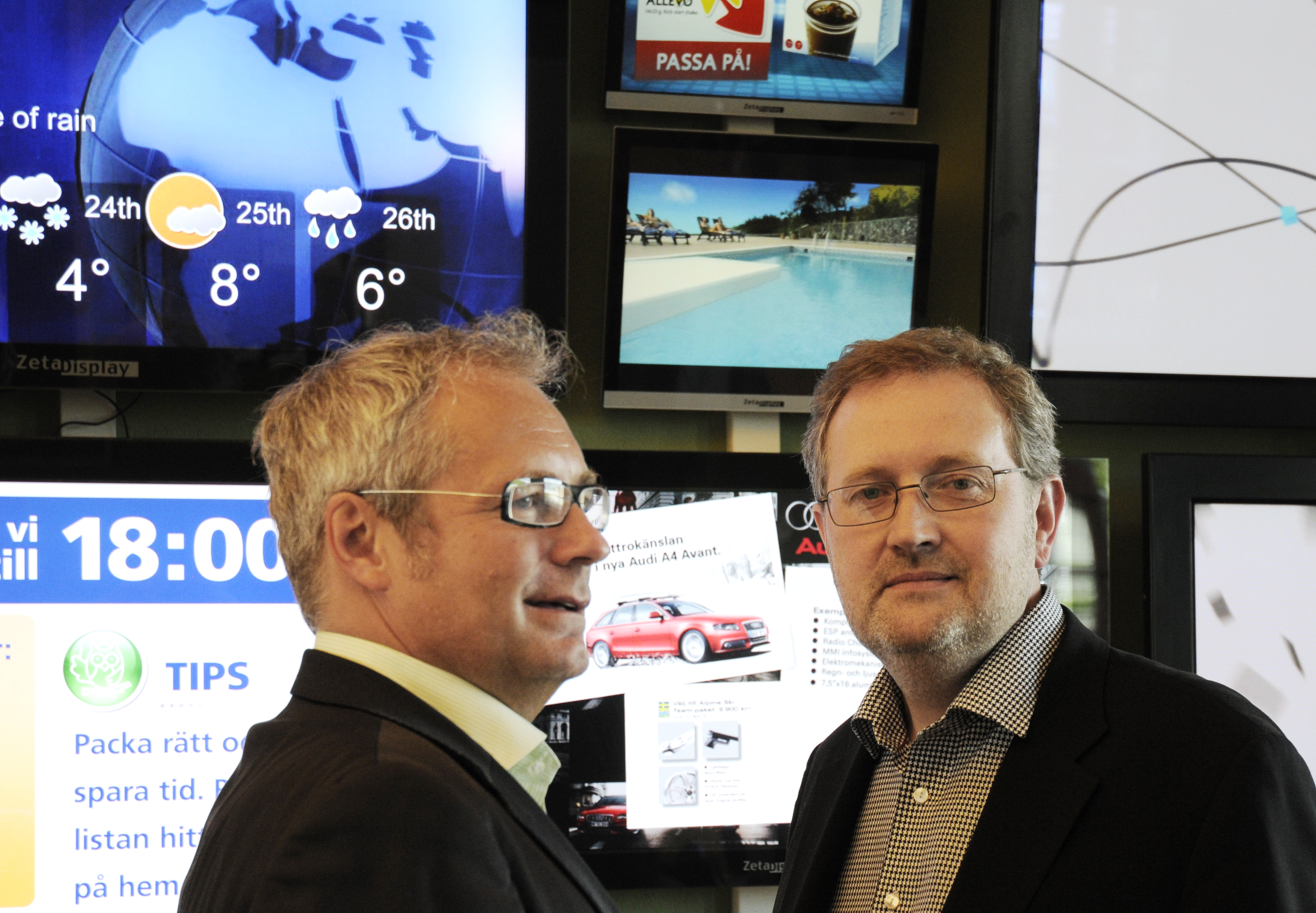
The early ZetaDisplay proposition was quite specific. Its Mobile Active Display System combined display stands, advertising films and offers, wireless communication and software controlling what appeared on each display and when. The package also included project management, installation, service and training. Ongoing agreements could cover the production of fresh films and offers.
That list matters. A screen on its own is equipment. A screen that needs new offers, working connections and somebody to answer when it stops working becomes an ongoing commercial relationship. ZetaDisplay was selling the machinery and the work required to keep the machinery useful. A blank display is an unusually public way for a service business to disappoint its customer.
Johansson also appears alongside Ben Lindgren as an inventor on a published US patent application for a device and method for displaying information. The application describes wirelessly connected display stands and a system capable of sending information across multiple sites. Its priority date was December 2003; the US application was later abandoned. It remains a small, tangible connection between the founder’s name and the mechanics behind the product.
By the 2009 leadership change, ICA had signed a group-wide agreement and begun rolling out ZetaDisplay’s technology across its store formats. Subsidiaries had been established in Denmark, Finland and Norway. Expansion was already practical work, involving customers and operations across borders. Johansson’s new board brief gave that work a place in his own job description.
Three years to prepare a successor
Liljebrunn brought experience from Visma Software, where he had been deputy managing director. His recruitment in 2006 gave ZetaDisplay time before the formal transfer on 1 July 2009. Johansson’s years as founding CEO ended on 30 June. The dates are tidy; the preparation behind them is the more revealing part.
The board was changing too. Anders Moberg, whose previous roles included leading IKEA and Ahold, joined in 2009. For a company serving retail chains, his background was directly relevant to the customers it hoped to reach. The succession and the board appointment belonged to the same stated ambition: extending ZetaDisplay’s international business.
It would be easy to turn the episode into a personality test and declare Johansson unusually detached from titles. The observable decision is more useful. He transferred executive responsibility and remained involved through governance and ownership. Readers can judge the arrangement by what followed, rather than by an imagined conversation in the founder’s head.
Ownership has a longer calendar
ZetaDisplay listed on First North in April 2011. Around the listing, Johansson, Gullberg and Öberg said they intended to remain long-term owners. In 2013 Johansson became chairman. His relationship with the business had moved from running the company to chairing its board, while retaining a financial stake.
In November 2014, he acquired another 200,000 shares. The purchase brought his holding to 2,030,775 shares, equivalent at that time to 16.6 per cent of votes and capital. Those are historical figures, attached to a particular transaction and share count. They show what staying involved meant in money as well as in meetings.
“We believe in the long term future of the company”
Mats Johansson, November 2014
The same announcement gave two measures of the business beneath the ownership: average annual growth of 15 per cent over the five trading years through 2013, and a 50 per cent increase in licensing sales during 2013. The figures describe different periods and different things. Together, they explain why software licensing was becoming a useful part of the company’s story.
In December 2017, ZetaDisplay moved from First North to Nasdaq Stockholm’s main market. That milestone came eight years after Johansson’s CEO handover. The company’s public-market history makes the distinction between a founder’s executive tenure and the life of the enterprise particularly visible.
The company could change hands, too
By March 2021, the board was examining strategic alternatives. Remaining a listed company was one possibility. Acquisition by a new owner, followed by taking the company private, was another. As chairman, Johansson described improved market positioning, a stronger customer offering and growth in software-as-a-service revenue as the setting for the review.
The language had travelled some distance from mobile display stands. ZetaDisplay now described a software and service business working across retail environments, public spaces and workplaces. At the time of the review, it reported around SEK 370 million in revenue, 160 employees and 50,000 installations across 50 markets. Those measures belong to 2021, rather than to Johansson’s six years as CEO.
In June, Hanover’s Alpha Acquisition offered SEK 27 in cash per share. Johansson was among the shareholders who committed to accept. In July, Alpha acquired 2,059,775 shares from him at that price. By September, the buyer controlled approximately 96.05 per cent of the company. Trading ended on 8 October 2021.
The transaction gave the earlier succession a second echo. First, operational responsibility had passed to another executive. Years later, ownership passed to a new controlling investor. For Johansson, the ZetaDisplay chapter included founding, management, chairmanship and a sale. Each required a different relationship with the same business.
From shop floors to floor space
While ZetaDisplay was developing, Johansson had also moved into property. He helped establish KlaraBo with Anders Pettersson and Andreas Morfiadakis. In June 2017, the business raised SEK 65 million, adding investors including Bo Forsén and Lennart Sten. Its proposition was to develop space-efficient rental housing at reasonable rents in growing regions.
There is a pleasingly literal change of scale here. At ZetaDisplay, the commercial question concerned what could happen inside a shop. At KlaraBo, it concerned the building itself. The customers and assets were different, while the task of bringing partners and capital around a repeatable proposition remained recognisable.
Johansson later co-founded Easy Depot with Pettersson, Sten and Sofia Wäborg, who became CEO. The business combined warehouse space with offices for smaller companies. At its launch, Johansson compared the concept with KlaraBo for businesses. The ambition was to give companies room to operate through premises designed around their needs.
Easy Depot’s own chronology records its first completed project in Löddeköpinge in 2023, followed by Rosersberg in 2025 and Helsingborg in early 2026. Johansson remains its co-founder and chairman. His KlaraBo board service ended at the 2025 annual meeting. The distinction matters: a founder’s name can stay attached to a company long after a particular assignment ends.
Patient capital, with a restless adjective
Today, his Abraxas holding company describes its approach as “long-term impatient.” The phrase is brief enough to survive a board presentation. It also accommodates the two speeds visible in Johansson’s career: years of ownership alongside repeated decisions to start, recruit, invest or hand over.
His other roles include chairmanships at SiB Solutions and Volubus. With Jeanette Andersson, he co-owns Nudging Capital, whose stated interest includes technology businesses founded or co-founded by women. These are distinct ventures rather than extensions of ZetaDisplay, but they keep him occupied with the practical questions of ownership and company development.
The most useful image of his career may still be that unhurried 2009 succession. A deputy arrived, learned the business and became chief executive three years later. The founder took another assignment. A company designed to keep changing the messages on its screens had found a way to change the name on the CEO’s door.