Richard Scrushy had already tried the corner office, the concert stage and the television studio when he arrived at the podcast microphone. In July 2025, the former public-company chief introduced Scrushy on Business, a show about building and running companies. His country band had once recorded a song called “Honk if you Love to Honky Tonk.” The new act offered advice on leadership and raising capital. He had changed the material. He still wanted people to listen.
The career behind that microphone is difficult to compress into an introduction. Scrushy co-founded HealthSouth in 1984, helped take it public two years later and became a conspicuous figure in Alabama business. Then came his removal, an accounting scandal, a criminal acquittal, a separate bribery conviction and a civil judgment of nearly $2.9 billion. Each event requires its own sentence. Running them together makes the story tidier and the history wrong.
Now he is offering his experience to entrepreneurs. The invitation carries a question that a conventional executive biography rarely has to ask so directly: how should an audience weigh business knowledge against the record of the person delivering it? Scrushy has continued to make his case, through books, public statements and conversation. A long silence has never been his preferred format.
A taste for the front of the room
He was born in Selma, Alabama, in 1952, and went by his middle name, Marin, when he was young. His early jobs included working at a hamburger-and-milkshake stand and carrying luggage as a hotel bellboy. There were lawns to cut and cars to wash. The childhood portion of his biography has the recognisable texture of a small-town working life: several jobs, little ceremony, money earned a task at a time.
He left high school at seventeen, married young and worked manual jobs while supporting a family. He later returned to education and attended the University of Alabama at Birmingham. His route into executive work passed through Lifemark, a Houston-based corporation, where he rose into management. He had acquired experience before he acquired the founder’s title, a useful detail in a life later crowded with titles.
Music was there early, too. He played guitar and piano and performed in a teenage garage band. The interest would survive his ascent into business. Some executives buy a good stereo when money arrives. Scrushy recruited musicians. His later performances suggest that the desire to lead a room could find more than one outlet, though a guitar solo and a quarterly presentation impose rather different demands on their audience.
The company and the country band
In 1984, Scrushy, Aaron Beam and other associates established HealthSouth in Birmingham. Scrushy became its chief executive; Beam was its first chief financial officer. The company went public in 1986. Over the following years, expansion brought the business into the Fortune 500 and made its founder wealthy and widely recognised. The climb was real, even though the financial record later required a painful reconstruction.
The founding partnership is important because Beam would eventually become one of the people publicly describing how the company had gone wrong. The two men shared a corporate beginning and developed sharply different accounts of what followed. Their history complicates the familiar portrait of a solitary founder. A company is built through relationships, and those relationships can later become testimony.
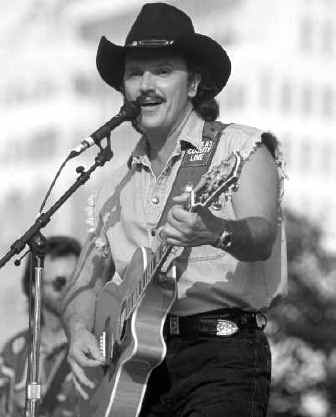
Meanwhile, the music became considerably more organised than a garage hobby. Scrushy fronted Dallas County Line, a country band whose professional players included musicians with connections to Sawyer Brown and the Oak Ridge Boys. A February 1995 trade report described a planned signing with Curb Records. He also performed with a rock group called Proxy. The corporate chief had given himself a second reason to rehearse.
Dallas County Line’s video included appearances by Chet Atkins and Bo Jackson. Those names catch the peculiar mixture around Scrushy: entertainment, sport, business and personal ambition sharing the same frame. His performance interests were public and sustained. The archival photograph of him in a cowboy hat, singing and playing guitar, belongs in his story as naturally as a photograph taken outside a courthouse.
By 2003, however, the attention around his company had become an investigation. Its directors removed him as chairman and chief executive, effective March 19. His leadership had lasted nearly nineteen years, with a brief interval when he held the chairmanship without the CEO job. The departure severed his authority over the corporation. It did little to reduce his determination to speak about what had happened.
Three outcomes, three different questions
The accounting prosecution reached its verdict on June 28, 2005. A Birmingham jury acquitted Scrushy on all thirty-six counts submitted to it. The case had tested the government’s effort to hold a chief executive criminally responsible for false corporate reporting. Five former chief financial officers had testified against him. His defence argued that subordinates had committed the fraud without his knowledge.
The verdict was an acquittal, with all the significance that word carries. It did not conclude every proceeding in his life. A separate prosecution concerned payments connected to Alabama governor Don Siegelman’s campaign for an education lottery and Scrushy’s appointment to a state regulatory board. On June 29, 2006, a Montgomery jury convicted Scrushy of bribery, conspiracy and honest-services mail fraud.
All 36 counts submitted in the accounting-fraud trial.
A separate bribery case involving Don Siegelman.
$2.876 billion judgment; affirmed in 2011.
The bribery case centred on $500,000. Scrushy has continued to dispute the prosecution and maintain that he was wrongfully convicted. Appeals changed part of the case: two mail-fraud counts were reversed in 2011, while other convictions remained. He spent about five years in federal custody and was released in 2012. His imprisonment followed the bribery proceedings, a distinction easily lost in casual retellings of the accounting scandal.
Civil proceedings followed a further path. In April 2007, a settlement with the Securities and Exchange Commission required $81 million in disgorgement and civil penalties and imposed a public-company officer and director bar. Scrushy consented without admitting or denying the allegations. Two years later, an Alabama court entered a $2,876,103,000 judgment against him in shareholder-derivative litigation. The state supreme court affirmed that judgment in January 2011.
These results answer different legal questions under different procedures and standards. The acquittal cannot be silently replaced by the civil judgment; the civil judgment cannot be silently discarded because of the acquittal. His biography contains both. They make it possible to be precise about a person whose public identity has often been compressed into a headline.
A book with an argument in its title
Scrushy had addressed the public directly before his imprisonment. He and his wife, Leslie, hosted Viewpoint, a television programme that included religious discussion. After his release, consulting and writing gave him other ways to speak. In June 2021, NewSouth Books published his memoir, It Should Not Happen in America, tracing his journey from Selma to Wall Street and presenting his account of his legal troubles.
The title makes its position plain before the reader opens the book. Faith and family are central to the way he describes his experience. His version is a participant’s argument, and it belongs beside the court record as his version. Publishing gave him space to develop that argument beyond a courthouse statement or a short interview.
His company, meanwhile, had acquired a new name. HealthSouth became Encompass Health in 2018, long after his departure. That chronology explains why his name appears in its corporate ancestry. It also marks a boundary: the former founder’s subsequent public activities and the corporation’s later leadership are separate stories. An institutional biography does not end when a founder loses his position.
In March 2025, he issued another public appeal for an investigation into his prosecution. In November, reporting described his lawsuit against Bradley Arant Boult Cummings over alleged conflicting representation. Those accusations are his claims. They show how actively he continues to contest his past, rather than establishing the misconduct he alleges. For Scrushy, the argument remains a present-tense activity.
Back at the microphone
The podcast launched in July 2025 with Dave Greene, whose work includes Podcast Heat. Its stated subjects are practical business problems: financing a start-up, assembling managers, selling, expanding and avoiding mistakes. Scrushy described his interest as “what actually works in the real world.” The programme puts him in a familiar position, talking to people who want to build something and presenting his experience as useful instruction.
“what actually works in the real world”
Richard Scrushy / July 2025 podcast launch
By early 2026, listed episodes covered annual planning and venture-capital fundraising, including traction, runway and capital efficiency. The subjects are ordinary concerns for founders. What makes this show unusual is the biography on the other side of the microphone. Advice about managing a company arrives alongside a history of disputed responsibility, a criminal conviction and civil liability.
That history gives listeners plenty to consider without requiring them to treat every sentence as either wisdom or evasion. They can evaluate a business claim, examine an example and keep the speaker’s record in view. His experience includes building an organisation and confronting the consequences of its collapse in trust. Any useful reading of his career has to make room for the people affected as well as the executive describing it.
The photograph from 1995 now has an unexpected companion in his later studio image: another microphone, another audience, another attempt to hold attention. Thirty years separate the country-band performance and the podcast launch. The instruments have changed, and so have the stakes. Richard Scrushy is still prepared to take the floor. His listeners inherit the work of deciding what the performance is worth.