The retailer had a number: eight. What it needed was an explanation. In a case study published by ISS-Corporate, an unnamed American retail company wanted to understand its governance risk score and what might improve it. Knowing the score was easy. Deciding what the board should do next was the harder problem.
- Compass combines corporate data, modeling tools and specialist advice.
- Customers use it to prepare pay plans, governance changes and disclosures.
- A subscription buys analysis. Favorable ISS recommendations are never guaranteed.
ISS-Corporate compared the retailer with peers, identified weaknesses and modeled proposed changes. The company built a roadmap. Over 24 months, its ISS Governance QualityScore improved from eight to two, according to the published account. That is a reported client outcome, rather than a promise. Its attraction is the sequence: a vague concern became a set of decisions someone could actually make.
Governance risk score · 24 months
Lower indicates lower risk. One client case, not a forecast.
The business on the other side of the table
ISS-Corporate occupies an interesting corner of financial services. Its customer is often a company preparing to be examined by someone else: a shareholder considering executive pay, a lender assessing a sustainability claim, or a board questioning cyber exposure. The product is a better-informed rehearsal for that examination.
Compass is the central platform. Software supplies benchmarks and models; specialists help interpret them. Governance and compensation customers get access to dedicated advisors with the platform. Professional advisory firms can also subscribe to research, voting analytics and compensation resources, with shared-access programs supporting collaboration with their corporate clients.
The distinction matters. A database can reveal that a company differs from its peers. It takes judgment to decide whether the difference represents a problem, a sensible exception or a disclosure that needs explaining. ISS-Corporate sells both the comparison and help thinking through its consequences.
That combination helps explain its reach into large-company workflows. Deutsche Börse’s 2025 annual report says 71 percent of S&P 500 companies paid to use Compass, compared with 79 percent in 2024. The measure counts paying companies, rather than every employee using the software. It establishes a substantial presence while also showing that adoption can move in either direction.
A database can reveal a difference. A board still has to decide what that difference means.The decision behind the dashboard
A pay plan is also a message
The corporate business began in 1997. Compass arrived in January 1998 as an online tool for designing and benchmarking equity incentive plans. That origin is revealing. A compensation plan has two audiences: the executive receiving it and the investors being asked to accept it. The numbers must make sense to both.
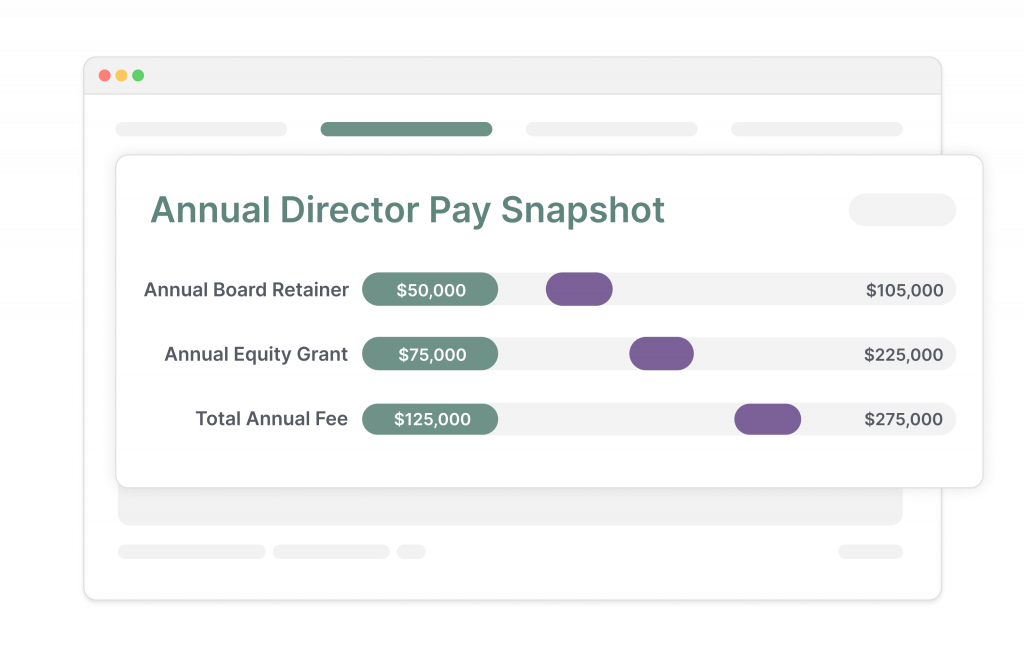
Today, customers can compare executive and director pay, test custom peer groups, model equity plans and examine pay against performance. They can track total shareholder return and anticipate questions about say-on-pay. The useful question becomes specific: if we change this assumption, how does the proposal look?
The market keeps moving. In October 2026, ISS-Corporate reported that 49 FTSE 100 companies proposed new remuneration policies during its 2026 proxy year; 15 acted before their existing frameworks expired. A benchmark is therefore a moving reference point. Last year’s defensible explanation may need fresh work.
For a buyer, the first demonstration should follow a real decision: a proposed award, a disputed peer group or an investor’s question. Comparing several plausible scenarios can expose which assumptions drive the answer. The exercise is useful only if the team can explain those assumptions and has authority to act on what it learns.
When customers asked for the paperwork
The expansion into sustainability has a practical origin. In an April 2024 executive interview, Head of ISS-Corporate Marija Kramer said two client surveys had put sustainability reporting at the top of companies’ priorities. Clients wanted help with the machinery behind the disclosures.
That month, ISS-Corporate acquired Oslo-based Celsia, whose software organized sustainability reporting workflows and supporting documentation. In October it acquired Florida-based SustainaBase, adding carbon accounting and emissions-data management. Read together, the deals connect two jobs that are easily separated on an organization chart: assembling credible measurements and turning them into usable reports.

The broader sustainability offering covers materiality assessments, peer comparisons, climate work, emissions accounting and reporting. Another service examines sustainable bond and loan frameworks through second party opinions. For a treasury team, that means getting an external assessment of its claims before asking the market to finance them.
There is a useful lesson here for anyone buying reporting software: start with the evidence that must survive scrutiny. A polished document depends on traceable inputs, defined responsibilities and a process for keeping information current. The workflow deserves as much attention as the final page.
The boundary customers need to understand
ISS Corporate Solutions, Inc. is a wholly owned subsidiary of Institutional Shareholder Services and part of ISS STOXX. That relationship makes the separation of activities consequential. The group’s governance and sustainability research teams operate separately from ISS-Corporate. Buying its services does not secure a favorable voting recommendation, rating or assessment.
The same restraint belongs in reading the products. Cyber Risk Score uses externally observable signals and a model trained on breach events to assess future incident risk. It can inform board discussions, peer comparisons and vendor monitoring. A probability estimate still requires people to investigate exposure and carry out security improvements.
There is also a useful distinction between paid advice and checking facts. Eligible issuers can verify covered data through Compass without becoming paying clients. That service has timing restrictions, including the interval between proxy filing and publication of ISS’s proxy analysis. Checking the inputs is a sensible first move.
Better questions before the meeting
Competition depends on the task. Glass Lewis offers compensation benchmarking and modeling. Workiva supports sustainability data collection and reporting. ISS-Corporate’s proposition combines those kinds of corporate decisions with governance intelligence, cyber analysis and specialist advice.
Its own October 2026 review of ten large European companies’ climate transition disclosures offers a telling example of that advice: financial planning was a persistent weakness. Targets were easier to find than clear spending and funding pathways. The sample was explicitly nonrepresentative, but the question travels well: who will pay for the plan, and when?
That is the habit a reader can copy. Compare the proposal, test the assumptions and connect the promise to an action. The retailer’s eight became useful when it prompted a roadmap. A dashboard earns its place when the next meeting contains a better decision.