Mark Tarr’s first chief executive job came with an admission that tends to disappear from executive biographies: he had plenty to learn. In 1993, he joined the company now called Encompass Health to run its Vero Beach, Florida, location. Looking back, he credited the resources and support that helped him get started. The title arrived before the experience. The experience would take considerably longer.
Twenty-three years later, Tarr became chief executive of the whole company. Between those appointments came Nashville, a regional portfolio, a division presidency and responsibility for operations across the enterprise. It is a career with an unusual narrative advantage: each larger job contains a smaller job he has already done. The organization chart doubles as a record of places he has worked.
There is an appealing lack of theatre in that progression. Business profiles often open with a founding revelation or a dramatic departure. Tarr’s story asks a different question: how much can a person change his working life while remaining inside the same organization? In his case, the answer stretches from a single location to the leadership of a publicly traded company based in Birmingham, Alabama.
A bigger job, one step at a time
Tarr earned his undergraduate degree at Ball State University and an MBA at Emory University’s Goizueta Business School. His subsequent working education had a distinctly geographical syllabus. After Vero Beach came Vanderbilt Stallworth in Nashville, which he described as the company’s first joint venture. His responsibilities expanded to additional locations in the Nashville market, then to operations across the Southwest.
That sequence matters because running one location and overseeing a region are different exercises. At one site, a leader can know a problem at close range. Across several, the work increasingly involves choosing managers, allocating attention and deciding which practices deserve to travel. Read as a management apprenticeship, Tarr’s résumé shows a widening radius of responsibility rather than a series of fresh starts.
By September 2004, he was president of the company’s inpatient division. He became executive vice president of operations in 2007, then chief operating officer in 2011. When the board selected him to succeed Jay Grinney in 2016, it was promoting someone whose operational history was already familiar. The company dates his service as president and CEO to December 29, 2016.
- 1993Joins the company
Vero Beach, Florida - 2004Division president
Inpatient division - 2011Chief operating officer
Enterprise operations - 2016President & CEO
December 29
A long tenure can be an inert fact, useful mainly at anniversary dinners. Here, the sequence gives it substance. Tarr’s route to the top ran through the machinery he would eventually oversee. The interesting question becomes what he does with that familiarity, particularly when the next person is ready for a larger assignment.
The promotion has to travel
In April 2025, Encompass Health promoted Patrick Tuer from group president to a newly established chief operating officer position. Tuer had joined the company in 2018. Explaining the appointment, Tarr pointed to internal management talent and linked the larger role to the company’s growth. More locations meant a larger operating task; the leadership structure needed to catch up.
The parallel with Tarr’s own career is useful, although the timelines differ. An operator accumulates responsibility, then moves into a job designed to coordinate more of the enterprise. For employees considering their future, a named promotion says something that a recruiting slogan cannot. Someone has actually moved. The job has actually changed. The promise has acquired a person and a date.
Tarr has also discussed the slower work that makes such appointments possible. In a 2020 interview, he described leadership development and succession planning as ways to broaden representation in management. He treated the objective as both immediate and long term, acknowledging that developing people internally takes time. That is a less convenient answer than announcing a target and declaring the matter settled.
“It was my first time in a CEO role, and I had a lot to learn.”
Mark Tarr, recalling Vero Beach
His own recollection gives that position a personal foundation. He describes receiving help early in his career and wants advancement to be accessible to others. It would be easy to turn this into a lesson about merit alone. His account includes something more practical: people need tools, resources and support before a promotion can become a success.
Eight openings, years of preparation
When Tarr discussed the eight locations Encompass Health opened in 2023, he emphasized the preparation behind them. Each opening required years of coordination. The company had standardized the process and continued refining it. To an outsider, an opening is a ribbon and a photograph. To the operator, it is the visible end of a long schedule.
That distinction helps explain the appeal of his career to anyone who has had to make an ambitious plan work on a Tuesday. Growth has a public vocabulary of milestones. It also has a private vocabulary of dependencies: recruitment, construction, training, budgets and deadlines. Standardizing an opening is a way of carrying experience from one project into the next without relying on everyone to remember everything.
At the company’s 2023 investor day, Tarr moderated an operations panel that included regional leaders and a financial operations executive. The presentation listed participants’ company tenures alongside their names. Several had spent more than two decades there. It is a revealing presentation choice: institutional experience was being offered as part of the explanation for how the business worked.
1993 to 2016. Plenty of room for the job to change before the employer did.
By August 2026, the next set of milestones was already on the table. Encompass Health reported three new openings in the first half of the year and expected five more before year end. Second-quarter net operating revenue reached $1.5974 billion, up 9.6% from the comparable period. Those are company results, earned across an organization; they also describe the scale of the assignment Tarr now holds.
Net operating revenue
Staying through a change of name
Remaining with one employer does not mean working for an unchanged business. Tarr joined HealthSouth. During his CEO tenure, the company became Encompass Health, adopting the new corporate name in January 2018. The transition of locations to the new brand continued through the following year. A stable employment history can contain a substantial amount of organizational change.
Then came a change in the company’s boundaries. On July 1, 2022, Encompass Health completed the separation of Enhabit into an independent public company. Shareholders received shares in the new entity. For Tarr, the career continuity sat alongside a consequential restructuring: the business under his leadership had a different perimeter after the transaction.
These episodes complicate the easy image of the executive who simply stays put. Tarr’s employer has changed its name, its structure and the reach of its operations while he has moved through its ranks. Staying gave him continuity of experience. It did not relieve him of the task of learning what the next version of the company required.
Birmingham is more than an address
Tarr’s national responsibilities coexist with a visible local role. In December 2022, he spoke about the company’s roots in Birmingham and its intention to remain headquartered there. The remark put a place inside a growth story usually told through a map of other places. Expansion elsewhere could proceed alongside a continuing commitment to the home city.
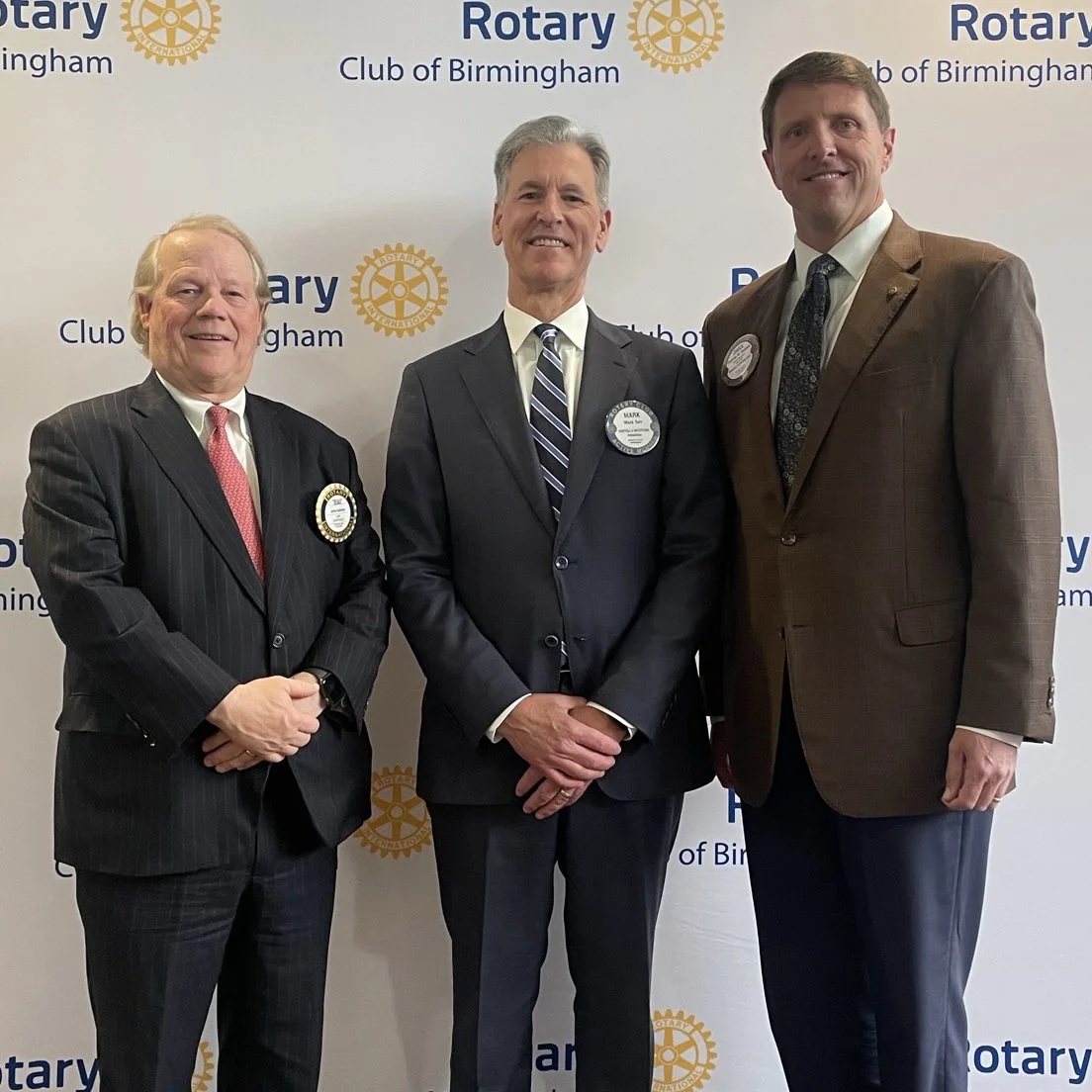
That October, the Rotary Club of Birmingham had welcomed him as a featured speaker and fellow Rotarian. The accompanying photograph places him between Beau Grenier and club president Chuck Redden, all three wearing their badges. There is something useful about seeing an executive identified by a small round badge. Even a chief executive occasionally benefits from a label.
His local involvement extends beyond speaking engagements. The Birmingham Business Alliance lists him on its 2026 executive committee. In March 2026, he was named to the Birmingham Business Journal’s Power 60 for a fifth consecutive year. Those connections place his corporate role within the city’s wider business life, where employers, investment and civic organizations share a great deal of common ground.
In a 2018 guest column, Tarr chose to describe the company through individual employees and their contributions. The corporate name had just changed, but his account put people at the center of its identity. That choice fits the broader pattern in his public communication: growth is discussed alongside the staff who must carry it out. A business can redraw its map and replace its signs quite quickly. The experience held by its employees takes longer to assemble, which makes keeping and developing them part of the operating challenge.
Two setters, no quarterly agenda
There is another, smaller circle around the executive career. Tarr enjoys time outdoors with his wife, fishing, bird hunting and walking their two English setters. These are concrete pleasures, refreshingly free of corporate terminology. A dog walk is allowed to remain a dog walk. It need not become a metaphor for a leadership competency.
The contrast is pleasing all the same. His working life involves making a large organization more repeatable: developing managers, refining processes, preparing the next opening. His leisure includes animals described as high energy. Anyone hoping to impose a tidy agenda on two English setters may discover that the agenda has limited support among the participants.
Tarr’s career leaves its clearest impression in the distance between his first assignment and his present one. He remembers needing help. He has since spent decades taking on larger responsibilities and discussing how others might advance. The arithmetic is straightforward: one employer, many jobs, a long accumulation of experience. What gives the story its human interest is that the learning began after he first received the title.
Follow the thread
Continue with Tarr’s public updates, company milestones and Birmingham connections.
- Official biography at Encompass Health
- Mark Tarr on LinkedIn
- Watch: Quarterly Connection on opening new locations YouTube
- Tarr’s account of his career progression PDF
- The 2020 interview on developing leaders
- His October 2022 Birmingham Rotary appearance
- Birmingham Business Alliance leadership
- Encompass Health’s second-quarter 2026 results
- Encompass Health website · Company YouTube channel